India Is Your Most Valuable Hiring Market, and Your Most Underestimated Compliance Risk
India has become the default answer for enterprises looking to scale talent fast. The numbers make the case easily: over 1,800…
For years, enterprise identity systems were built on a quiet, unquestioned belief: every identity belonged to a human being.
Your IAM framework knew the rhythm. Employees logged in during office hours. They were onboarded when hired and deactivated when they left. MFA verified them. Quarterly access reviews cleaned up the loose ends. Predictable patterns. Predictable behavior. Predictable risk.
Then 2026 arrived, and the entire model started cracking under pressure.
Not because IAM platforms suddenly failed. Not because security teams stopped paying attention. But because enterprise environments are no longer populated by humans alone. AI agents, autonomous systems, machine identities, third-party automations, and non-human actors are now requesting access, making decisions, triggering workflows, and operating at a scale traditional identity governance was never designed to handle.
The old rule was simple: one identity, one person.
That rule no longer exists.
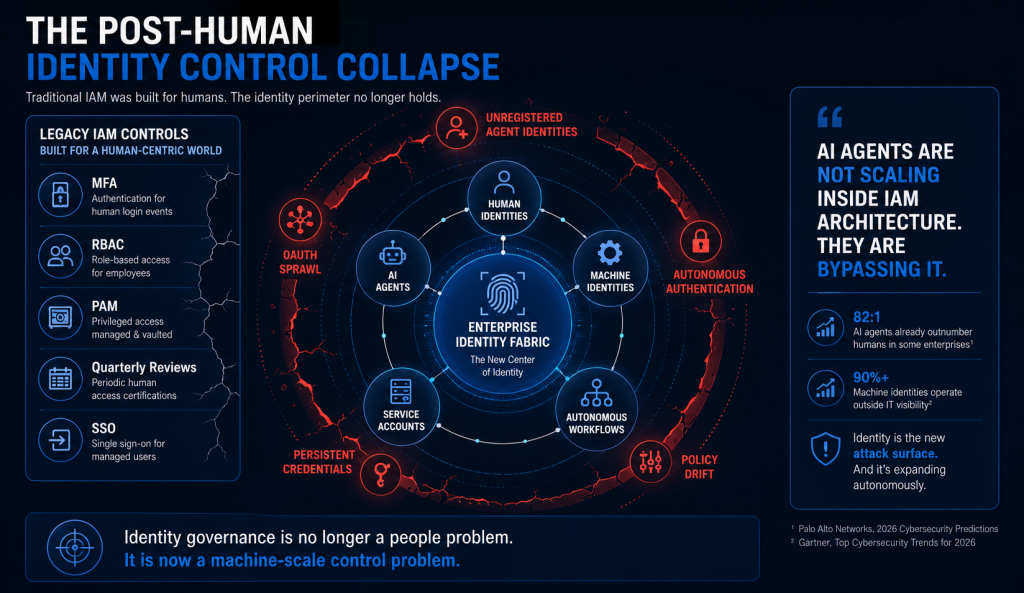
AI agents do not log in. They do not follow work hours. They do not have lifecycle events tied to employment. And according to Palo Alto Networks’ 2026 cybersecurity predictions, autonomous agents already outnumber humans by 82:1 in some enterprise environments. Most of those agent identities exist completely outside your governance model.
The 5 IAM Assumptions AI Agents Break
When security teams built their identity programs, they made five foundational assumptions. Each one is now a gap.
Why PAM and IGA Cannot Fill the Gap
Security leaders often assume PAM and IGA solutions already cover this problem. In reality, they do not, at least not without major redesigns.
PAM was built to secure known privileged accounts. But most non-human identities are created outside traditional IT workflows. A developer spins up an integration during a product launch. A SaaS platform auto-generates API credentials. A marketing employee connects a third-party AI tool using OAuth access from a personal account. None of these identities ever make it into the vault.
IGA faces a different challenge. It was designed for human access governance, not for thousands of machine identities appearing and changing in real time. AI agents do not follow employee lifecycles, fixed roles, or predictable usage patterns.
For example, an AI-powered customer support bot may access CRM data, trigger workflows, connect with payment systems, and interact with multiple SaaS applications simultaneously. Traditional IGA tools struggle to track whether those permissions are still necessary, who approved them, or when they should expire.
According to Gartner, AI agents are forcing organizations to rethink IAM strategies entirely, especially around identity registration, credential automation, governance, and policy-based authorization for machine actors.
What Post-Human IAM Architecture Looks Like
Fixing this requires more than adding a tool. It requires rethinking the governance model.
The Governance Shift That Has to Happen First
The technology is only part of the answer. Before your platform can govern AI agent identities, your organization needs to decide who owns them.
Most enterprises do not have a role defined for machine identity ownership. Developers create agents. IT does not know they exist. Security cannot audit what it was never told about. Building a post-human IAM program starts with an organizational design question: who is the AI identity owner, and what are they accountable for?
You can explore how Compunnel approaches this through our Identity and Access Management Services and our broader Cybersecurity Services framework.
For a deeper look at the identity sprawl problem, IBM’s 2026 Cybersecurity Predictions offer a strong grounding in where enterprise risk is heading.
Ready to assess your AI agent identity exposure? Talk to our identity security team today.


India has become the default answer for enterprises looking to scale talent fast. The numbers make the case easily: over 1,800…

Global hiring is one of the best growth moves a company can make. It opens talent markets, cuts time-to-hire, and builds the…