Shadow Data Is the Compliance Time Bomb No One Is Defusing
Can you prove, right now, that every copy of your customer data is classified, protected, and deletable on request? For most enterprises…
India has become the default answer for enterprises looking to scale talent fast. The numbers make the case easily: over 1,800 active Global Capability Centers already operate in the country, employing roughly 2.4 million professionals across technology, finance, analytics, and AI. According to NASSCOM, the GCC sector is projected to reach $100 billion in annual revenue by 2030. US-headquartered firms drive 70 percent of that demand. There are strong, practical reasons India keeps winning.
What does not make the pitch decks or the site-selection reports is the compliance complexity waiting on the other side of the hire. India is not a difficult market because of talent scarcity or infrastructure gaps. It is difficult because its employment law is genuinely fragmented, state-dependent, and regularly updated in ways that catch even experienced global HR teams off guard.
India operates a dual labor law system. Some legislation, like the Employees’ Provident Funds Act and the Employees’ State Insurance Act, is centrally administered. But much of what governs day-to-day employment, including working hours, leave entitlements, termination procedures, and establishment registration, falls under state-specific Shops and Establishments Acts. There are 28 states and 8 union territories, each with its own version.
A 50-person team spread across Bengaluru, Hyderabad, and Pune is not operating under one employment system. It is navigating three different legal realities at the same time. Notice period requirements shift from state to state. Leave accrual rules follow different formulas. Professional tax registrations depend on varying thresholds tied to geography and salary bands.
Most India market-entry playbooks barely scratch the surface of these operational nuances. But when these differences are overlooked or handled casually, they do not remain administrative for long. They turn into compliance risks, financial liabilities, and legal exposure waiting to surface.
As noted in the eSparkBiz GCC Compliance Guide 2026, setting up or scaling a GCC in India offers access to world-class talent, but legal compliance is where many GCC strategies quietly fail. This maturity gap is a top priority for global leaders entering the market in 2026.
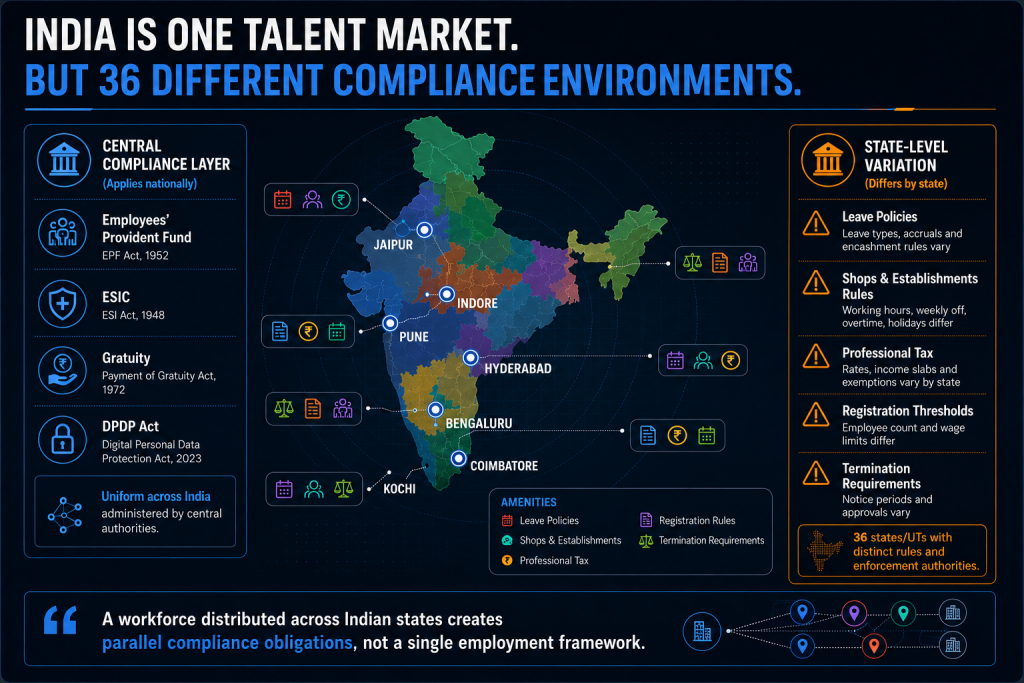
Every employer in India with more than a certain headcount threshold is required to contribute to the Employees’ Provident Fund at 12 percent of basic salary from both the employer and employee sides. ESIC, the state insurance scheme, runs at 3.25 percent employer contribution and 0.75 percent employee contribution for workers below a salary ceiling. Both are monthly statutory obligations with precise calculation rules that vary based on salary structure, allowances, and the specific components of each employee’s compensation package.
Getting this wrong is not a theoretical risk. Under-contribution, late contribution, or incorrect salary-band classification triggers back payment obligations, interest charges, and potential penalties from both the EPFO and ESIC authorities. Many multinational teams entering India replicate their home-country payroll logic and discover months later that Indian statutory payroll does not work the same way.
Gratuity adds another layer. Employees who complete five or more years of continuous service are entitled to a statutory gratuity payment calculated at fifteen days of salary per year of service. This liability accrues from the first day of employment but is not always provisioned correctly by companies that assume it only becomes relevant at exit. For a team that scales quickly, this represents a growing balance sheet obligation that needs to be tracked from the start.
India’s Digital Personal Data Protection Act became law in 2023 and is moving toward full enforcement by May 2027. Its implications for GCC operations go beyond IT security. The Act creates data localization and consent requirements for employee personal data, which includes payroll records. For multinational companies running global payroll on centralized platforms, the question of where Indian employee data is processed and stored is now a legal compliance question, not just a technical one.
The DPDP Act enforcement timeline requires 72-hour breach reporting and mandatory consent management. Companies running payroll data for Indian employees through systems hosted exclusively outside India need to assess their compliance posture now, before the enforcement ramp-up makes reactive remediation the only option.
The most common mistake global companies make when entering India is treating entity setup and hiring as parallel tracks. Setting up a wholly owned subsidiary in India can take anywhere from 12 to 24 weeks. The process includes company registration, tax IDs, PAN and TAN approvals, bank account setup, labor registrations, and ESIC enrollment. But while the paperwork moves slowly, your talent pipeline does not wait.
Accessing the best employer of record services allows you to hire in India in two to three business days. The EOR becomes the legal employer on record, managing PF, ESIC, professional tax, gratuity provisioning, and state-specific compliance from day one. You get operational presence without the entity overhead, and your team can start building immediately while the entity process runs in the background.
The EOR-to-entity transition is itself a structured process that quality EOR service providers manage. When your India team reaches the scale where a wholly owned subsidiary makes financial sense, typically somewhere between 50 and 100 employees, depending on the functions involved, a well-structured EOR transition plan moves workers to the new entity without compliance gaps or workforce disruption. Companies that skip EOR and go straight to an entity often spend their first 6 months of Indian operations firefighting payroll issues rather than building their team.
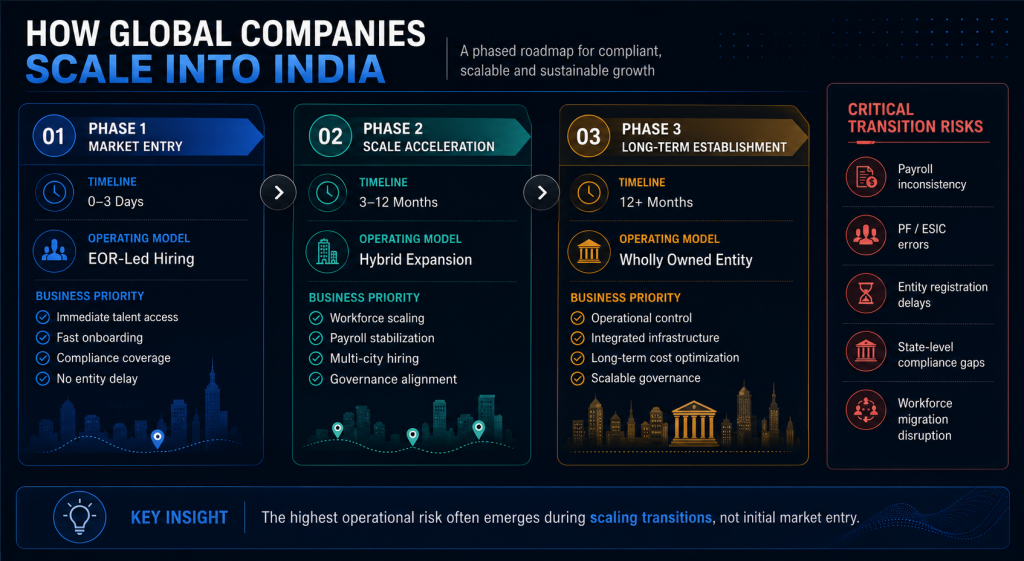
India’s GCC footprint is expanding beyond Bengaluru, Hyderabad, and Pune into cities like Coimbatore, Jaipur, Indore, and Kochi. This geographic diversification makes sense from a talent and cost standpoint. Bengaluru tech salaries have risen sharply, and competition for senior AI and engineering talent in major hubs is intense. Tier 2 cities offer better retention rates and lower compensation benchmarks for many roles.
What changes in Tier 2 is the compliance environment. Professional tax slabs, local establishment registration requirements, and available legal infrastructure differ from those in major metro centers. Companies expanding to multiple Indian cities need a compliance model that handles this geographic variation systematically, not city by city as issues arise. This is another area where global employer of record solutions provide real operational value, because in-country legal expertise covering multiple states is built into the service, not billed separately as a consulting engagement.

List of Content

Can you prove, right now, that every copy of your customer data is classified, protected, and deletable on request? For most enterprises…

For years, enterprise identity systems were built on a quiet, unquestioned belief: every identity belonged to a human being. Your…