Shadow Data Is the Compliance Time Bomb No One Is Defusing
Can you prove, right now, that every copy of your customer data is classified, protected, and deletable on request? For most enterprises…
Global hiring is one of the best growth moves a company can make. It opens talent markets, cuts time-to-hire, and builds the international presence your business needs to compete. But there is a cost most finance teams never put on the balance sheet. Every cross-border hire made without the right classification, employment structure, or statutory benefit framework quietly adds to a compliance debt that grows in the background, compounding exactly like financial debt, and it almost always surfaces at the worst possible moment.
Compliance debt is not a single fine or a missed filing. It is the accumulated gap between how your workforce has been structured and how it should have been structured under local employment law. By the time it becomes visible, through an audit, a regulatory inquiry, or an M&A due diligence review, the cost to remediate is typically three to five times what it would have cost to get it right at the point of hire.
Where the debt starts accumulating
Worker classification is the most important decision you make at the point of hire, and it is also the one most companies get wrong when scaling internationally. Global contractor hiring has grown significantly over the past two years as companies look for flexibility and speed. The problem is that many of those contractor relationships do not meet the legal tests for independent status in the jurisdictions where the work is performed. The U.S. Department of Labor applies the economic reality test to determine whether a worker is genuinely independent or effectively an employee. A contractor who works exclusively for your company, follows your schedule, and uses your tools almost always fails that test.
The financial exposure is not theoretical. According to recent enforcement data, misclassifying a single worker can generate $15,000 to $100,000 or more in combined IRS back taxes, Department of Labor penalties, state fines, and legal fees. In states like California and Massachusetts, civil penalties alone can run from $5,000 to $25,000 per misclassified worker. Multiply that across ten or twenty contractors in multiple countries, and you can see how quickly the exposure grows before a single audit letter arrives.
In fiscal year 2025, the DOL’s Wage and Hour Division recovered more than $259 million in back wages for nearly 177,000 workers across the United States. Audits are triggered by employee complaints, and one complaint typically surfaces an entire engagement model.
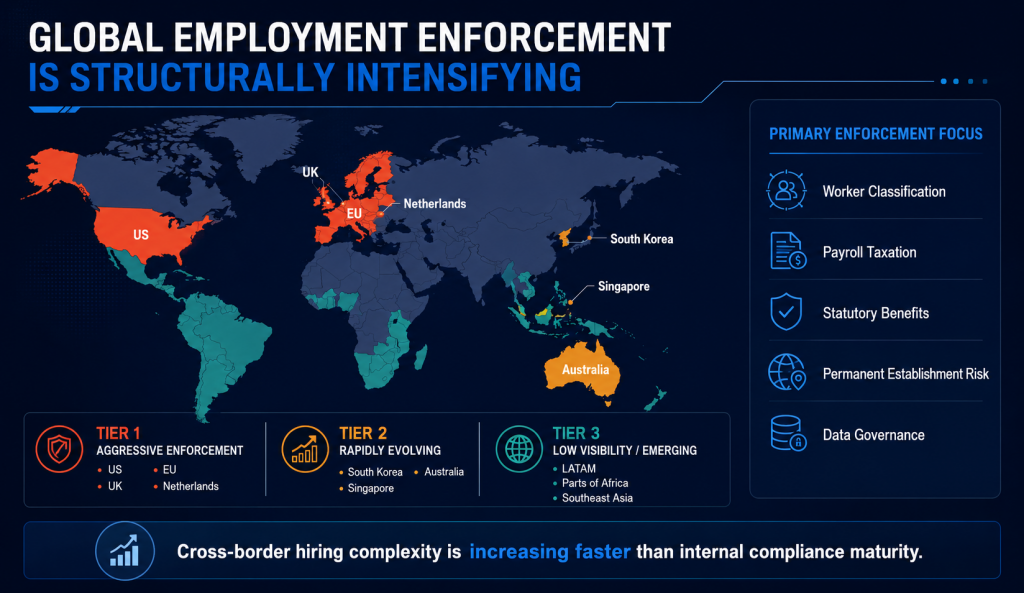
Domestic misclassification is manageable. International misclassification is a different problem entirely. Employment law varies by jurisdiction in ways that catch even experienced HR teams off guard. What is legally acceptable in one country can constitute employment in another. The Netherlands and South Korea, for example, have been actively expanding the definition of employer based on how work is directed, not just on what a contract says.
Here is what makes 2026 a turning point for the European workforce strategy. The EU Platform Work Directive, rolling out across member states throughout this year, now places the burden of proof on companies rather than workers. Unless an employer can demonstrate that a contractor relationship meets specific independence criteria, worker-employee status is presumed by default. For companies that have already built European contractor teams under the old framework, this is not a future concern. It is an active compliance position that needs to be reviewed and resolved now, before regulators do it for you.
The compounding effect comes from the lookback window. The UK’s HMRC, for instance, can assess unpaid IR35 taxes going back six years in standard cases and twenty years where behavior is considered deliberate. A contractor relationship that started in 2019 is potentially still in scope today. This is what makes compliance debt so dangerous: it does not expire cleanly, it accumulates interest, and it almost always grows faster than the underlying business value it was funding.
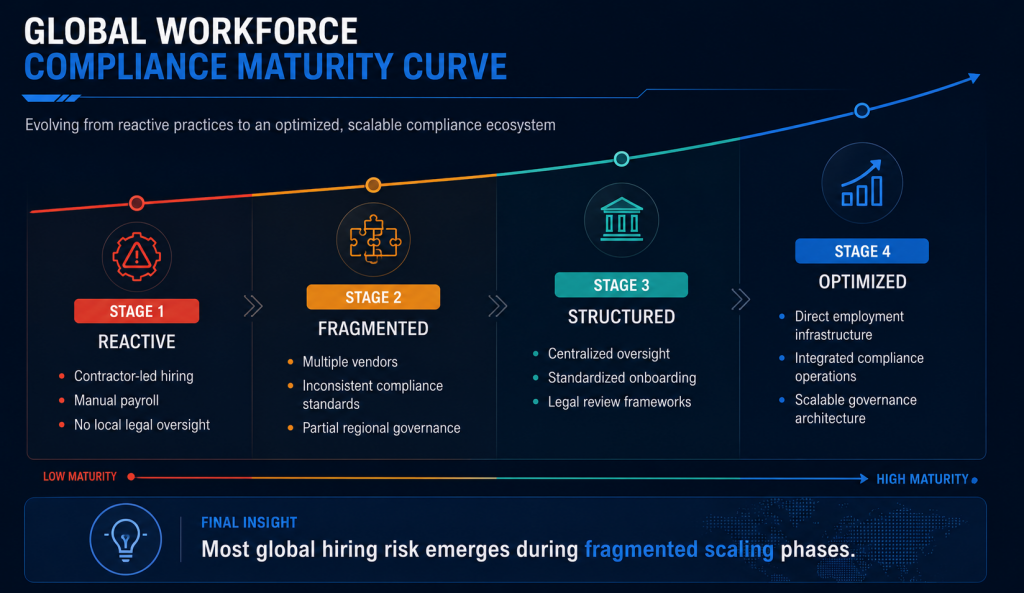
The structural fix for compliance debt is not better internal monitoring. It is getting the employment relationship right from the first hire. This is exactly where employer of record services change the equation. An EOR becomes the legal employer of your workers in each country, taking on statutory payroll obligations, benefits administration, and employment classification under local law. The compliance structure is correct from day one because the EOR owns the risk.
The distinction between EOR models matters here. Aggregator EOR providers, those that use third-party in-country partners rather than their own legal entities, create liability layers that enterprises often do not discover until an audit or acquisition surfaces them. A directly owned EOR infrastructure means your workers are employed through a compliant legal entity, not a subcontract chain where indemnification may not extend to misclassification penalties.
Beyond classification, quality EOR solutions handle the full statutory compliance stack: provident fund contributions, mandatory leave entitlements, termination notice requirements, and benefits that vary by jurisdiction. Each of these is a potential compliance debt source when managed manually across multiple countries without local legal expertise.
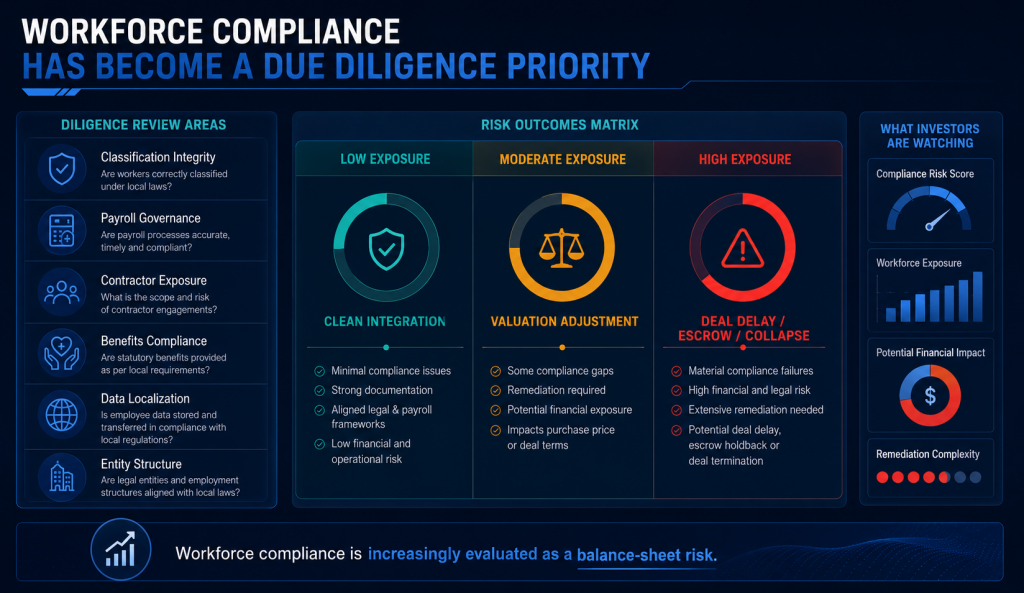
For many companies, the reckoning comes during acquisition due diligence. Investors and acquirers now conduct workforce compliance reviews as a standard component of M&A diligence, and what they find is often sobering. Misclassified contractors, retroactive benefit obligations, and payroll data governance gaps are among the most common workforce liabilities that surface post-LOI. These findings do not just affect deal pricing; they can stall or kill transactions entirely.
Companies that close deals smoothly usually either built compliant employment structures from the start or switched to an EOR model before the acquisition process began. EOR can also serve as a bridge structure during M&A integration, absorbing the acquired workforce into a compliant employment framework while the buyer prepares their own entity infrastructure. Learn more about how global EOR services can de-risk cross-border workforce transitions.

List of Content

Can you prove, right now, that every copy of your customer data is classified, protected, and deletable on request? For most enterprises…

For years, enterprise identity systems were built on a quiet, unquestioned belief: every identity belonged to a human being. Your…