Home>Insights>Blogs > Shadow Data Is the Compliance Time Bomb No One Is Defusing
Shadow Data Is the Compliance Time Bomb No One Is Defusing
Can you prove, right now, that every copy of your customer data is classified, protected, and deletable on request?
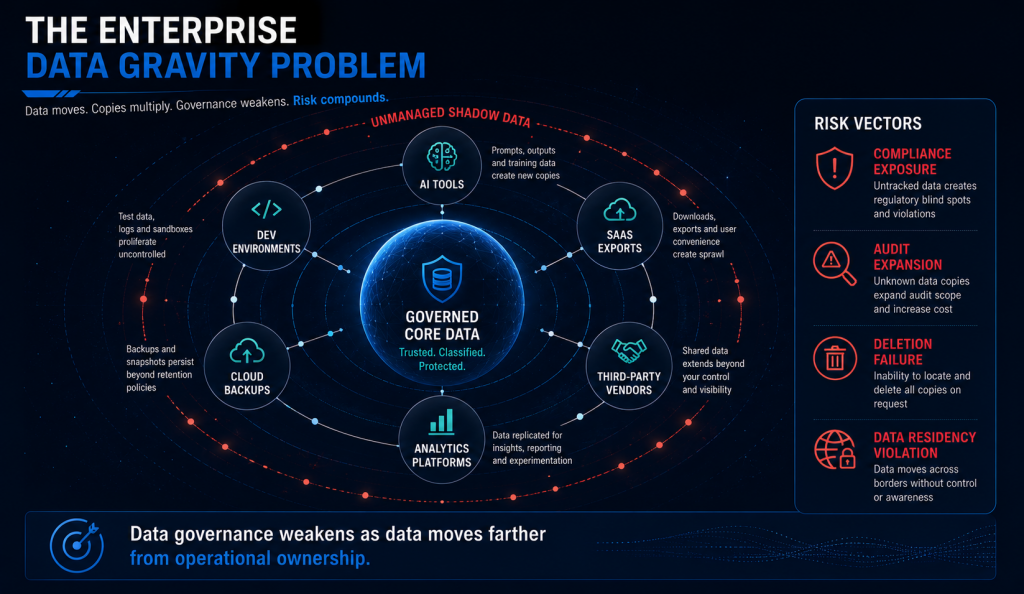
For most enterprises in 2026, the honest answer is no. Not because the security team is careless, but because the way enterprise data moves through cloud environments, SaaS tools, and development workflows makes it structurally impossible to know where all copies live.
This is the shadow data problem. And it just became a legal problem, not only a security one.
According to Netwrix’s 2025 Cybersecurity Trends Report, lack of visibility into sensitive data has ranked as the top security challenge for three consecutive years. More than a third of data breaches now involve unmanaged shadow data. With EU Cyber Resilience Act reporting obligations arriving in September 2026, compliance and legal teams are asking questions that security teams cannot yet answer.
How Shadow Data Is Created
Shadow data is not the result of negligence. It is the natural byproduct of how modern enterprises operate.
Development and test environment clones. Developers copy production databases to build and debug features. These copies often outlive the project and accumulate across forgotten environments.
SaaS exports and BI extracts. Marketing downloads a customer list from the CRM. Finance pulls a year-end report into a desktop analytics tool. Each export immediately escapes governance frameworks.
Forgotten cloud storage. The S3 bucket was created for a proof-of-concept that launched two years ago. The Azure Blob container from a vendor demo. These persist long after the original purpose is gone.
The compliance exposure created by shadow data is specific and serious.
GDPR Article 17 grants individuals the right to erasure. You cannot delete what you cannot find. If a customer requests deletion and you have 17 unindexed copies of their data scattered across cloud buckets, SaaS platforms, and developer environments, you are in violation the moment you cannot confirm deletion.
HIPAA’s minimum necessary rule applies to every copy of protected health information, not just the primary database. Shadow copies of PHI in unmanaged environments create audit perimeter exposure that most healthcare organizations have not fully mapped.
PCI DSS scope creep is one of the most overlooked shadow data risks. Every unmanaged copy of cardholder data expands your audit perimeter automatically, whether your security team knows it exists or not.
The organizations that will face the steepest regulatory exposure in 2026 are not those that had the biggest breaches. They are the ones that could not demonstrate data lineage, ownership, and deletion capability when an auditor asked.
Why Discovery Alone Is Not Enough
Most DSPM conversations start and stop at discovery. Finding shadow data is necessary. It is not sufficient.
The gap that most security teams fall into is treating inventory as control. Knowing where data exists is different from being able to prove it is protected, classified, and managed to regulatory standards. An unencrypted S3 bucket that has been discovered is still an unencrypted S3 bucket.
True data-centric security means protection travels with the data. Classification, encryption, access controls, and deletion workflows need to follow each dataset wherever it goes, not just where you expect it to be.
The DSPM Maturity Model
Building toward complete shadow data governance follows a clear progression:
Level 1: Know where the data is. Continuous discovery across cloud, SaaS, and on-premises environments.
Level 2: Classify and assign ownership. Every dataset gets a sensitivity label and a human owner.
Level 3: Enforce controls that travel with the data. Encryption, access restrictions, and DLP policies tied to data classification, not just to system perimeters.
Level 4: Continuous posture validation. Automated remediation workflows that act on new shadow data as it appears, not quarterly.
Sakshi Porwal is Compunnel's Global CISO with 15+ years of hands-on experience across cybersecurity's most critical domains — from cloud and application security to GDPR and HIPAA compliance. Her writing bridges the gap between complex security frameworks and the real-world decisions IT and business leaders face every day. at
Compunnel Inc,
The security leader spent 18 months building a Zero Trust architecture. They implemented ZTNA, deployed microsegmentation, and enforced MFA across all applications. Then…