Contingent Workforce Planning: Forecasting Flexible Headcount for the Year Ahead
Contingent workforce planning helps organizations estimate how much external talent they may need, when they will need it, and where…
Select location
Every company expanding internationally faces the same foundational question: should we set up a local entity, or use an Employer of Record? The EOR vs entity setup global expansion debate is not a matter of preference – it’s a structural decision that affects cost, speed, compliance exposure, and operational flexibility for years.
Many organizations evaluating EOR solutions are not just comparing hiring models, but determining how quickly they can enter new markets without taking on unnecessary legal and administrative complexity.
In 2026, this decision carries even more weight. Regulatory complexity has intensified across every major hiring market, entity dissolution costs have increased, and the speed advantage of Employer of Record services has widened as providers invest in AI-driven compliance and integrated payroll infrastructure. At the same time, entity setup remains the right choice for specific scenarios – particularly high-headcount, long-term commitments in single markets.
This guide provides a clear, data-backed comparison of both models – covering costs, timelines, compliance, scalability, and exit flexibility – so you can match the right structure to your expansion strategy.
Employer of Record (EOR)
An Employer of Record is a third-party provider that becomes the legal employer of your international workforce. The EOR handles contracts, payroll, tax compliance, benefits, and termination in-country – while you retain full operational control over the employee’s work. No local entity is required. Onboarding typically completes in 5–14 days, and contracts are month-to-month with no lock-in.
Entity Setup (Local Subsidiary or Branch)
Entity setup involves registering a legal business presence – typically a subsidiary, branch office, or representative office – in the target country. This requires legal incorporation, local banking, tax registration, and compliance infrastructure. The company becomes the direct legal employer, with full control and full liability. Setup timelines range from 4 to 16+ weeks, depending on jurisdiction, with costs between $15K and $80K per country.
Several converging regulatory and market trends have raised the stakes of this decision:
In this context, the EOR vs entity setup decision is not just about operational convenience – it’s about risk architecture.
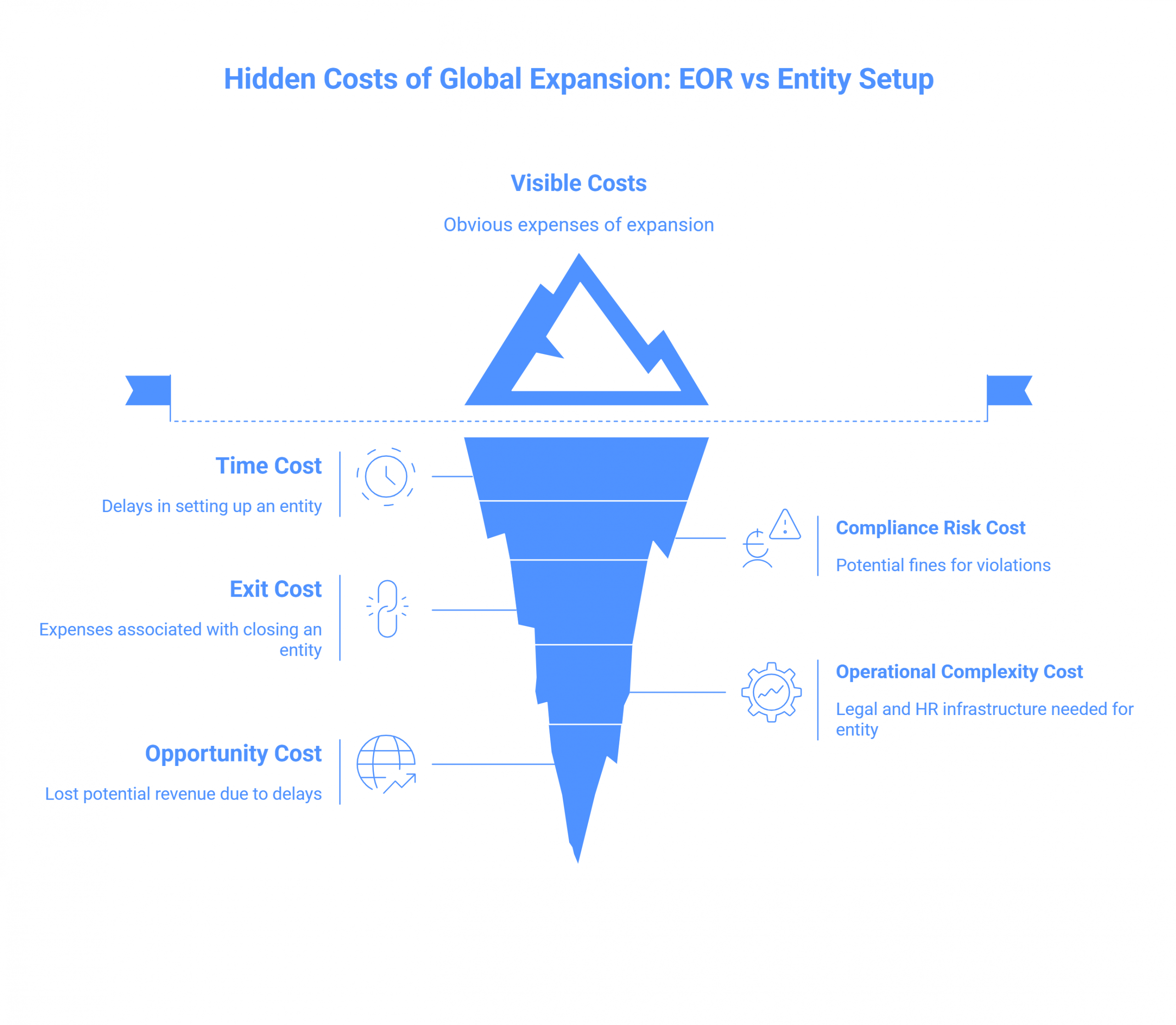
The following table provides a comprehensive, criteria-by-criteria comparison of both models across the dimensions that matter most to expansion decision-makers.
EOR vs Entity Setup – Comprehensive Comparison Table
| Criteria | EOR (Employer of Record) | Entity Setup (Subsidiary) |
|---|---|---|
| Legal Structure | No entity required. EOR is the legal employer in-country. | Full subsidiary or branch registered in the target country. |
| Setup Timeline | 5–14 days to first hire. | 4–12 weeks (often 16+ weeks in complex jurisdictions). |
| Setup Cost | $0 entity cost. $199–$600/employee/month. | $15K–$80K per country (legal, registration, banking, office). |
| Compliance Liability | 100% transferred to EOR provider. | 100% retained by the company. |
| Ongoing Admin Burden | Minimal – EOR manages payroll, tax, benefits, and filings. | High – in-house or outsourced legal, accounting, and HR teams required. |
| Scalability | Instant scale-up/down. Add countries in days. | Slow – each new country requires a separate entity setup. |
| IP Protection | Strong – direct employment through EOR. | Strongest – direct ownership through an owned entity. |
| Control Over Operations | Full operational control. EOR handles legal/admin. | Full operational + legal control. |
| Exit Flexibility | Monthly contracts. Wind down in weeks. | Entity dissolution takes 6–18 months and $10K–$30K. |
| Immigration Support | End-to-end visa and work permit management. | The company must manage independently or hire immigration counsel. |
| Best For | Market testing, speed-to-hire, <50 employees per country. | Long-term presence, 50+ employees, full local autonomy. |
*Estimates may vary by country, provider, workforce size, and specific business requirements.
Benefits of EOR for Global Expansion
Benefits of Entity Setup
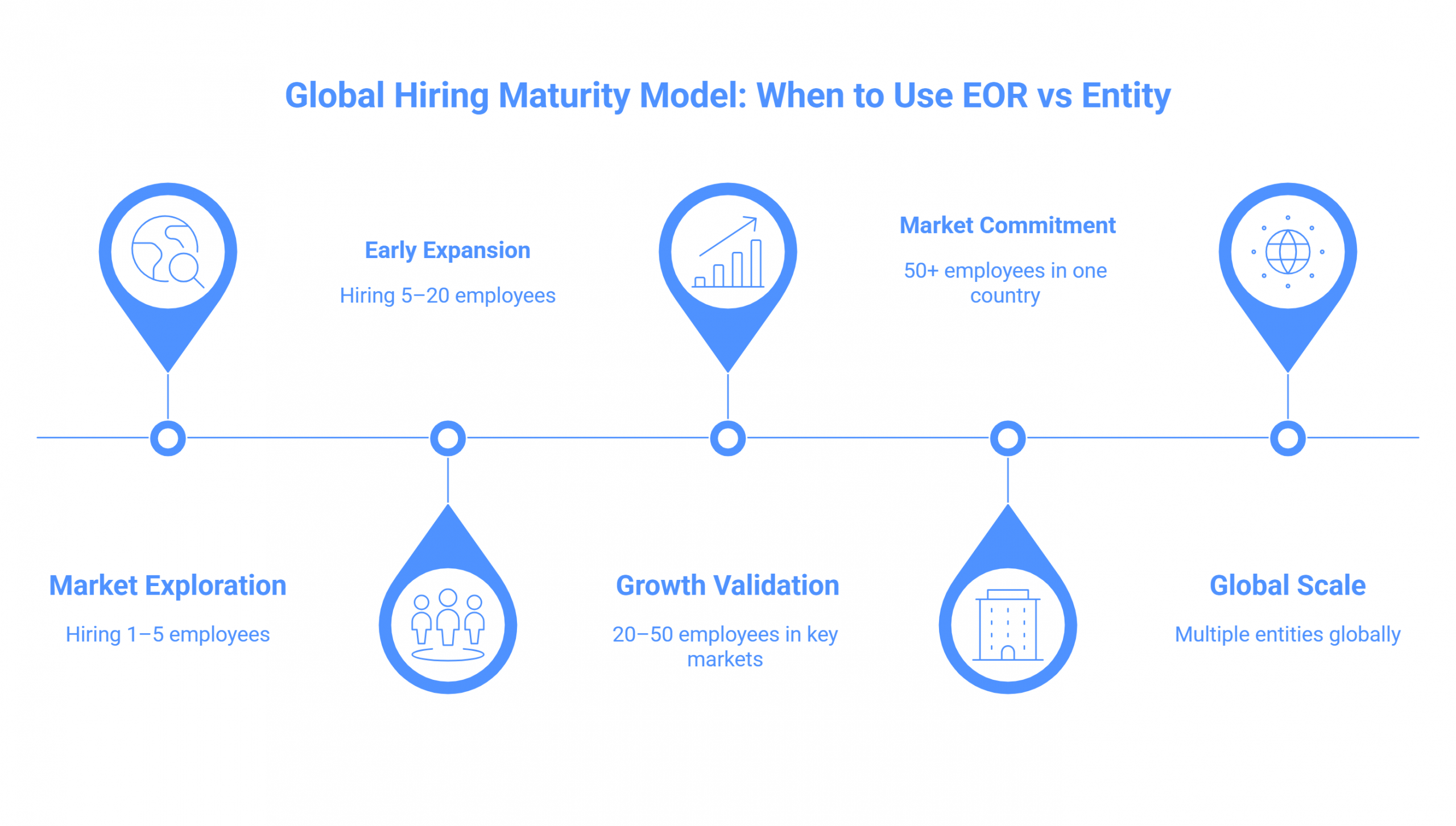
Per-employee fees at scale: At $300–$600/employee/month, EOR costs for 50+ employees in a single country can exceed the annualized cost of maintaining a local entity. The break-even point typically falls between 30 and 50 employees, depending on the jurisdiction.
Limited local autonomy: Because the EOR is the legal employer, the client cannot directly open local bank accounts, sign local commercial contracts as the employer, or hold certain industry-specific licenses.
Provider quality variance: Not all EOR providers deliver the same level of compliance rigor, payroll accuracy, or immigration support. Selecting a financially stable, operationally mature provider is essential.
High upfront investment: $15K–$80K per country for legal incorporation, banking, tax registration, and local office setup – before a single employee is hired.
Slow time-to-hire: 4–16+ weeks for entity establishment means talent is lost to competitors during the setup window. In fast-moving markets, this delay is often the deciding factor.
Ongoing compliance burden: The company retains 100% of compliance liability. Local legal counsel, accounting, HR administration, and regulatory monitoring must be staffed or outsourced – adding $33K–$85K+ annually per country.
Expensive exit: Dissolving an entity takes 6–18 months and $10K–$30K in most jurisdictions. This makes entity setup a poor fit for market-testing or short-term engagements.
The following framework compares estimated Year 1 costs for hiring 10 employees in a single international market using EOR versus entity setup. These ranges reflect typical costs across mid-complexity jurisdictions (Germany, India, Brazil, UK).
EOR vs Entity Setup – Year 1 Cost-Benefit Analysis
| Cost Category | EOR Model (10 Employees) | Entity Setup (Same Market) |
|---|---|---|
| Entity Registration | $0 | $15K–$80K (legal, registration, banking) |
| Monthly Service Fee | $199–$600 × 10 = $1,990–$6,000/mo | N/A (absorbed into entity overhead) |
| Annual Service Cost | $23,880–$72,000 | N/A |
| Local Legal Counsel | Included in EOR fee | $10K–$25K/year retainer |
| Local Accounting/Tax Filing | Included in EOR fee | $8K–$20K/year |
| HR Administration | Included in EOR fee | $15K–$40K/year (headcount or outsourced) |
| Immigration/Visa Support | Included (most providers) | $5K–$15K per visa (external counsel) |
| Year 1 Estimated Total | $23,880–$72,000 | $53K–$180K |
| Break-Even Point | Immediate value from day 1 | Typically 18–36 months at 30–50+ employees |
| Exit/Wind-Down Cost | $0 – monthly contracts | $10K–$30K + 6–18 months dissolution |
*Estimates may vary by country, provider, workforce size, and specific business requirements.
Key takeaway: For teams of 10–30 employees in a single market, the EOR model delivers 40–60% lower Year 1 costs with zero setup investment. The entity model becomes cost-competitive only at 30–50+ employees with a multi-year commitment.
Not every expansion scenario has the same answer. The following decision tree maps eight common scenarios to the model that delivers the strongest strategic fit, with a clear recommendation for each.
EOR vs Entity Setup – Scenario-Based Decision Tree
| Your Scenario | EOR? | Entity? | Recommendation |
|---|---|---|---|
| Entering a new market with <10 hires | ✅ Best fit | ❌ Overkill | Start with EOR; evaluate entity at 30–50 hires |
| Testing demand before committing to a market | ✅ Ideal | ❌ Premature | EOR validates the market before entity investment |
| Hiring 50+ employees long-term in one country | ⚠️ Works but costly at scale | ✅ Best fit | Entity justified at this headcount and commitment |
| Need to hire within 2 weeks | ✅ 5–14 days | ❌ 4–12 weeks minimum | EOR is the only viable option for speed |
| Require full local autonomy and direct banking | ❌ Limited | ✅ Full control | Entity needed for direct financial operations |
| Expanding into 5+ countries simultaneously | ✅ Scales instantly | ❌ 5 separate setups | EOR handles multi-country expansion under one contract |
| Short-term project (6–18 months) | ✅ Flexible exit | ❌ Dissolution costs | EOR avoids entity wind-down expenses |
| Industry requires local licensing/permits | ❌ May not suffice | ✅ Required | Regulated industries often need a direct entity |
Scenario: A US-based AI company (Series B, $35M revenue, 180 employees) wanted to hire sales and customer success teams across the UK, India, and Mexico to validate product-market fit before committing to entities in any of the three markets.
Challenge: Establishing entities in all three countries would have cost $120K–$180K upfront, taken 12–16 weeks, and locked the company into ongoing compliance infrastructure with no guarantee of market traction. The CFO required a reversible, cost-controlled approach.
EOR Solution: The company engaged an EOR to hire 6 employees across all three markets: 2 sales reps in the UK, 2 customer success managers in India, and 2 sales reps in Mexico. All contracts were drafted and signed within 8 days. Monthly EOR cost: approximately $3,600 for all 6 employees.
Results: After 9 months, the UK market showed strong traction – the company grew to 18 UK employees via EOR and began entity setup planning. India performed well with a stable headcount. Mexico underperformed – the company wound down both hires within 30 days with zero dissolution cost. Total savings vs. upfront entity setup across three markets: approximately $140K.
Compunnel has operated across global workforce solutions for over 30 years – supporting companies through every stage of international expansion, from first-hire EOR engagements to entity transition planning.
The EOR vs entity setup decision is rarely binary. Most companies use EOR to enter markets quickly, validate demand, and build initial teams – then transition to entity setup once headcount and commitment justify the investment. Compunnel supports this entire lifecycle: EOR engagement from day one, followed by structured entity transition support when the time is right.
Compunnel’s EOR operates across 150+ countries with no advance payroll funding, no security deposits, and flexible monthly contracts.
For companies approaching the entity transition threshold, Compunnel provides parallel support during the handover period to ensure zero compliance gaps.
Whether you’re testing a new market with 3 hires or planning entity setup after 50, the starting point is the same: a clear understanding of which model fits your current stage.
EOR-to-Entity Migration Services: Leading EOR providers are building structured transition frameworks that allow companies to move from EOR to owned entity without disrupting employee contracts, payroll continuity, or compliance status.
Hybrid Models Gaining Traction: Companies are increasingly running EOR and entity models in parallel – using entities in core markets and EOR in secondary or test markets. This blended approach is becoming the standard playbook for mid-market international expansion.
AI-Powered Entity Readiness Scoring: Some EOR platforms now offer predictive analytics that calculate when a company’s headcount, tenure, and market activity warrant the transition from EOR to entity, turning the decision from subjective to data-driven.
Cross-Border Entity Dissolution Simplification: Regulatory streamlining in the EU and parts of Asia is reducing entity dissolution timelines, though costs remain high enough to make EOR the safer choice for non-permanent market presence.
The EOR vs entity setup global expansion decision is fundamentally about matching structure to stage. Employer of Record (EOR) delivers speed, compliance transfer, and cost efficiency for market entry, demand validation, and teams under 30–50 employees. Entity setup delivers full control and cost advantages for long-term, high-headcount commitments in proven markets.
The most effective global expansion strategies use both models in sequence: EOR first to enter, test, and build – then entity setup when the data, headcount, and commitment justify the investment. Treating the decision as either/or limits flexibility; approaching it as a staged progression maximizes both agility and long-term efficiency.
The critical mistake is setting up an entity before the market justifies it. The second-most critical mistake is staying on EOR after the market has clearly outgrown it. The right partner helps you navigate both transitions seamlessly.
Ready to evaluate which model fits your next market?
Explore Compunnel’s Employer of Record (EOR) services and see how you can hire globally without setting up an entity. Or book a 15-minute consultation with Compunnel’s global expansion team to map EOR vs entity setup to your specific markets, headcount, and timeline. No pitch – just clarity.

List of Content

Contingent workforce planning helps organizations estimate how much external talent they may need, when they will need it, and where…

Managed payroll services move much of the day-to-day payroll administration to a third-party provider. The provider can handle payroll calculations,…