AI-Native Vendor Management System for Contingent Workforce
Most enterprises are running a contingent workforce program that was designed for a slower era. Requisitions sit in queues for…
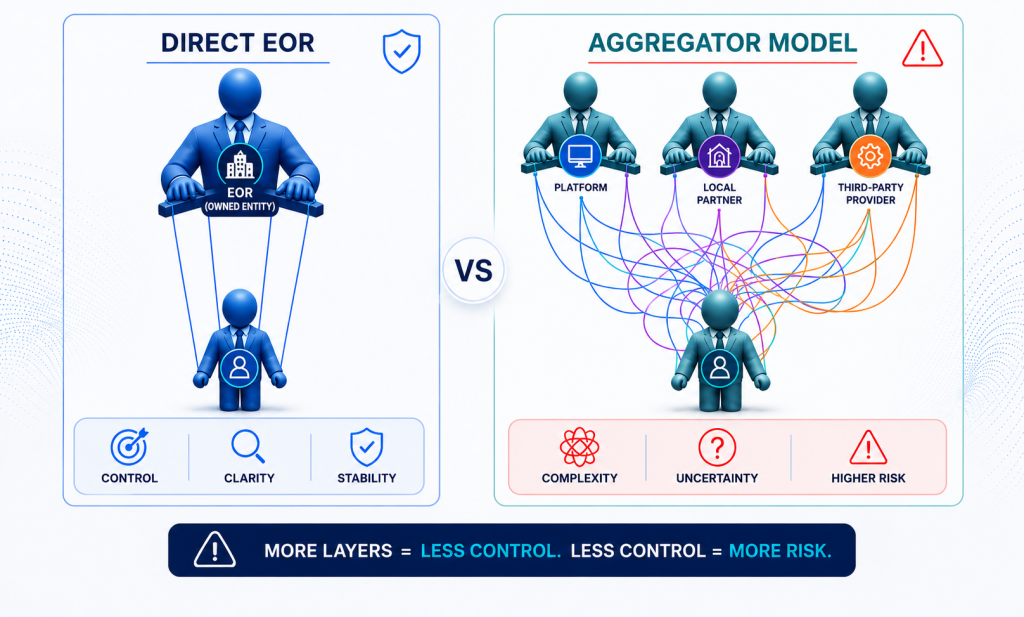
Every EOR provider’s website says the same thing: compliant hiring in 150+ countries. Simple. Fast. Risk-free. But behind that promise, two fundamentally different business models are operating, and the difference determines whether your compliance risk is actually transferred or just redistributed.
The distinction is this: does the EOR own its legal entities in the countries where it employs your people, or does it subcontract the employment to local third-party partners?
The first model is a direct EOR. The second is an aggregator. Most buyers never ask the question. They should.
An aggregator sells EOR services across a broad country footprint, but it rarely owns legal entities in all those locations. Instead, it contracts with a network of local partners, sometimes called in-country partners or ICPs, who become the actual legal employer of your workers. The aggregator acts as a technology layer and account management interface between you and a patchwork of local firms.
From your dashboard, everything looks unified. Your employee in Brazil, your contractor-turned-employee in Germany, and your new hire in Singapore all appear on the same platform. Behind the scenes, three different local firms are handling their employment, each with its own processes, compliance standards, and response times.
This matters because every handoff in the chain is a potential failure point.
Compliance lag. Labor laws change constantly. A provider with owned entities in Germany knows immediately when the minimum wage increases from €13.50 to €13.90 because their own payroll team processes it. An aggregator relies on its German partner to communicate the change, which creates an information delay. Weeks can pass where your employees’ contracts are technically non-compliant.
Liability murkiness. When an aggregator’s local partner makes a payroll error, files taxes late, or fails to update a contract after a regulatory change, who is liable? The aggregator may argue it is merely the technology platform. The local partner may point to unclear instructions. You are the one facing the regulatory consequence, stuck between two entities pointing at each other.
Data security gaps. Your employee’s personal data moves from your systems to the aggregator’s platform to the local partner’s payroll system. Every additional party in the chain is an additional data processing relationship that needs GDPR-compliant agreements, security audits, and breach notification procedures. You have limited visibility into the local partner’s cybersecurity practices.
Cost opacity. Every layer in the supply chain adds margin. The local partner charges a fee. The aggregator adds a markup. These costs often surface as higher FX rates, opaque billing where statutory costs are bundled with administrative fees, or additional charges for “custom” HR support that a direct provider would handle as standard service.
The aggregator versus direct distinction stopped being theoretical in early 2026. Several high-profile compliance failures involving aggregator-model providers made buyers re-examine their EOR arrangements. The pattern was consistent: a local partner in the chain failed to update contracts or payroll configurations after a regulatory change, the aggregator was slow to detect the gap, and the client discovered the problem only when an audit notice or employee complaint arrived.
This is not an argument that all aggregators are bad or all direct providers are good. It is an argument that the ownership structure of your EOR provider’s infrastructure directly affects your compliance exposure, and you should evaluate it with the same rigor you apply to any other vendor risk assessment.
Ask three questions and verify the answers independently.
“Do you own your legal entity in [target country]?” Request the local company registration number. A credible provider will answer without hesitation. If the answer involves phrases like “local partner network” or “flexible infrastructure,” you are likely dealing with an aggregator.
“Who is the named employer on my employee’s contract?” If the contract names a company you have never heard of that is not the EOR you signed with, a local partner is involved.
“What is your SLA for contract amendments following a regulatory change?” A direct provider with in-house legal teams can commit to 48 to 72 hours. An aggregator dependent on partner communication will hedge with “as soon as practicable.”
If you haven’t verified whether your EOR provider owns its entities in your target countries, do it this week-the answer directly impacts your risk exposure. Compunnel operates as a direct employer of record provider with transparent entity ownership, dedicated in-country support, and a pricing structure free from hidden partner markups. Ask us for entity registration details to validate your provider’s model.
Verify Compunnel’s Direct EOR Model

List of Content

Most enterprises are running a contingent workforce program that was designed for a slower era. Requisitions sit in queues for…

Payroll at enterprise scale is no longer just about paying people on time. Multi-state and federal tax compliance, a mix…