10 Key Benefits of Managed Payroll Services and When They Make Sense
Managed payroll services move much of the day-to-day payroll administration to a third-party provider. The provider can handle payroll calculations,…
US immigration policy shifted significantly in early 2025. Processing times for skilled worker visas lengthened. Some categories saw application backlogs stretch past 18 months. For companies that built their hiring strategy around bringing international talent to the US, the math changed overnight.
The response from most fast-growing companies was not to stop hiring international talent. It was to change where those employees are based.
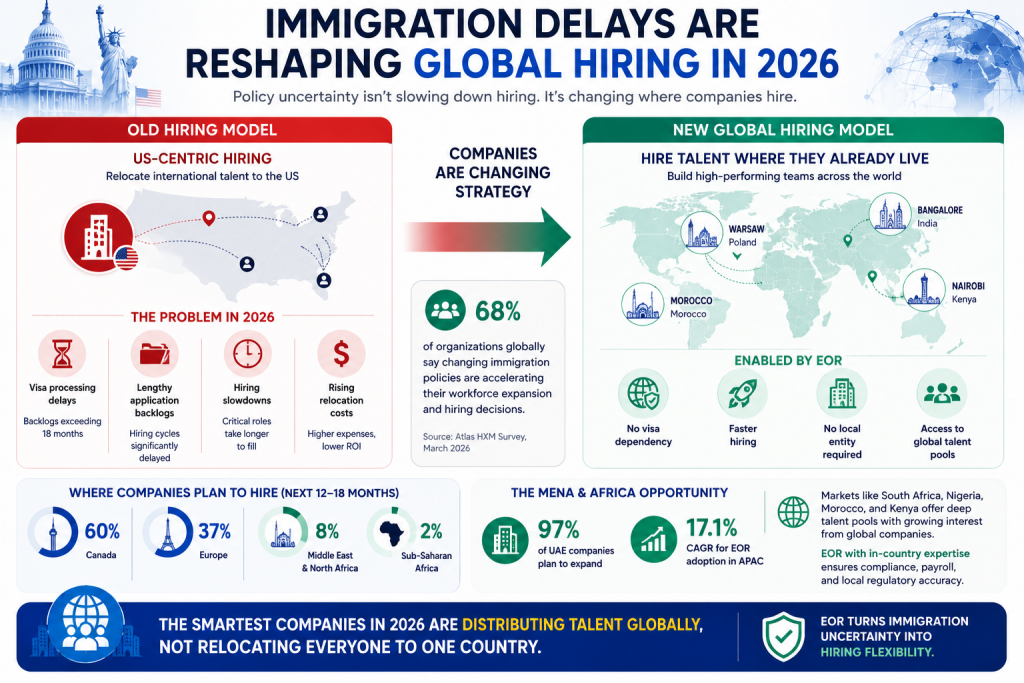
A survey by Atlas HXM released in March 2026 found that 68% of organizations globally say changing immigration policies are accelerating their workforce expansion and hiring decisions. Fewer than one in five reported delays. The instinct to slow down hiring in response to policy uncertainty is less common than it might seem. The more typical response is to look for a different entry point.
That entry point, for a growing number of companies, is hiring workers in the countries where they already live rather than relocating them. An engineer in Bangalore, a designer in Warsaw, a data analyst in Nairobi: all of them can be employed compliantly through an employer of record service without a visa, a relocation package, or an 18-month wait.
This approach was already gaining ground before 2025. The immigration policy shifts accelerated adoption significantly, because they removed the practical alternative for many hiring managers.
Immigration is not the only policy variable companies are navigating. Tariff uncertainty under US Section 301 and 232 provisions has made some companies reconsider where they base teams that support global operations. When trade relationships with specific markets become unpredictable, having employees distributed across multiple jurisdictions rather than concentrated in one location provides operational flexibility.
EOR structures make this easier because they allow companies to hire in a new market within days rather than months. You do not need a local entity to test whether a market works. You hire through an EOR, see whether the team performs and the market delivers, and then decide whether to establish a permanent presence. If circumstances change, you have options.
The Atlas HXM data shows that while 60% of US organizations plan to hire in Canada and 37% in Europe, only 8% are considering the Middle East and North Africa, and just 2% are looking at sub-Saharan Africa. Given that 97% of UAE companies plan to expand, and that APAC is growing at a 17.1% CAGR for EOR adoption, there is a significant talent pool that most US companies have not engaged with yet.
South Africa, Nigeria, Morocco, and Kenya are seeing growing interest from companies building engineering and operations teams. The regulatory environments are more complex than in North America or Europe, which is exactly where having a well-resourced EOR makes the difference. An EOR with in-country staff in Nairobi or Lagos tracks labor law changes, processes local payroll correctly, and manages statutory contributions. You get access to a talent pool that most of your competitors have not yet found.
The companies that handled 2025 immigration disruptions the best were the ones that had already built distributed hiring muscle. They had EOR relationships in multiple markets, existing workflows for onboarding remote employees, and compensation benchmarking data across geographies.
Building that infrastructure during a crisis is harder and more expensive than building it in advance. The cost of setting up an EOR relationship in a new market is relatively low. The benefit, having an operational hiring pathway ready before you need it, compounds over time.
If your company’s hiring strategy currently depends heavily on bringing people to a single location, 2026 is a reasonable time to start diversifying that model. The policy environment is unlikely to simplify. The talent pools in markets like India, Vietnam, Poland, and Morocco are real and growing. EOR makes them accessible without requiring a commitment to full entity establishment in each one.
Ready to hire globally without the compliance headache? Talk to our experts at Compunnel EOR Services and find out how we can get your next international hire done right.

List of Content

Managed payroll services move much of the day-to-day payroll administration to a third-party provider. The provider can handle payroll calculations,…

Most enterprises are running a contingent workforce program that was designed for a slower era. Requisitions sit in queues for…