10 Key Benefits of Managed Payroll Services and When They Make Sense
Managed payroll services move much of the day-to-day payroll administration to a third-party provider. The provider can handle payroll calculations,…
Select location
The attacker did not hack the system. They logged in.
That is the uncomfortable reality behind modern identity breaches. Stolen credentials remain the starting point for nearly 70% of attacks, yet most security strategies still focus only on credential storage, MFA enforcement, and periodic access reviews.
The real problem begins after authentication succeeds. Once a legitimate credential is compromised, traditional identity controls often lose visibility into what happens next.
This is the gap Identity Threat Detection and Response was built to solve. But deploying an ITDR tool does not automatically create an effective ITDR program. That gap between tooling and operational maturity is where many enterprise identity security strategies are breaking down today.
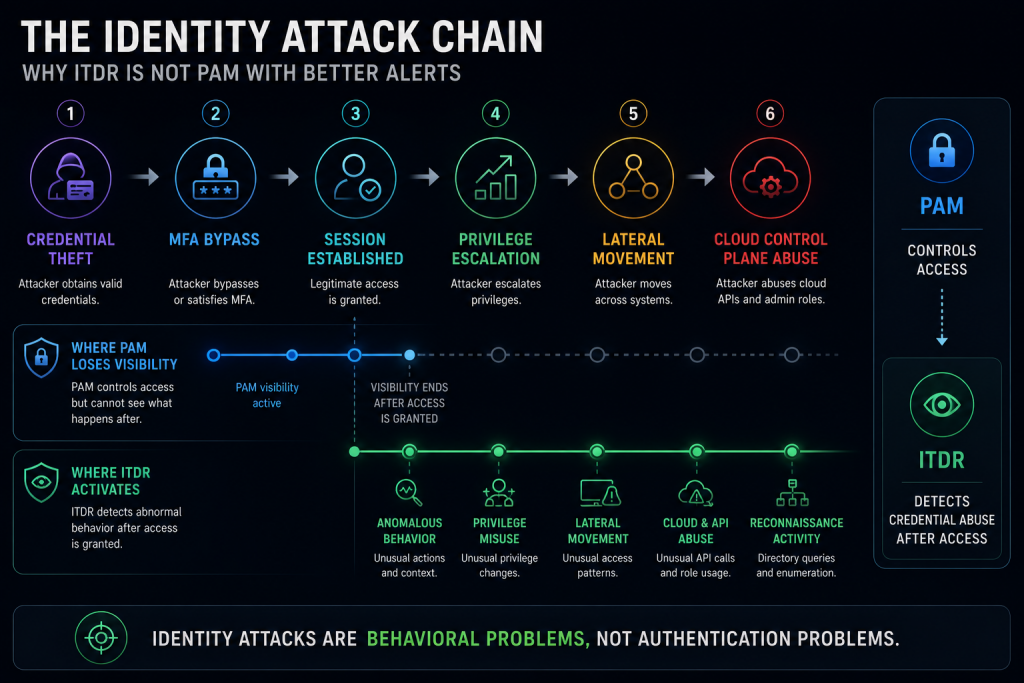
PAM controls access to privileged accounts. It vaults secrets, records sessions, and enforces least privilege on accounts it knows about. What it cannot do is detect the abuse of credentials after authentication has already succeeded.
ITDR operates on a fundamentally different data model from PAM or endpoint security. Building an effective ITDR capability requires pulling from the right telemetry sources:
The goal is a unified identity threat picture that connects login events, session activity, privilege use, and lateral movement indicators across every environment where identities operate.

List of Content

Managed payroll services move much of the day-to-day payroll administration to a third-party provider. The provider can handle payroll calculations,…

Most enterprises are running a contingent workforce program that was designed for a slower era. Requisitions sit in queues for…