Contingent Workforce Planning: Forecasting Flexible Headcount for the Year Ahead
Contingent workforce planning helps organizations estimate how much external talent they may need, when they will need it, and where…
Select location
The price on the EOR provider’s website is real. It is also incomplete.
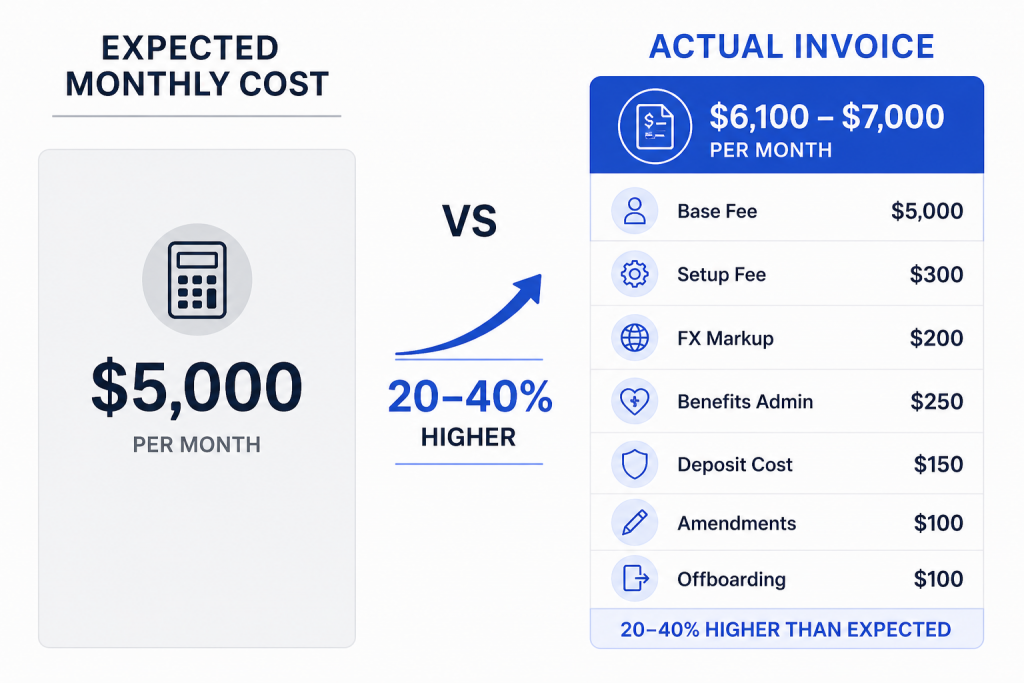
Research consistently finds that total invoiced costs for employer of record services run 20 to 40 percent higher than the advertised monthly rate. The gap is not a rounding error. It is a business model. Providers compete on headline fees and recover margin through charges that surface only after the contract is signed or the first invoice arrives.
If you are evaluating EOR providers in Q2 2026, and most mid-market companies are, you need to know where the money hides. Here are nine fee categories that rarely appear on the pricing page.
A one-time charge per employee covering employment contract drafting, payroll configuration, tax ID registration, and compliance setup. The typical range is $200 to $2,000 per employee, depending on the jurisdiction. Some providers advertise “zero setup fees” and fold this cost into the first month’s invoice under a different label. Ask specifically: Is there any one-time charge when I add a new employee? Get the answer in writing.
Many EOR providers require a refundable deposit per employee, typically equal to one month’s gross salary. This is money you cannot deploy elsewhere for the duration of the employment relationship. On a team of 20 employees with an average salary of $60,000, that is $100,000 locked up. Ask whether the deposit is negotiable, what triggers a return, and what the timeline for refund is upon termination.
This is the fee you never see on a line item because it is built into the conversion rate. Providers that process payroll in a different currency from your billing currency typically add a margin of 0.5 to 3 percent on top of the mid-market exchange rate. On $1 million in annual cross-border payroll, that is $5,000 to $30,000 in hidden FX costs per year. Ask for the exact FX markup policy and whether you can pay in local currency directly.

Some providers include statutory benefits (health insurance, pension, and social security) in the base fee. Others charge separately for benefits administration, enrollment, and any plan changes. A $399/month fee that excludes benefits administration is more expensive than a $499/month fee that includes it once you add the line items back. Ask for a sample invoice that shows every component of the total cost of employment.
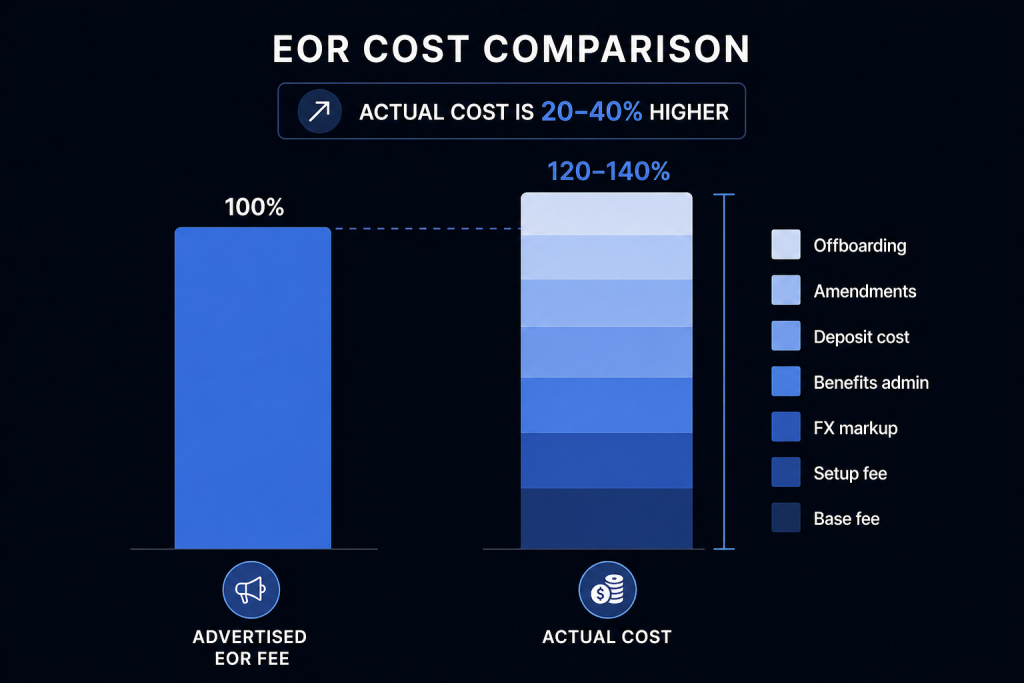
Employment contracts need to change. Salary adjustments, role changes, location transfers, and updated benefit elections. Some EOR providers charge $100 to $500 per amendment, and they define “amendment” broadly. If you make three changes per employee per year across a team of 15, that is $4,500 to $22,500 in fees that did not appear in your cost projection.
Terminating an employee through an EOR involves statutory notice, severance calculations, final payroll processing, and compliance filings. Some providers charge a flat offboarding fee, while others apply a multiplier based on the notice period or severance amount. This cost is invisible until you need to use it. Ask for the exact fee structure before you sign, and model the cost of terminating 10 to 20 percent of your EOR-managed headcount in your first year. It happens more often than anyone budgets for.
If your EOR-managed employees need work authorizations, visa sponsorship, or immigration support, this is almost always a separate engagement with its own fee schedule. A typical immigration case can cost $3,000 to $15,000, depending on the country and complexity. Ask whether immigration support is included or a separate line item, and what a typical case costs in your target countries.
Some providers require 12 to 24-month minimum commitments per employee or per account. If you need to exit the EOR arrangement early, whether because you are setting up your own entity, consolidating providers, or reducing headcount, early termination penalties can eat through any savings the EOR was supposed to provide. Read the cancellation clause before you read the pricing page.
The catch-all category. Some providers add line items for regulatory compliance updates, annual contract renewals, or generic “administrative fees” that have no clear deliverable attached. These charges are typically $50 to $200 per employee per month and represent pure margin. If a fee does not correspond to a specific, named service, push back.
Q2 is budget review season. If you’re comparing EOR providers or renegotiating an existing contract, start with the total cost of employment, not just the headline fee. Compunnel’s transparent pricing approach, fast onboarding timelines, and no-advance-payment model are designed to eliminate the hidden surprises that inflate costs over time. Request a detailed cost comparison for your target countries.

List of Content

Contingent workforce planning helps organizations estimate how much external talent they may need, when they will need it, and where…

Managed payroll services move much of the day-to-day payroll administration to a third-party provider. The provider can handle payroll calculations,…