ITDR Is Not PAM With Better Alerts. Why Identity Threat Detection Needs Its Own Program
The attacker did not hack the system. They logged in. That is the uncomfortable reality behind modern identity breaches. Stolen…
The security leader spent 18 months building a Zero Trust architecture. They implemented ZTNA, deployed microsegmentation, and enforced MFA across all applications. Then an attacker compromised a legitimate service account, moved laterally through two cloud environments, and encrypted critical business systems over a weekend. Recovery took three weeks.
The lesson was not that Zero Trust failed. The lesson was that prevention alone is no longer a complete security strategy.
According to the Absolute Security 2026 Resilience Risk Index, the most significant impact of a cyber incident in 2026 is no longer the breach itself. The real challenge is the operational disruption that follows. Enterprises now manage an average of 83 security tools, yet one in five devices still cannot be consistently protected, patched, or recovered when systems fail.
Downtime has become one of the largest and least-controlled sources of financial risk in the enterprise.
AI-enabled attackers have fundamentally changed the timeline of enterprise attacks. What used to take days now takes minutes. Reconnaissance, privilege escalation, lateral movement, and impact are increasingly automated. Human defenders operating at human speed cannot intercept attacks running at machine speed.
Verizon’s 2025 Data Breach Investigations Report confirms that the human element drives 60% of all breaches, in a context where humans are increasingly outpaced by automation on the attacker side. The question is no longer whether your perimeter will hold. It is whether your organization can absorb the impact when it does not.
IBM’s Cost of a Data Breach data puts the US average at $10.22 million per incident. But breach cost alone understates the real damage. The operational disruption, stakeholder trust erosion, regulatory scrutiny, and customer loss that follow a prolonged recovery compound the financial impact far beyond the initial figure.
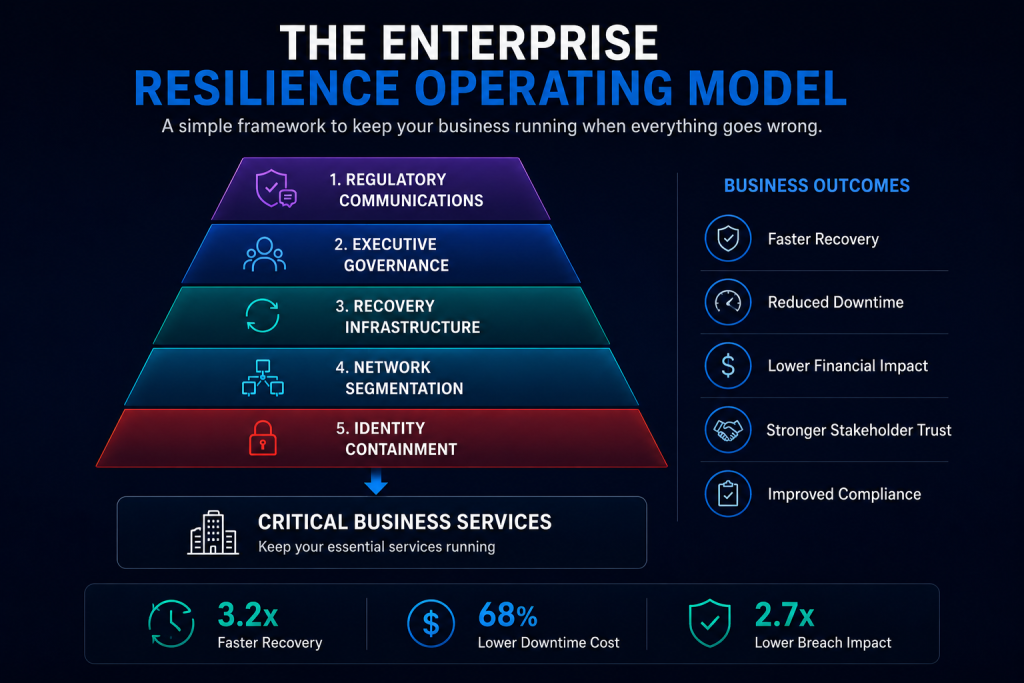
CISOs who are winning board confidence in 2026 have made one critical shift. They stopped presenting security risk as a technical problem and started presenting it as a financial one.
Cyber risk quantification translates exposure into probable loss ranges, downtime cost per hour by business unit, and recovery investment versus impact prevented. This is the language CFOs and board members use to make decisions. Security leaders who can present risk in these terms get the investment they need. Those who present it in technical metrics fight the same budget battles every year.
Regulatory requirements are accelerating this shift. SEC rules now require material cybersecurity incident disclosure. EU NIS2 and the Cyber Resilience Act impose board-level accountability for resilience capabilities. Compunnel’s Cyber Strategy Services help security leaders build the governance framework that satisfies both requirements.
The Compunnel approach to resilience connects Security Operations Services that provide real-time detection and containment capability with Cybersecurity Strategy Services that translate operational resilience into board-ready governance frameworks.
The measure of a security program in 2026 is not whether you got breached. Every organization should assume it will. The measure is how fast you recover, how contained the damage is, and whether your leadership team had a plan before the incident began.
Build a security program designed to survive what it cannot prevent. Talk to our cybersecurity strategy team about building your resilience framework.

List of Content

The attacker did not hack the system. They logged in. That is the uncomfortable reality behind modern identity breaches. Stolen…

US immigration policy shifted significantly in early 2025. Processing times for skilled worker visas lengthened. Some categories saw application backlogs stretch past 18…