Aggregator vs. Direct EOR Model: Which One Actually Protects You?
Every EOR provider's website says the same thing: compliant hiring in 150+ countries. Simple. Fast. Risk-free. But behind that promise,…
A European HR director told me something recently that stuck: “We thought we were compliant until we got the letter.” The letter was a preliminary audit notice from Dutch tax authorities, triggered by contractor payment patterns their data systems had flagged automatically. No tip-off, no warning. Just an algorithm and a deadline.
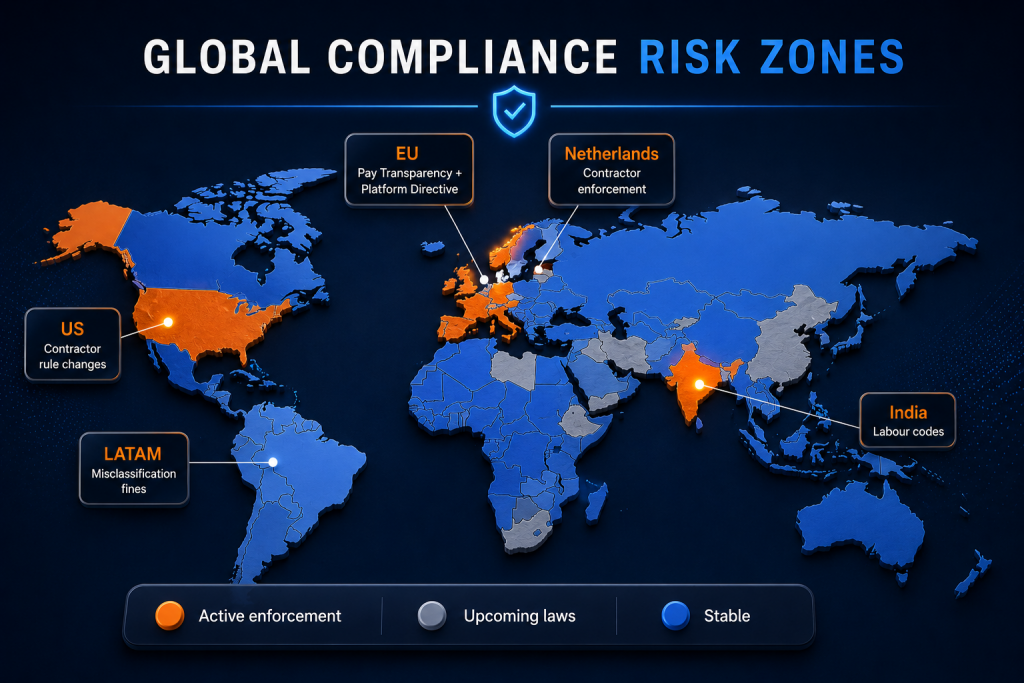
That anecdote captures where employer of record compliance stands in 2026. The regulatory ground is shifting under every company with cross-border workers, and the shifts are happening simultaneously across multiple jurisdictions. The EU Pay Transparency Directive hits its transposition deadline on June 7. India is rolling out consolidated labor codes that rewrite decades-old employment rules. The Netherlands resumed active enforcement of false self-employment rules and is now running data-driven audits with retroactive fines on the table. And the US Department of Labor published a proposed rule in February 2026 to overhaul independent contractor classification under the Fair Labor Standards Act.
If your global hiring strategy still runs on assumptions from 2024, you are exposed. Here are the compliance risks that matter most right now.
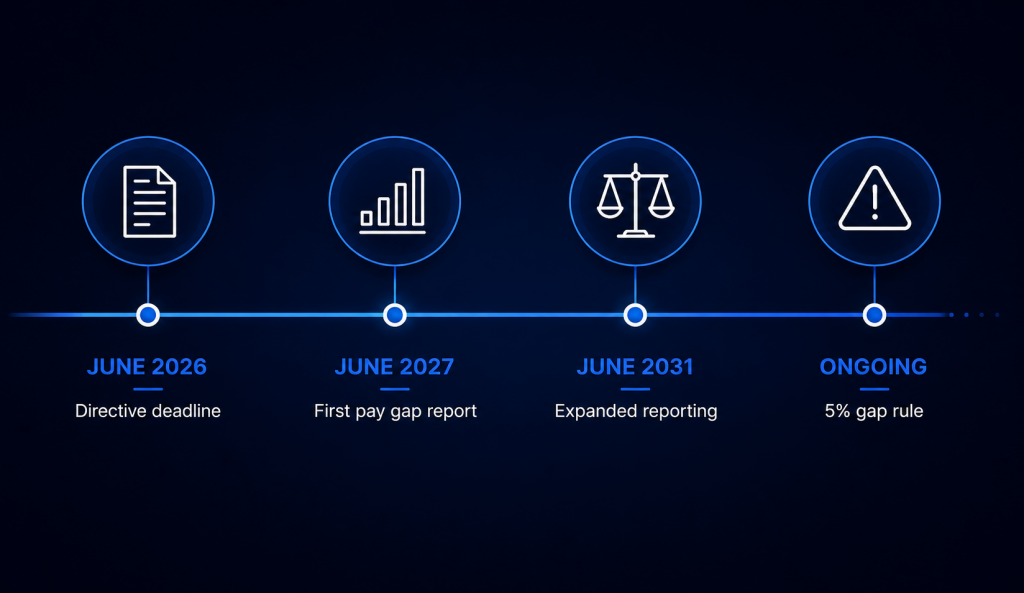
Every EU member state must transpose Directive 2023/970 into national law by June 7, 2026. The European Commission confirmed in April that the deadline will not slip, even though, as of late April 2026, no member state has fully completed transposition. Sweden has pushed back, announcing a delay to January 2027. The Netherlands will not have its implementing law in effect until 2027 either.
But waiting is not an option. The first gender pay gap reports are due in June 2027, covering 2026 calendar-year data for employers with 150 or more workers. That means the data collection window is already open.
For companies using employer of record services in Europe, the directive creates a specific structural problem. EOR providers are the legal employer but typically have zero involvement in recruitment. They do not set the salary, do not write the job ad, and do not interview the candidate. Yet the directive places disclosure obligations on the legal employer. If a salary range is missing from a job posting, or if an employee requests pay information that the EOR cannot meaningfully provide because it employs people across hundreds of unrelated client organizations, liability sits with the EOR on paper but with the client in practice.
The most consequential provision is the reversal of the burden of proof. If an employer fails to meet transparency obligations and an employee brings a pay discrimination claim, the employer must prove there was no discrimination. An EOR that lacks structured pay data and reporting processes will trigger this burden shift by default.
Ask your EOR provider three questions now: Can they produce pay band data segmented by your organization, not just their aggregate portfolio? Have they updated employment contracts for every EU jurisdiction ahead of the transposition deadline? Do they have a process for handling employee pay information requests within the legal timeframe?
Governments are not issuing warnings anymore. They are issuing fines.
The Netherlands resumed active enforcement of false self-employment rules in January 2025. In 2026, the Dutch Tax Authority moved to data-driven audits, and retroactive fines are now on the table for arrangements that predate the enforcement restart. The Wet VBAR, expected to enter force on July 1, 2026, introduces a legal presumption of employment for workers earning below a specified threshold.
The EU Platform Work Directive, adopted in October 2024, has a December 2026 transposition deadline. It introduces a rebuttable presumption of employment for platform workers. Member states are drafting their own implementing laws now.
In Latin America, Mexico and Brazil are using digital tracking and cross-agency data sharing to flag “simulated” independent relationships. Fines in Mexico can reach over $300,000 per incident, and retroactive liability for back benefits, social security contributions, and mandatory profit-sharing compounds quickly.
The pattern is global. Australia is increasing audits partly due to gig economy reforms. Japan and South Korea maintain strong protections against worker misclassification. The UK’s IR35 rules already place the burden of status determination on end clients.
If you are hiring through an EOR, ask whether the provider has a documented classification methodology for every jurisdiction. An EOR that simply labels everyone as an employee without applying local legal tests is creating a different kind of risk: one where the EOR structure itself could be challenged as a disguise for contractor management.
India is in the middle of consolidating 29 existing labor laws into four codes: the Code on Wages, Industrial Relations, Social Security, and Occupational Safety. Implementation has been phased and uneven, with states moving at different speeds on rules and notifications.
For companies using employer of record solutions in India, the practical risks are in the details. Social security contribution calculations are changing. Gratuity and leave entitlement rules are being reworked. The EPFO ran an Employees’ Enrolment Campaign with an amnesty window closing on April 30, 2026, targeting employers who failed to register workers hired between 2017 and 2025.
India is Compunnel’s home market, and the regulatory nuance matters here. A generic global EOR playbook will not handle the state-by-state variation in how these codes are being implemented.
Cross-border employee data transfer is becoming a compliance issue in its own right. The EU General Data Protection Regulation already restricts how employee personal data moves outside the EEA. But as more jurisdictions adopt their own privacy frameworks, including India’s Digital Personal Data Protection Act 2023, the web of overlapping requirements grows.
EOR arrangements involve multiple data controllers and processors. Your employee’s personal information moves from your systems to the EOR’s platform to local payroll processors to government filings. Every handoff is a potential vulnerability, especially when the EOR uses an aggregator model with third-party local partners whose data handling practices you cannot directly audit.
The common thread across every risk listed above is the same: compliance in 2026 is not a static achievement. It is a continuous process. Laws change monthly. Enforcement postures shift. Data collection obligations have fixed calendar-year windows.
An EOR that does not proactively monitor regulatory changes, update contracts in advance of enforcement dates, and maintain structured pay and classification data is not reducing your risk. It is storing it.
Before your next quarterly review with your EOR provider, ask for their regulatory change log. How many contract amendments did they initiate in the past six months? How many compliance alerts did they send you? If the answer to either is “zero,” the problem is already bigger than you think.
If your global workforce spans even two countries, a compliance audit is not optional in 2026. Compunnel operates as a compliance-first EOR service provider with in-country legal expertise, structured pay data infrastructure, and proactive regulatory monitoring across 150+ countries. Talk to our team before the next deadline catches you off guard.

List of Content

Every EOR provider's website says the same thing: compliant hiring in 150+ countries. Simple. Fast. Risk-free. But behind that promise,…

The CISO presents the managed SOC proposal to the CFO. The price is $25,000 monthly. The CFO’s immediate response:…