Contingent Workforce Planning: Forecasting Flexible Headcount for the Year Ahead
Contingent workforce planning helps organizations estimate how much external talent they may need, when they will need it, and where…
Select location
Global employment compliance has never been more complex. In 2026, the convergence of EU pay transparency mandates, expanded misclassification enforcement, and real-time statutory reporting requirements has created a regulatory environment where manual processes and fragmented systems are no longer viable. For companies hiring across borders, EOR global compliance 2026 has become a strategic priority, not an administrative convenience, driving increased adoption of global employer of record services to manage regulatory complexity at scale.
With 74% of international employers reporting at least one compliance incident and average penalties reaching $42,000 per event, the cost of getting it wrong is substantial. This guide examines the specific 2026 compliance challenges and how EOR structurally addresses each one.
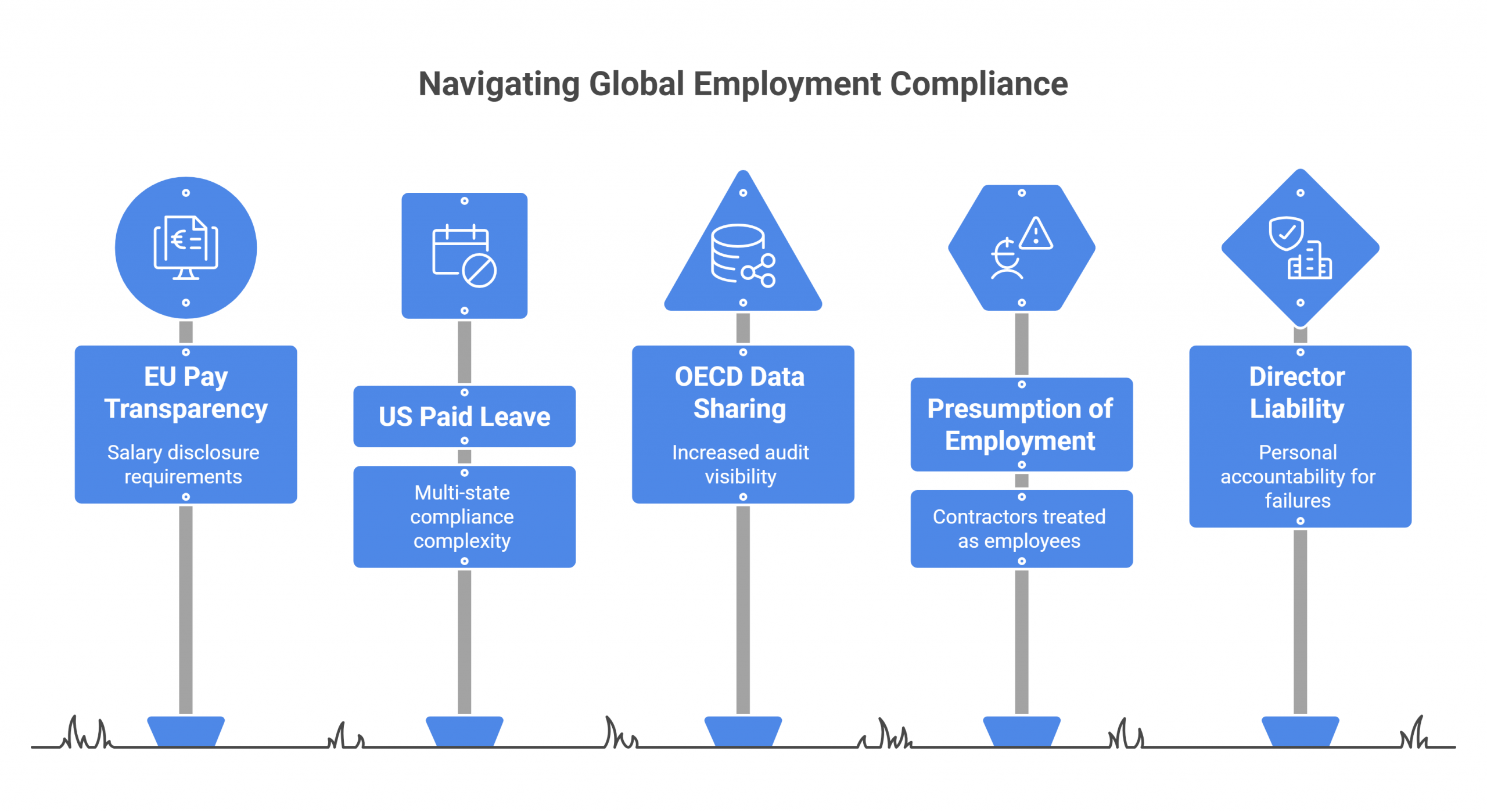
Several regulatory shifts are converging to make 2026 the most challenging year for international employment compliance in recent history:
2026 Global Compliance Risk Map
| Regulation / Risk | Region | Impact | Effective |
|---|---|---|---|
| EU Pay Transparency Directive | EU (27 member states) | Standardized compensation reporting, pay gap disclosures, and salary range mandates | June 2026 |
| Paid Leave Expansions | US (13+ states) | New PTO, sick leave, and family leave mandates for distributed workforces | Rolling 2026 |
| Cross-Border Data Sharing | OECD nations | Tax authorities share payroll data; increased misclassification audit triggers. | Active |
| Presumption-of-Employment Rules | Spain, Italy, the Netherlands | Long-term contractors presumed employees; burden of proof on the company | Active |
| Real-Time Statutory Reporting | Multiple (expanding) | Monthly filings replaced by real-time payroll/tax submissions | Rolling 2026 |
| AI Hiring Regulations | California, EU | Bias audits required for AI-driven hiring and decision tools | Jan 2026 |
| Director Liability Expansion | UK, EU, Australia | Personal liability for officers in misclassification and compliance failures | Active |
The EOR drafts jurisdiction-specific employment contracts that reflect current labor law, not adapted templates. This eliminates the misclassification risk that arises when companies use contractor agreements in markets with presumption-of-employment rules. In Spain, Italy, and the Netherlands, for instance, the EOR ensures proper employee classification from day one.
As jurisdictions shift to real-time statutory reporting, the EOR’s integrated payroll systems handle automated tax withholding, employer contributions, and filing submissions without manual intervention. Consequently, the client avoids the penalty exposure that comes from late or inaccurate filings across multiple countries.
The EU Pay Transparency Directive requires standardized compensation documentation embedded in employment contracts. The EOR ensures that every contract in EU member states includes the required salary range disclosures, pay gap reporting inputs, and benefits transparency clauses -built in at the contract drafting stage, not retrofitted.
With expanding director liability across the UK, EU, and Australian jurisdictions, the EOR’s assumption of legal employer status directly shields company officers from personal exposure. Employment compliance failures become the EOR’s liability, not the client’s directors’.
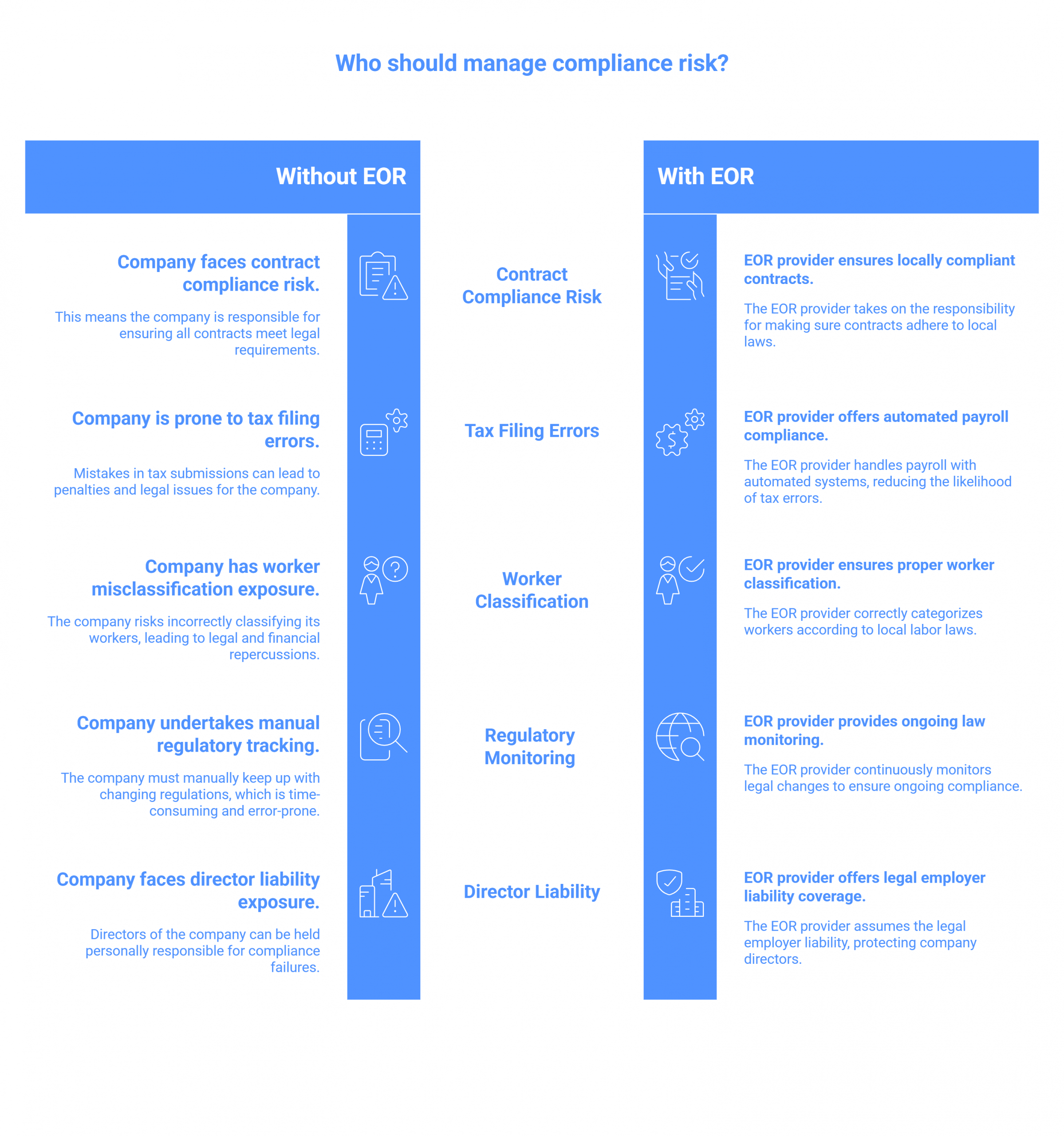
EOR Compliance Coverage Framework
| Compliance Area | Without EOR | With EOR |
|---|---|---|
| Contract Compliance | Client drafts; risk of non-compliant clauses | EOR drafts jurisdiction-specific contracts |
| Tax Registration & Filing | Client registers in each country; manual filings | EOR handles all registrations and filings |
| Misclassification Risk | High – especially with contractor-heavy models | |
| Pay Transparency | Client must build a reporting infrastructure | EOR embeds disclosures into contract and payroll systems |
| Statutory Benefits | Client must research and administer per country | EOR administers all mandatory benefits |
| Director Liability | Personal exposure for officers | EOR assumes legal employer liability |
| Regulatory Monitoring | Client must track changes across jurisdictions | EOR monitors and adjusts proactively |
A UK-based SaaS company (200 employees) had contractors in Spain and the Netherlands. Following the new presumption-of-employment rules, both contractors were reclassified as employees by local authorities. The company faced €85,000 in back benefits and penalties. After transitioning to EOR, 14 contractors across 6 EU markets were properly classified as employees within 3 weeks. Zero subsequent compliance issues. The EOR absorbed all classification liability going forward.
Compunnel has navigated global compliance across 150+ countries for over 30 years -through regulatory shifts, economic downturns, and the complete transformation of cross-border employment law. The compliance infrastructure isn’t bolted on; it’s the operational core. EOR starts with a highly competitive, scalable pricing model, offering full compliance coverage, no advance funding, and no lock-ins.
EOR global compliance 2026 isn’t about outsourcing paperwork -it’s about structurally transferring regulatory risk to a partner with the infrastructure, expertise, and legal standing to absorb it. As EU transparency rules, real-time reporting mandates, and director liability provisions continue expanding, the compliance case for EOR becomes more compelling with every legislative cycle.
Is compliance on your radar for 2026?
Book a 15-minute consultation with Compunnel’s global hiring team -no pitch, just clarity. Discover our EOR services.

List of Content
Contingent workforce planning helps organizations estimate how much external talent they may need, when they will need it, and where…

Managed payroll services move much of the day-to-day payroll administration to a third-party provider. The provider can handle payroll calculations,…