Aggregator vs. Direct EOR Model: Which One Actually Protects You?
Every EOR provider's website says the same thing: compliant hiring in 150+ countries. Simple. Fast. Risk-free. But behind that promise,…
In early 2024, a finance executive approved a $25 million wire transfer on a video call – every colleague on screen was an AI-generated deepfake. This is a documented incident, and in 2026, it is no longer an outlier. It is a preview of the threat landscape enterprises navigate every single day.
87% of global organizations have already experienced AI-driven cyberattacks in the past 12 months, up from a theoretical risk just two years ago. (Darktrace / Kiteworks, 2026)
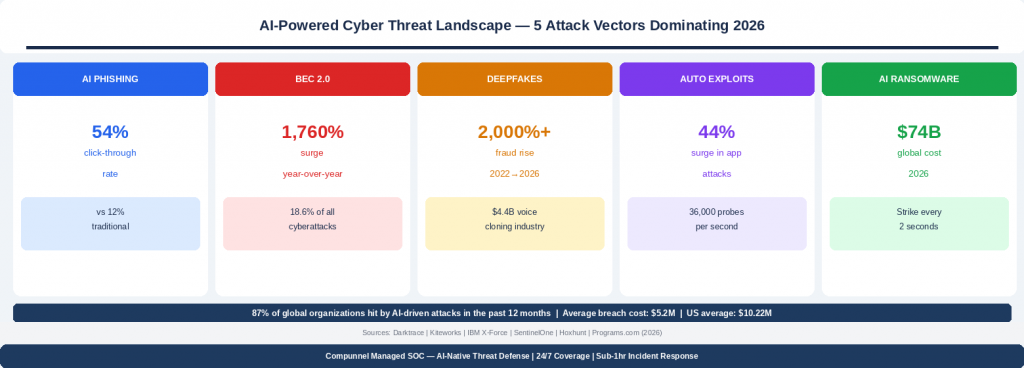
1) Hyper-Personalised AI Phishing: AI-generated emails now reference real projects, mirror each recipient’s tone, and are timed using scraped calendar data. The traditional red flags – poor grammar, suspicious addresses – have been engineered out of existence. AI-generated lures achieve click-through rates of 54%, compared to 12% for traditional phishing.
2) Business Email Compromise 2.0: Modern AI systems ingest stolen email archives, learn executive writing styles, and inject themselves into live threads. Since the rise of generative AI, Business Email Compromise (BEC) attacks have surged 1,760% year-over-year – now accounting for 18.6% of all global cyberattacks.
3) Deepfake Identity Fraud: Voice cloning requires just 3 seconds of audio. Real-time video deepfakes run on consumer hardware. 53% of finance professionals have personally experienced adeepfake attack. The $4.4 billion voice cloning industry is almost entirely weaponized.
4) Autonomous Vulnerability Exploitation: AI tools scan 36,000 IP addresses per second, match themagainst public exploits, and automatically initiate attacks. IBM X-Force reports a 44% surge in attacks on public-facing applications, driven entirely by this capability.
5) AI-Accelerated Ransomware: Ransomware-as-a-Service (RaaS) operators use AI to select the most lucrative targets, time attacks for peak disruption, and move from initial access to full deployment in under 60 minutes. Annual global ransomware costs are projected to reach $74 billion in 2026.
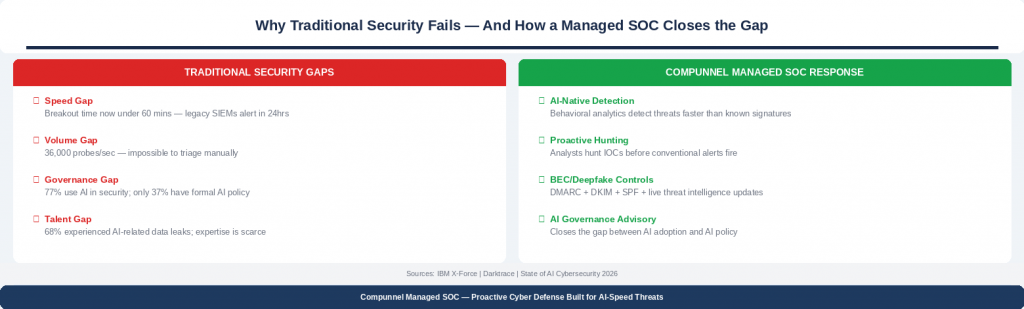
Compunnel’s SOC was designed specifically for AI-speed threats. Every capability maps directly to one of the five threat vectors above.
– 24/7 AI-native threat monitoring – behavioral analytics that detect novel attacks, not just known signatures.
– Proactive threat hunting – analysts actively search for Indicators of Compromise (IOCs) before conventional alerts fire.
– Deepfake and BEC-specific detection – Domain-based Message Authentication, Reporting and Conformance (DMARC), DomainKeys Identified Mail (DKIM), Sender Policy Framework (SPF) enforcement with continuously updated detection rules.
– AI-assisted vulnerability management – Common Vulnerabilities and Exposures (CVE) prioritization aligned to active exploit intelligence feeds.
– Sub-one-hour incident response Service Level Agreement (SLA) – predefined playbooks with board-ready communications templates.
– AI governance advisory – helps enterprises build formal AI usage policies to close the governance gap.
Organizations with AI-powered defenses detect threats 80 days faster and save an average of $1.9 million per breach compared to those relying on legacy tools. (IBM / All About AI, 2026)
Request a Compunnel Managed SOC Assessment at compunnel.com/cybersecurity

List of Content

Every EOR provider's website says the same thing: compliant hiring in 150+ countries. Simple. Fast. Risk-free. But behind that promise,…

The CISO presents the managed SOC proposal to the CFO. The price is $25,000 monthly. The CFO’s immediate response:…