10 Key Benefits of Managed Payroll Services and When They Make Sense
Managed payroll services move much of the day-to-day payroll administration to a third-party provider. The provider can handle payroll calculations,…
Select location
The traditional product development approaches are no longer sufficient in today’s fast-growing healthcare industry. The addition of artificial intelligence into healthcare solutions has moved from a competitive advantage to an essential component. But do you know who exactly builds these AI-powered healthcare products? And how can you create a team skilled in navigating both the technical complexities of AI and the stringent needs of healthcare?
he traditional healthcare software product engineering teams focus on feature development, user interface design, and system architecture. Apart from these crucial skills, they are insufficient when building AI-driven healthcare products. Consider these statistics:
The message is clear: you need a specialized team structure to succeed in this space.
An AI-focused healthcare product engineering team needs a balanced blend of technical AI expertise, healthcare domain knowledge, and product development skills. Here’s what your dream team should look like:
These specialists carry the core AI capabilities to your team. Unlike general software engineers, AI/ML engineers possess deep expertise in:
Hiring Tip: Examine the above basic ML knowledge. Healthcare AI requires engineers who understand both the technical and ethical implications of their work.
Did you know no AI solution exists in a vacuum, especially in healthcare? Domain experts try to bridge the gap between technical capabilities and real-world applications:
Hiring Tip: You can consider part-time clinical advisors or consultants if full-time domain experts are hard to find.
Healthcare UX is distinct from consumer applications. Specialized designers understand:
Hiring Tip: You can look for designers who have created products for clinical settings or who have experience making complex data comprehensible.
While overlapping somewhat with ML engineers, data scientists focus more on:
Hiring Tip: Healthcare data scientists should have experience with protected health information and clinical data structures.
Given healthcare’s regulated nature, these team members are non-negotiable:
Hiring Tip: These specialists should have specific experience with AI applications along with general healthcare compliance.
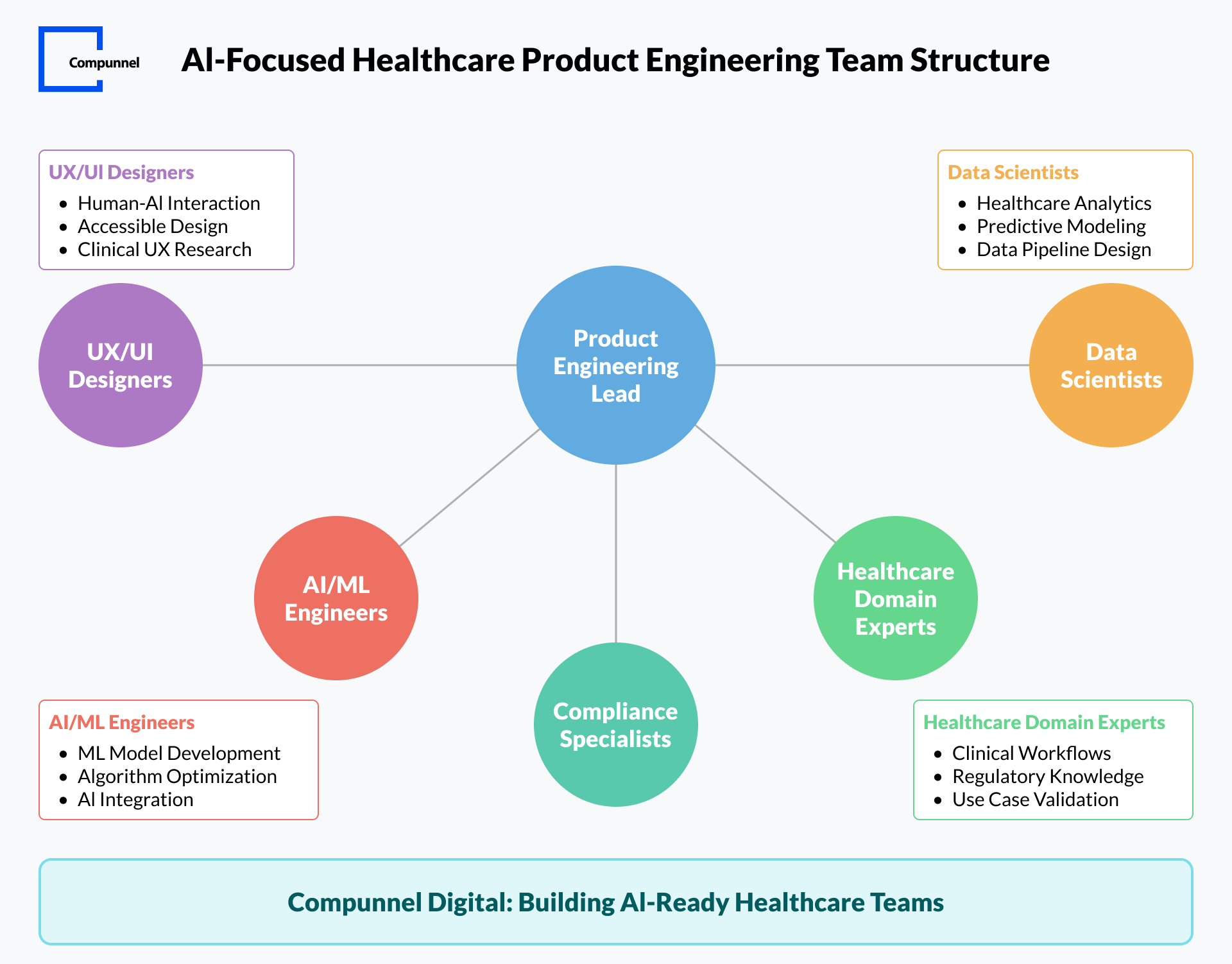
Simply assembling the right roles isn’t enough – these specialists must work together effectively. Here are some key strategies for fostering collaboration:
Incorporate representatives from all disciplines while planning sessions. It ensures that AI development is aligned with clinical needs and regulatory requirements from the beginning.
Implement regular knowledge-sharing workshops where:
Consider a dual product ownership model where technical and healthcare leads share decision-making authority. It ensures that neither technical capabilities nor clinical relevance take precedence at the expense of the other.
Make ethics and compliance review an integrated part of your development process, not a final checkpoint. Conduct these reviews at each milestone to avoid late-stage redesigns.
Apart from assembling the right people, your team needs the right structure and resources:
Provide your team with:
AI-driven healthcare products require:
Setting realistic timelines from the start prevents rushed development and compliance issues.
Healthcare AI is evolving rapidly. Budget for:
Define metrics that balance:
A leading healthcare technology company reorganized its engineering team to follow this cross-functional model when developing an AI-driven diagnostic support tool. The results were compelling:
What is the key difference? Integration of clinical expertise throughout the development process and dedicated AI specialists focused on healthcare applications.
Building an AI-focused healthcare product engineering team is not just challenging – it’s a specialized undertaking that needs deep expertise in both healthcare and advanced technology. At Compunnel, we specialize in assembling, training, and supporting cross-functional AI healthcare teams. Our expertise includes:
Whether you need to build a team from scratch or improve your current capabilities, Compunnel has the expertise to help you succeed in this challenging field. Contact Compunnel to discuss how we can help you build the right team for your healthcare AI innovation journey. Our healthcare software product engineering experts are ready to guide your organization toward successful, compliant, and impactful AI product development.
Visit our website and explore our product engineering services to accelerate your growth with Compunnel, schedule a consultation with our healthcare AI team development specialists. Let us help you build the team that will build the future of healthcare.
1. Why do traditional engineering teams struggle with healthcare AI projects?
Traditional teams lack healthcare domain knowledge, regulatory expertise, and AI-specific skills. This often leads to compliance issues, failed implementations, and products that don’t align with clinical workflows.
2. What roles are essential for an AI-focused healthcare product engineering team?
Key roles include AI/ML engineers, healthcare domain experts, UX/UI designers with healthcare experience, data scientists, and compliance & ethics specialists. Together, they balance technical innovation with patient safety and regulatory compliance.
3. How do healthcare domain experts improve AI product development?
They bridge the gap between AI capabilities and real-world clinical needs by validating use cases, ensuring regulatory alignment, and defining success metrics based on patient outcomes.
4. What skills should AI and ML engineers have for healthcare projects?
They need expertise in model development, algorithm optimization, AI integration into clinical workflows, and responsible AI practices such as bias reduction and transparency.
5. Why is compliance important in AI healthcare product engineering?
Healthcare is highly regulated. Compliance and ethics specialists ensure products meet HIPAA, FDA, and other regulations, protecting patient data and avoiding costly delays or legal risks.
6. How can collaboration improve AI healthcare team performance?
Cross-functional collaboration through shared sprint planning, dual product ownership, and regular knowledge-sharing ensures AI products meet both technical and clinical requirements, improving adoption and regulatory success.
7. How does Compunnel help companies build AI healthcare product engineering teams?
Compunnel provides talent acquisition, team structure consulting, regulatory guidance, and specialized training for healthcare AI projects. This ensures organizations build high-performing, compliant teams ready to develop impactful AI solutions.

List of Content

Managed payroll services move much of the day-to-day payroll administration to a third-party provider. The provider can handle payroll calculations,…

Most enterprises are running a contingent workforce program that was designed for a slower era. Requisitions sit in queues for…