Contingent Workforce Planning: Forecasting Flexible Headcount for the Year Ahead
Contingent workforce planning helps organizations estimate how much external talent they may need, when they will need it, and where…
Select location
Your company just landed a major contract. You need 5 new engineers. Your hiring manager posts on Indeed. First week: 40 applications—mostly outsourcing firms and visa sponsors. By week 4, you’ve interviewed 15 people. None are right.
By week 6, the project deadline is approaching. Your team is panicking.
This is the hiring tax that most companies don’t budget for.
The average time-to-hire for specialized roles is 42 days (SHRM). But that’s the average. Many companies hit 60+ days.
In that gap between “we need someone” and “we found someone,” you’re either:
This guide explains what full-time hiring services actually are, how they work, when you should use them, and what questions to ask before you hire one.
By the end, you’ll know whether your company needs professional recruitment help.
Simple Definition
Full-time hiring services are professional organizations whose entire business is helping companies find and hire permanent, full-time employees.
Not To Be Confused With:
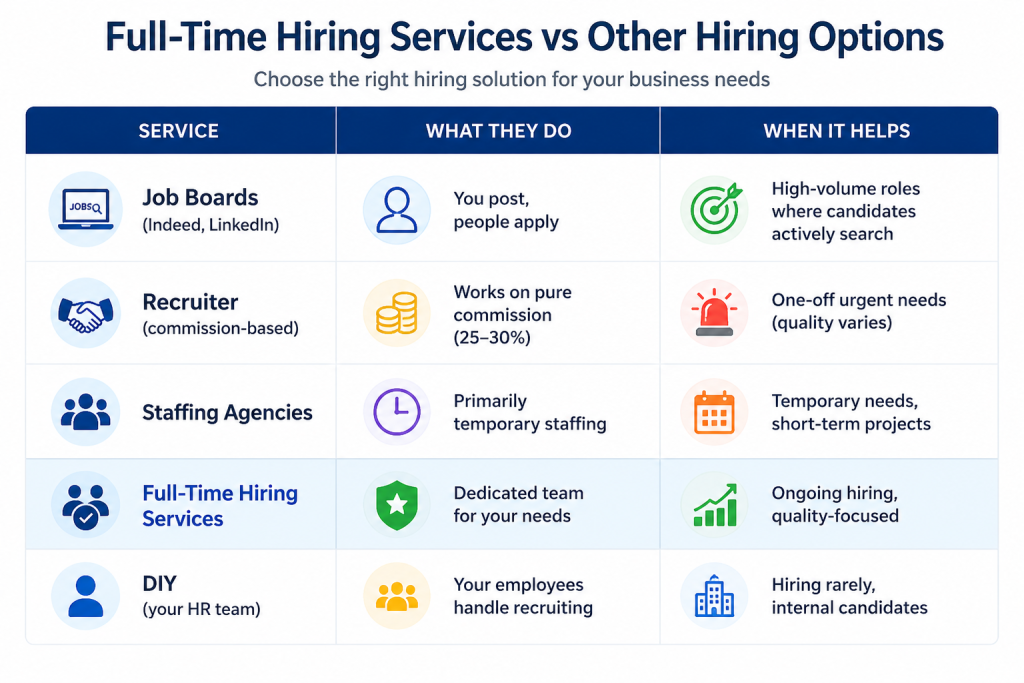
The Key Difference
Professional hiring services measure success by how long people stay, not just whether they fill the seat.
2010: Job boards worked great. Post on Craigslist, get qualified applicants.
2015: LinkedIn emerges. Quality starts declining on traditional boards.
2018: Best candidates aren’t on job boards anymore—they’re employed and not actively searching.
2020+: Talent wars. Every company is hiring. Best people have multiple offers within days.
Result: The old playbook doesn’t work anymore.
A company posting a “Senior Software Engineer” role might get:
Now you’re interviewing 5 candidates when you should be choosing from 20.
This is why hiring services exist: They have networks, industry relationships, and sourcing strategies that job boards don’t.
Most professional hiring services follow a similar framework.
Good hiring services don’t rush this part.
Questions they ask:
Real Example: A healthcare company needed “an experienced nurse manager.”
But when we dug deeper, they’d had 3 nurse managers in 3 years—all left within 18 months.
Why? The nursing director was overly critical and rarely delegated authority.
So we didn’t search for “experienced nurse managers.” We looked for nurses who thrived in mentoring-heavy environments and didn’t need a ton of autonomy.
Different candidate pool entirely.
Two years later? That hire is still there.
This one conversation prevented another 18-month failure.
Instead of “post on job boards and hope,” you get:
Passive Recruitment: Which industry communities does this type of person belong to? If you need an experienced QA engineer, where do QA engineers hang out?
Referral Programs: How do you incentivize employee referrals? Your employees know people. Use them.
Network Outreach: Which competing companies have people who might be interested? Which schools?
Specialized Sources: If you need a healthcare administrator, should we reach out to hospital associations?
Real Impact: One manufacturing client needed production supervisors. Job boards were failing.
We reached out to: – Employees’ personal networks (referral program) – Sister manufacturing plants in the region – Technical colleges with manufacturing programs – LinkedIn connections of existing supervisors
Result: For one role where they’d normally get 5 unqualified applications, we had 12 vetted candidates within 3 weeks.
Candidates get filtered here.
What you see: – Only pre-screened candidates – No sorting through 100 bad resumes – Candidates already vetted for technical fit and realistic expectations
What happens behind the scenes: – Phone screening (communication style, seriousness, salary expectations) – Skills assessments (if technical: coding test, healthcare test, etc.) – Reference checks (calling previous employers before interviews) – Cultural fit screening (will they mesh with your team?)
Real Example: A software startup was interviewing 8-10 candidates per role, still making bad hires.
We tightened screening. Now they interview 3-4 candidates per role.
Result: – Quality went UP – Bad hires went DOWN – Interview time savings = 50 hours recovered
By now, candidates are good. Now it’s about:
The hire isn’t successful on day 1. It’s successful on day 90.
Good hiring services: – Provide onboarding plans (not just “sit next to Janet”) – Check in at 30, 60, 90 days (is something not working? Fix it now) – Coach your manager (“here’s how to set boundaries,” “this person needs autonomy”) – Catch problems early (if it’s not working by day 30, better to know now)
Why this matters: Professional services report 25-40% better retention than DIY hiring.
Everyone knows vacancies cost money. But most companies underestimate it.
Real Example: You need one account executive ($100k salary)
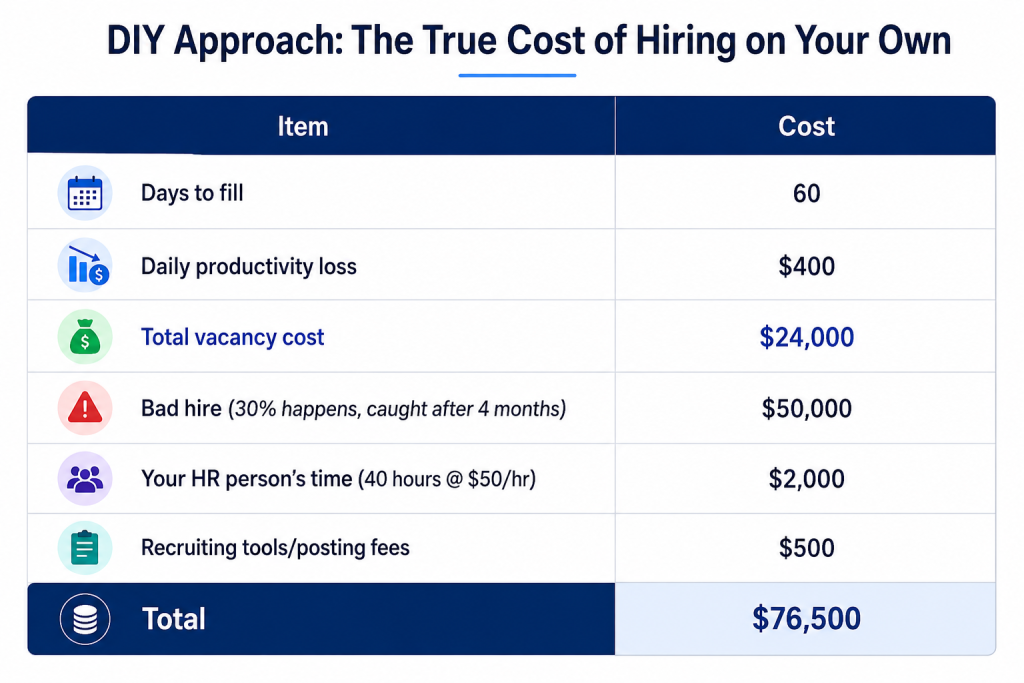
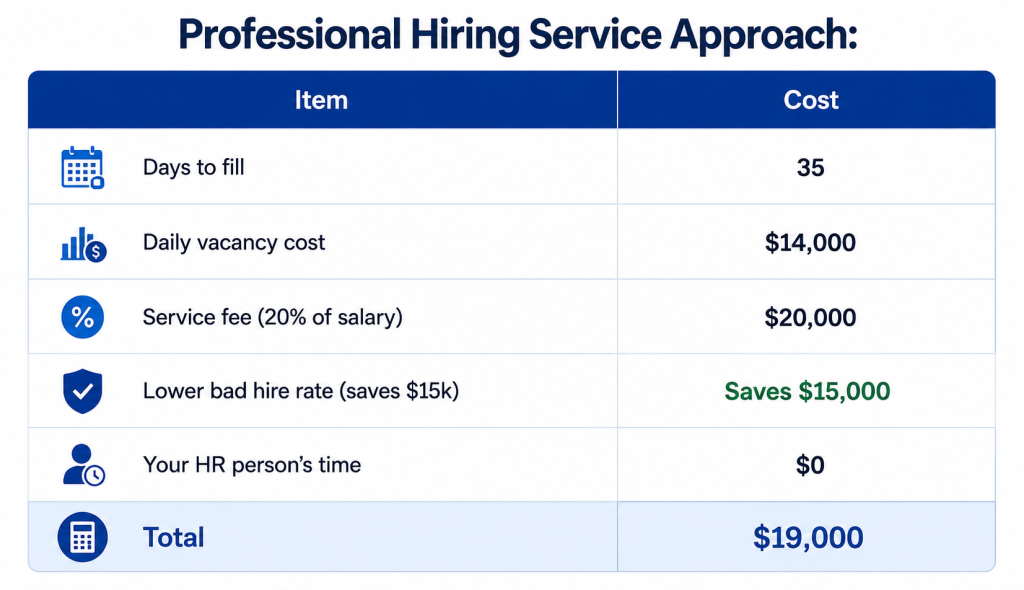
Savings: $57,500 (plus your HR person doing their actual job)
Tech is winner-takes-all. The engineer you interview on Monday has 3 other offers by Friday.
The Challenge: Finding engineers who want to work at your company, not just filling seats.
How Professional Services Help: – Deep relationships with engineering communities – Can speak the language (understand tech preferences) – Speed (72-hour offer-to-acceptance is normal, slow processes lose candidates)
Real Impact: One fintech startup needed a payments engineer (specialized, hard to find). Professional hiring found candidate within 2 weeks.
RNs need license verification. Lab techs need certifications. One wrong credential = liability.
The Challenge: How do you quickly verify state licenses without months of delays?
How Professional Services Help: – Relationships with licensing boards – Partnerships with hospital systems – Understanding shift patterns and what candidates actually want
Real Impact: Hospital needed 12 RNs for new unit. License verification usually takes 8 weeks. Professional service used existing relationships to get approvals in 3 weeks.
Manufacturing supervisor experience is incredibly specific. You can’t hire a “management” person.
The Challenge: Where do you even find people with manufacturing operations experience?
How Professional Services Help: – Relationships with equipment suppliers and industry groups – Understanding plant culture – Competing plant networks
Real Impact: Plant expanded to 2 locations. Needed 4 plant managers in 5 months. Professional service already had 2 in network. All 4 filled within timeline.
Hiring wrong compliance person = regulatory risk. Wrong investment manager = fiduciary liability.
The Challenge: How do you quickly vet backgrounds without taking 6 months?
How Professional Services Help: – Relationships with Big 4 firms – Understanding regulatory landscape – Expedited background checks
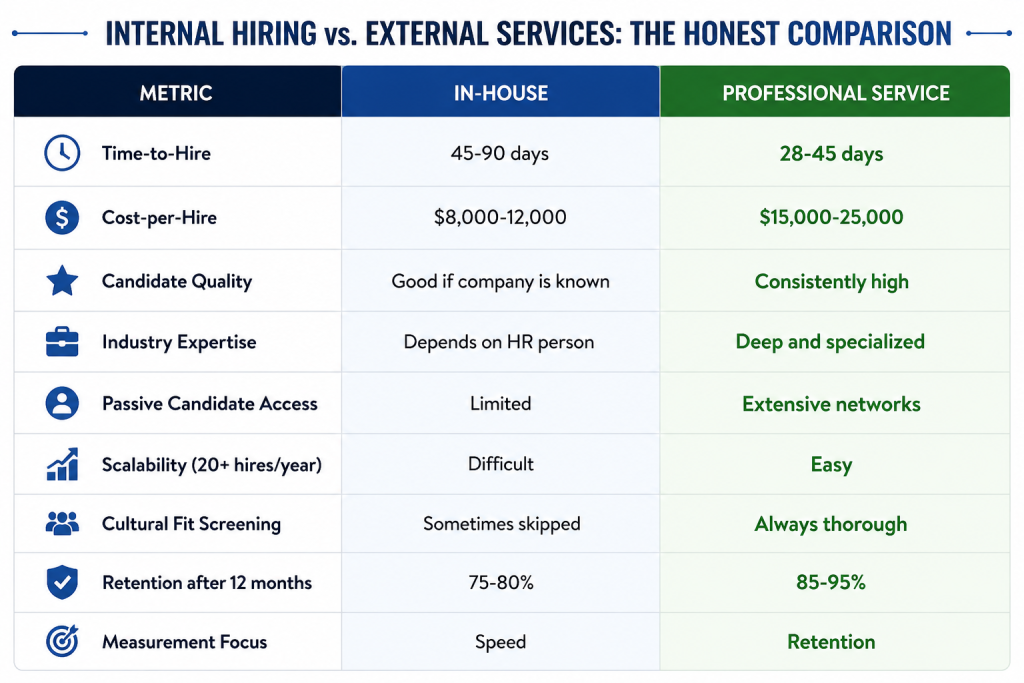 Bottom Line: If you’re serious about quality, professional services usually win. If you’re hiring one person every 18 months, DIY is fine.
Warning Signs: –
Green Flags: –
Q1: How much should a hiring service cost?
Depends on model: – Contingency: 18-25% of first-year salary (you pay only if placement succeeds) – Subscription: $2,000-5,000/month for unlimited roles – RPO: 15-20% of total recruiting budget (full outsourcing)
The cheapest option isn’t usually the best. Btter to pay slightly more for better retention.
Q2: Can they really find people who aren’t on job boards?
Yes. Good hiring services have networks, relationships, and credibility in your industry.
They’re not magical, but they’re methodical.
Q3: What if they place the wrong person?
Read the contract. Most reputable firms include a replacement guarantee.
Standard: Free or reduced fee if hire leaves within 90 days.
Q4: Shouldn’t HR own all of recruiting?
Ideally: HR owns culture, retention, development. Recruiting is a specialty.
Best outcome: Partnership where professional service handles sourcing/screening, HR handles onboarding/culture.
Q5: What if we try them for just one role?
Most services allow trial engagements.
If they won’t let you try with one role, that’s a sign of low confidence.
You should consider hiring a professional if:
If 3+ of these resonate, keep reading.
If any of this resonated, the next step is simple. Have a conversation about your specific situation. You don’t need to commit to anything. Just talk through:
Then decide if professional help makes sense.
Explore how our Full-Time Hiring Services help you build teams that stay — from sourcing and screening to offer and onboarding.
Hiring is too important to leave to chance. Whether you do it internally or with professional help, do it intentionally. The difference between a hire that stays 5 years and one that leaves after 6 months isn’t luck.
It’s process.
Talk to Our Expert → A 30-minute conversation. No commitment — just clarity on your hiring roadmap.

List of Content

Contingent workforce planning helps organizations estimate how much external talent they may need, when they will need it, and where…

Managed payroll services move much of the day-to-day payroll administration to a third-party provider. The provider can handle payroll calculations,…