Zero Trust Is Failing in Multi-Cloud. Here’s Why Architecture Is Not the Problem
The organization had already implemented Zero Trust. MFA was enabled. Access policies were in place. The security posture looked strong on paper.…
If your company works with contractors across borders, there is a good chance you are sitting on a compliance risk that has grown significantly in the last 18 months. Governments across Europe, Latin America, and Southeast Asia are no longer issuing warnings. They are issuing fines.
Worker misclassification, treating a full-time employee as an independent contractor, has always carried legal risk. What changed in 2026 is the enforcement environment. Tax authorities now run AI-powered audits that cross-reference payroll data, invoicing patterns, and work schedules. If your contractor works fixed hours, follows company processes, and has no other clients, regulators in the Netherlands, Spain, Brazil, and the UK are likely to reclassify that person as an employee retroactively. The penalties can reach tens of thousands of euros per worker.
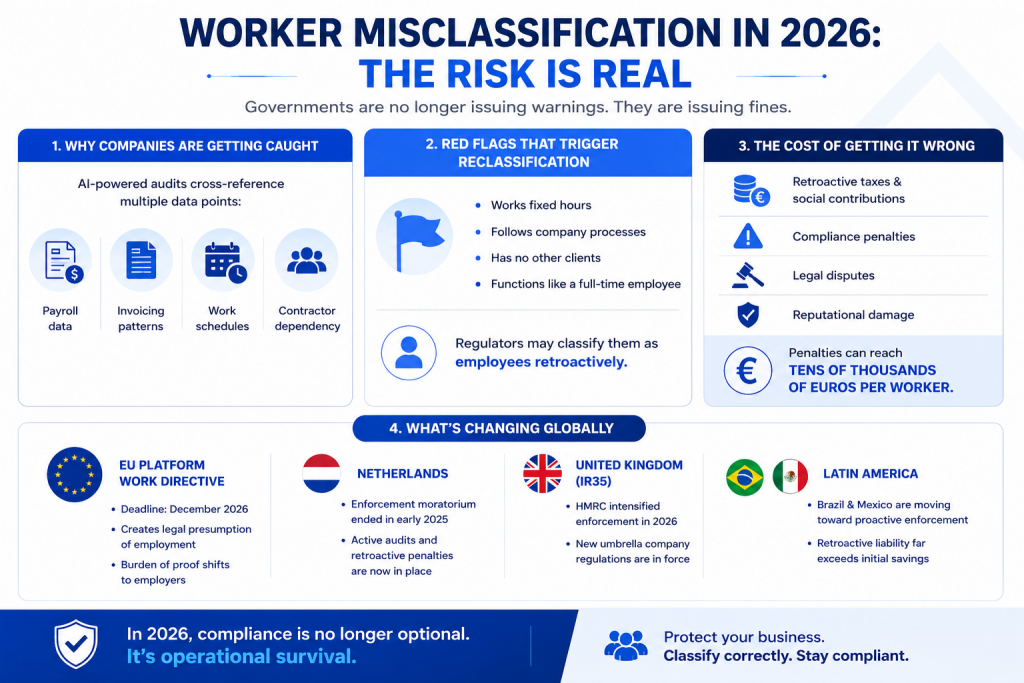
The EU Platform Work Directive has a December 2026 deadline, and most member states are still finalizing their national laws. What the directive does is create a legal presumption of employment for workers who meet certain indicators. That flips the burden of proof. Instead of regulators proving someone is an employee, your company has to prove they are genuine contractors.
In the Netherlands, the enforcement moratorium that protected companies from retroactive penalties ended in early 2025. The Dutch tax authority is now running active audits, not just issuing guidance. Companies that continued operating under the old assumption are getting hit with corrections going back multiple years.
The UK’s IR35 rules tell a similar story. HMRC intensified enforcement in early 2026, and new umbrella company regulations came into force in April. If you have long-term contractors embedded in your UK operations, IR35 now creates tax and legal exposure that a contract alone cannot fix.
In Latin America, Brazil and Mexico have both moved toward proactive enforcement rather than reactive. Many North American companies that expanded into LATAM through contractor arrangements are now facing retroactive liability that far exceeds the cost savings they originally sought.
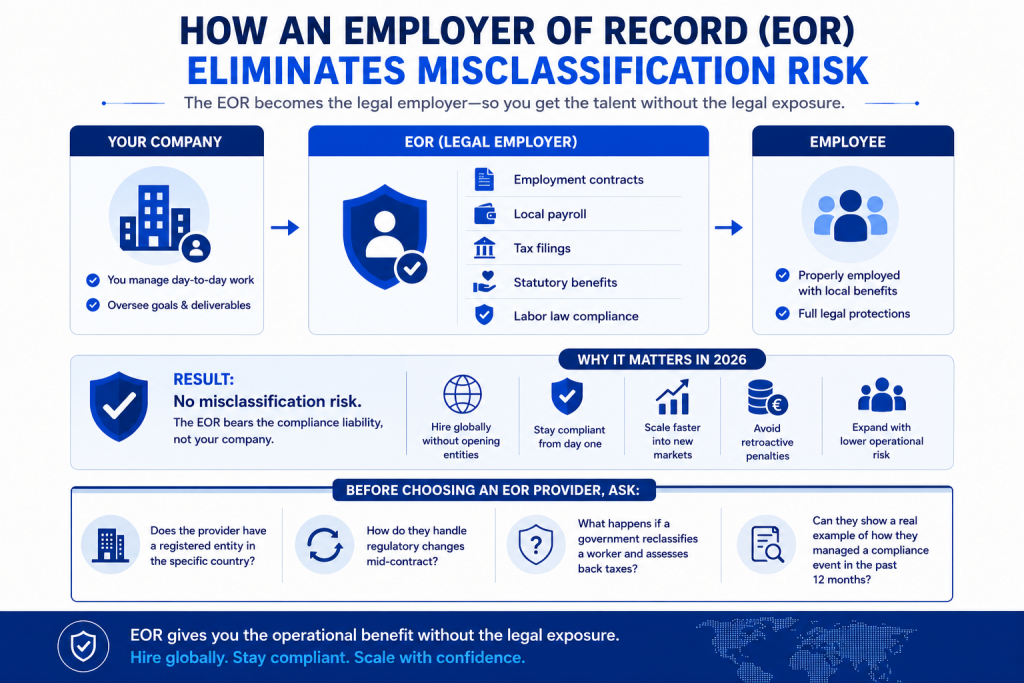
An employer of record steps in as the legal employer in each country where you have workers. The EOR handles the employment contract, local payroll, statutory benefits, and tax filings. Your team member gets a properly structured employment relationship that meets local labor law requirements. You get the operational benefit without the legal exposure.
The practical effect is straightforward: with a quality employer of record service, there is no misclassification risk because the worker is a properly classified employee from day one. The EOR bears the compliance liability, not your company.
This matters especially for companies scaling quickly in new markets. When you are testing whether a market works before committing to a local entity, an EOR gives you a clean employment structure without the overhead of incorporation.
The EOR market now has over 150 providers, and they are not all equal in compliance. The most important question is whether a provider operates through owned legal entities in your target countries or whether they use a network of third-party aggregators. Owned-entity providers track regulatory changes in real time through in-country staff. Aggregator models sometimes catch changes late, because they are dependent on partners relaying updates.
A few things worth verifying before you sign:
The Everest Group’s February 2026 analysis of EOR consolidation points out that some providers view compliance infrastructure as too strategic to leave in partners’ hands. That is the right instinct, and it is a useful filter when you are comparing vendors.
The compliance environment in 2026 rewards companies that set up employment relationships correctly from the start. An EOR is the most direct way to do that across multiple markets without building your own entity in each one.
Ready to hire globally without the compliance headache? Talk to our experts at Compunnel EOR Services and find out how we can get your next international hire done right.

List of Content

The organization had already implemented Zero Trust. MFA was enabled. Access policies were in place. The security posture looked strong on paper.…

Imagine ignoring 99% of your human identities. No access reviews. No offboarding. No ownership. No audit trail. Your security team…