Aggregator vs. Direct EOR Model: Which One Actually Protects You?
Every EOR provider's website says the same thing: compliant hiring in 150+ countries. Simple. Fast. Risk-free. But behind that promise,…
The CISO presents the managed SOC proposal to the CFO. The price is $25,000 monthly. The CFO’s immediate response: “Can’t we build this ourselves for less?”
It’s the right question to ask. The wrong way to answer it is to compare the managed service price to just hiring analysts. That misses 60% of the real cost.

Here’s what CFOs need to see: the total cost of ownership for security operations, the risk-adjusted value of faster detection and response, and the opportunity cost of internal resources managing infrastructure instead of security outcomes.
Let’s build the actual financial comparison.
The Real Cost of Building Internal SOC Capability
Organizations comparing managed SOC costs to “hiring a few analysts” consistently underestimate what 24/7 security monitoring actually requires.
Here’s the complete build cost for mid-market SOC capability:
Staffing (75% of total cost): – 4 SOC analysts (coverage requires minimum 3 shifts) = $280K-$360K – 1 SOC manager = $130K-$170K
– 1 threat intelligence analyst = $110K-$140K – 1 incident responder = $120K-$160K – Subtotal: $640K-$830K annually – Add 30% for benefits, recruiting, training = $832K-$1,079K
Technology (15% of total cost): – SIEM platform licensing = $50K-$150K annually – Threat intelligence feeds = $30K-$60K – SOAR orchestration platform = $40K-$80K – EDR/XDR platform = $40K-$100K (at scale) – Subtotal: $160K-$390K annually
Infrastructure and operations (10% of total cost): – Log storage and processing = $30K-$60K – 24/7 facility overhead = $20K-$40K – Tool maintenance and upgrades = $15K-$30K – Training and certifications = $25K-$50K – Subtotal: $90K-$180K
Total annual cost: $1,082K-$1,649K for basic capability. Mature SOC operations with threat hunting, proactive detection engineering, and comprehensive coverage run $2.5M-$3.5M annually.
Compare this to managed SOC services at $180K-$420K annually, depending on environment size and monitoring scope.
The pure cost difference is 5-8x. But that understates the value gap.
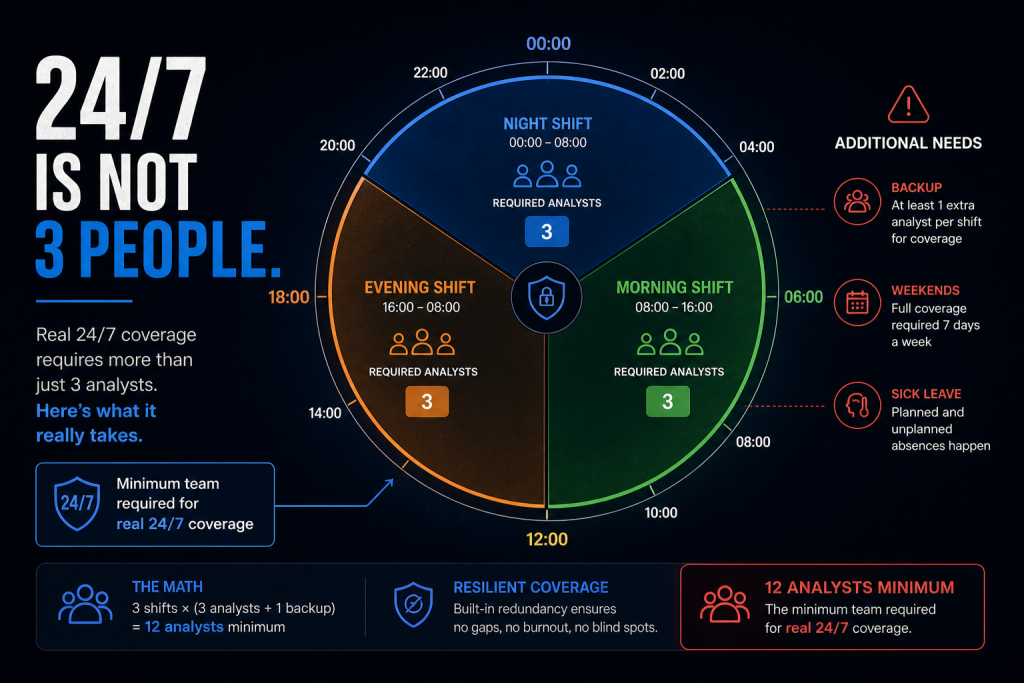
The staffing numbers above assume you can actually hire and retain qualified analysts. The cybersecurity talent shortage makes this assumption questionable.
Recruiting costs. The average time to fill cybersecurity positions is 4-6 months. During that time, you’re operating understaffed, or the existing team is burning out covering extra shifts. Recruiting fees for specialized security roles run 20-25% of annual salary.
Training and ramp time. New analysts need 3-6 months to become proficient with your specific environment, tooling, and processes. During ramp time, they’re net consumers of team bandwidth, not contributors.
Turnover and institutional knowledge loss. Average tenure for SOC analysts is 18-24 months. When they leave, they take institutional knowledge about your environment, your normal baselines, and your recurring false positives. The replacement starts from zero.
Tool expertise refresh. Security technology changes constantly. The SIEM you deployed 3 years ago has new features your team hasn’t learned. Threat intelligence feeds change. Detection rules need constant tuning. This ongoing learning overhead is invisible until incidents get missed.
Incident response gaps. Building SOC capability means building detection and monitoring. It doesn’t automatically mean incident response expertise. When sophisticated attacks occur, your team needs skills in forensics, malware analysis, threat hunting, and remediation. Either you maintain those additional specialists (add $250K-$400K annually), or you engage outside IR firms during incidents (typically $300-$500 hourly).
Add these hidden costs, and the real cost of internal SOC capability approaches $2M-$2.8M annually for mature operations.
Cost comparison alone doesn’t capture the strategic value. Managed SOC providers deliver capabilities that internal teams can’t match economically:
24/7/365 coverage with no gaps. Internal teams struggle with overnight and weekend coverage. Analysts call in sick. They take a vacation. Someone quits, and there’s a coverage gap for months. Managed SOC maintains consistent coverage regardless of individual availability.
Access to specialized expertise. When a ransomware incident occurs, you need forensics experts, malware reverse engineers, and threat intelligence analysts familiar with that specific ransomware family. Maintaining those specialists internally for infrequent incidents is economically nonsensical. Managed SOC providers maintain specialists shared across many clients.
Tool independence. You’re not locked into specific SIEM or detection platforms. If better technology emerges, switching is the provider’s problem, not yours. Internal SOC teams get locked into platforms they’ve built expertise around, even when better options exist.
Continuous detection engineering. Threats evolve constantly. Detection rules that worked last month miss this month’s attacks. Managed SOC providers maintain detection engineering teams continuously developing new rules, hunting for emerging threats, and adapting to attacker evolution. Internal teams struggle to maintain this continuous improvement while handling operational load.
Compunnel’s managed security services provide access to specialized threat hunters, detection engineers, and incident responders who have seen thousands of incidents across multiple industries. When a novel attack technique appears, our teams have likely seen it before in another environment and already built detections.
Here’s how CFOs should actually evaluate managed SOC ROI:
Cost avoidance from faster detection. Unit 42 data shows the fastest quartile of breaches reached exfiltration in 72 minutes. Managed SOC with 24/7 monitoring, detects, and responds before damage occurs. The average breach costs $4.88M according to IBM’s Cost of a Data Breach Report. Preventing one breach every 5 years through faster detection creates $976K annual value.
Cyber insurance premium reduction. Demonstrating 24/7 SOC monitoring reduces cyber insurance premiums 15-25%. On a $2M policy, that’s $300K-$500K annual savings. Managed SOC services often pay for themselves through insurance savings alone.
Compliance requirement satisfaction. PCI-DSS, HIPAA, CMMC, and other frameworks require continuous security monitoring. Managed SOC satisfies these requirements. Building internal capability to meet the same standards costs significantly more.
Opportunity cost of IT leadership time. Building and managing internal SOC capability consumes IT leadership bandwidth. That time has value. If your IT Director spends 25% of their time managing SOC operations instead of strategic initiatives, you’re spending $35K-$50K annually of leadership time on operational security management.
Business continuity impact. Faster detection and response mean shorter outages, less data loss, and reduced operational disruption. For organizations where downtime costs $10K-$100K per hour, preventing a 4-hour outage creates $40K-$400K value.
The value equation for managed SOC: Annual cost $180K-$420K. Annual value $1.3M-$2.4M through cost avoidance, faster response, insurance savings, and compliance.
ROI is 3-6x depending on organization size and risk profile.
Managed SOC isn’t always the right answer. Organizations where internal SOC makes more sense:
Very large enterprises (10,000+ employees, complex global operations) where the fixed cost of SOC infrastructure spreads across enough scale to achieve economies.
Organizations with unique security requirements in classified or highly regulated environments where external providers can’t operate.
Companies where security operations are strategic differentiators – think cybersecurity vendors or financial institutions where internal capability provides a competitive advantage.
For most mid-market organizations ($50M-$500M revenue, 500-2,000 employees), the economics favor managed services overwhelmingly.
The managed vs internal SOC decision isn’t about service cost versus salary cost. It’s about the total cost of ownership, risk-adjusted value, and strategic resource allocation.
Building internal capability costs 5-8x more than managed services when you account for staffing, tools, infrastructure, recruiting, training, and operational overhead.
Managed SOC delivers faster detection, access to specialized expertise, continuous coverage without gaps, and risk reduction that often pays for itself through insurance savings alone.
The question isn’t “can we build this cheaper?” The question is “does building this ourselves create strategic value worth $1.5M+ annually compared to managed services at $300K?”
For most organizations, the answer is no. Security operations are critical infrastructure, not a strategic differentiator. Buying world-class capability at 1/6th the cost of building it makes financial sense.
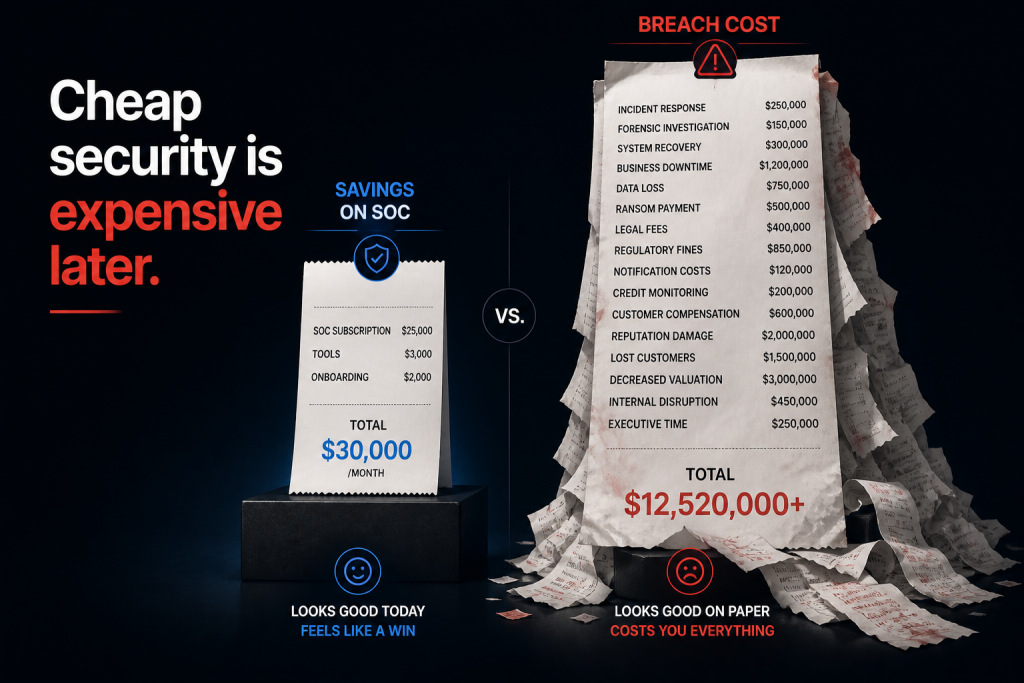
Stop comparing service costs to salary costs. Compare the total cost of ownership to the total value delivered. Compunnel’s managed SOC services provide 24/7 monitoring, expert threat hunting, and incident response at a fraction of internal build costs. We integrate with your existing security tools, provide transparent monthly reporting, and scale coverage as your environment grows. Request a detailed cost comparison showing the total cost of ownership for internal SOC vs managed services, specific to your environment size and requirements.

List of Content

Every EOR provider's website says the same thing: compliant hiring in 150+ countries. Simple. Fast. Risk-free. But behind that promise,…

The CFO asks a reasonable question: “Why should we pay $15,000 a month for a virtual CISO when we could…