VMS vs MSP: Understanding Technology vs Managed Services
As contingent workforce programs grow, managing staffing suppliers, worker onboarding, rates, compliance, time, invoices, and workforce data can become complex.…
The CFO asks a reasonable question: “Why should we pay $15,000 a month for a virtual CISO when we could hire one full-time for a similar cost?”
It’s the wrong comparison, but understanding why requires seeing past the vendor pitches to what vCISO services actually deliver.
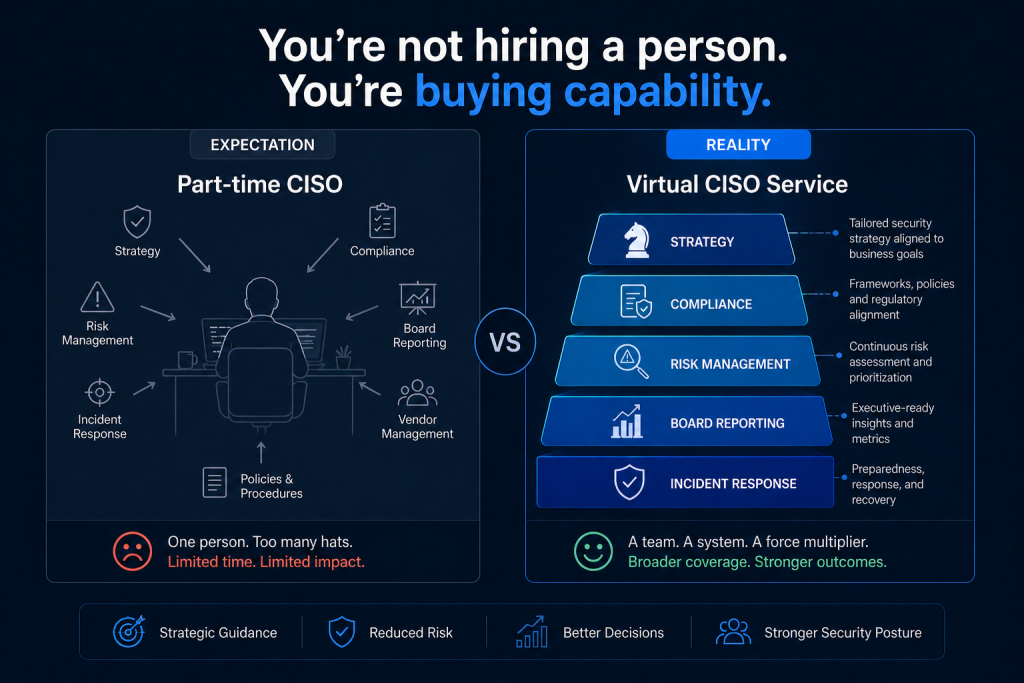
Here’s what most organizations think they’re buying: a senior security leader who works part-time for your company instead of full-time. Someone who attends your meetings, knows your systems, and makes security decisions.
Here’s what they actually need: strategic security expertise, program governance, regulatory compliance guidance, vendor management oversight, board-level communication, and incident response leadership – without the overhead of recruiting, onboarding, and retaining a full-time executive who might leave in 18 months.
The gap between expectation and reality is where vCISO engagements either deliver tremendous value or waste everyone’s time. Let’s talk about what actually works.
Virtual CISO services aren’t fractional employment. They’re strategic security leadership as a managed service. Here’s what that means in practice:
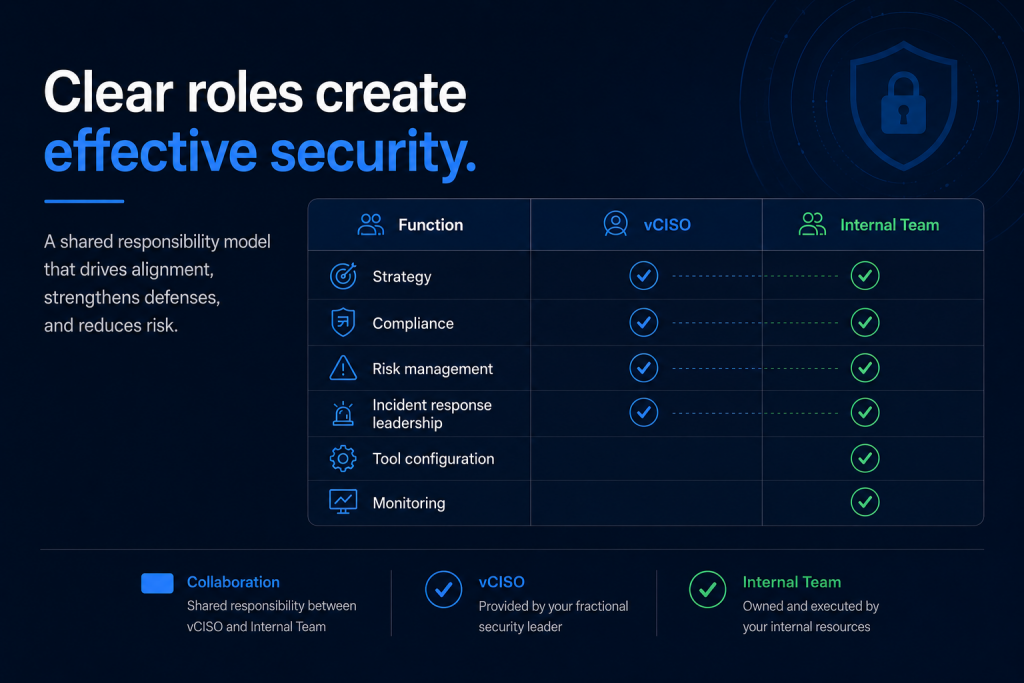
Security program governance and strategy. The vCISO assesses current security posture, identifies gaps against industry frameworks (NIST, ISO 27001, CIS Controls), creates remediation roadmaps, and provides ongoing strategic direction. This is the “what security should we implement and in what order” function that most organizations lack.
Regulatory compliance guidance. For organizations in regulated industries – healthcare (HIPAA), finance (GLBA, PCI-DSS), government contracting (CMMC) – the vCISO ensures security programs meet compliance requirements, manages audit preparation, and interfaces with auditors and assessors.
Risk management and vendor oversight. Evaluating third-party security posture, reviewing vendor contracts for security clauses, managing security questionnaires, and making risk acceptance decisions based on business context.
Security leadership for the executive team and board. Translating technical security into business risk, presenting to board of directors, explaining breach impact in financial terms, and representing security in strategic business decisions.
Incident response planning and leadership. Creating incident response plans, conducting tabletop exercises, and leading response when breaches occur. The vCISO becomes the calm, experienced voice during crisis.
Technology selection and architecture guidance. Recommending security tools based on actual needs rather than vendor marketing, designing security architecture for new initiatives, and ensuring security is built into projects from the start rather than bolted on afterward.
Notice what’s missing: hands-on configuration, day-to-day security operations, help desk support, tool administration. Virtual CISOs provide strategy and governance. They don’t replace your security team – they lead it.
The biggest disappointment in vCISO engagements comes from misaligned expectations. Here’s what virtual CISOs typically don’t provide:
Full-time availability. A vCISO serving multiple clients can’t be in your office every day or respond to every email within an hour. They provide scheduled time (typically 20-40 hours monthly) and incident availability, not constant presence.
Hands-on technical work. They won’t configure your firewall, tune your SIEM, or investigate security alerts. That’s what security analysts do. The vCISO ensures you have the right tools and people doing that work properly.
Project management execution. The vCISO defines what security projects should happen and why. Actually managing vendors, coordinating implementations, and executing rollouts typically falls to internal IT leadership or project managers.
Replacement for security staff. Organizations sometimes think: “We’ll hire a vCISO instead of building a security team.” That fails. The vCISO needs people to implement their strategy. Without internal security capabilities, strategic guidance has no execution path.
Compunnel’s cyber strategy services combine virtual CISO leadership with optional implementation support – addressing the common gap where strategy gets defined but not executed because organizations lack internal capability.
The CFO’s question about cost deserves a real answer. Here’s the actual economic comparison:
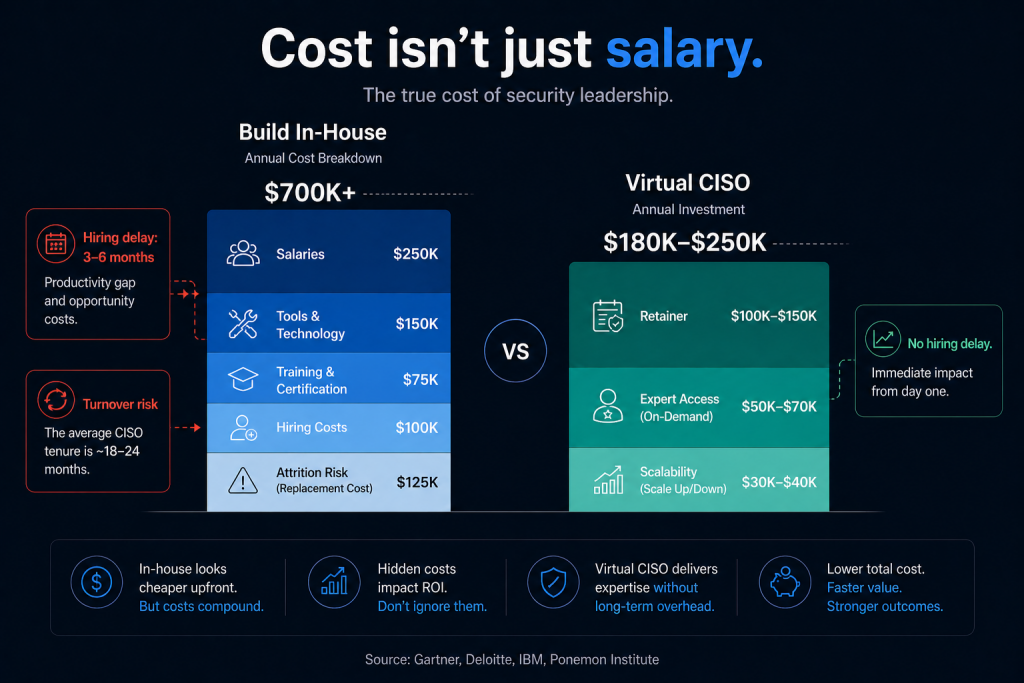
A full-time CISO in a mid-market company costs $200K-$300K in salary, plus benefits, recruiting fees, and opportunity cost if they leave. That’s $250K-$375K all-in for one person’s knowledge and experience.
Virtual CISO services typically cost $120K-$180K annually ($10K-$15K monthly). For that cost, you get: – Strategic leadership equivalent to a senior CISO – Access to an entire firm’s collective experience (they’ve solved similar problems for dozens of other clients) – No recruitment risk or turnover disruption – Immediate availability (no 3-month search then 90-day onboarding) – Scaled effort (more hours during major initiatives, less during steady-state)
But the real difference is expertise breadth. A full-time CISO knows what they know. A vCISO firm has specialists in compliance, cloud security, identity management, incident response, and threat intelligence. When your organization needs expertise in a specific domain, the vCISO engages specialists from their firm rather than learning it themselves.
For organizations that need security leadership but can’t justify or attract a full-time CISO, the economics are clear. For larger enterprises with full security teams, vCISO services often supplement internal leadership during major initiatives or provide independent oversight and assessment.
Not all vCISO services deliver equal value. Here’s what actually matters when evaluating providers:
Relevant experience in your industry. Healthcare security is different from financial services. Retail has different threats than manufacturing. The vCISO should have direct experience with organizations like yours facing similar regulatory requirements and business constraints.
Defined deliverables, not just access. “You’ll have access to our CISO” is vague. What reports get delivered? What meetings occur? What assessments get completed? Define specific deliverables tied to your actual needs.
Methodology and frameworks. Ask what security frameworks they use (NIST CSF, ISO 27001, CIS Controls). How do they assess the current state? What tools do they use for risk assessment? Providers with a defined methodology deliver consistent results. Those improvising deliver variable quality.
Team depth beyond the individual vCISO. You’re buying the firm’s expertise, not just one person. What specialists can they engage for compliance, cloud security, and incident response? Can they scale support during incident response or major projects?
Clear scope boundaries. What’s included in the base engagement versus additional services? Is incident response leadership included or extra? Are security assessments part of the monthly retainer or separate engagements?
References from similar organizations. Talk to current clients in your industry at your size. What value did they actually receive? What surprised them? What would they change about the engagement?
The providers worth considering welcome these questions. The ones who get defensive or can’t answer specifically probably won’t deliver value.
Virtual CISO services are ideal for: – Mid-market companies that need strategic security leadership but can’t justify full-time CISO cost – Growing startups preparing for compliance requirements (SOC 2, ISO 27001) as they scale – Organizations in regulated industries where compliance expertise is mandatory but changes too fast for one person to maintain currency – Companies undergoing digital transformation where security architecture guidance is critical but temporary – Leadership gaps when a CISO leaves and recruitment takes 3-6 months.
They’re not a good fit for: – Organizations with no security budget – strategy without implementation budget wastes everyone’s time – Companies wanting someone to “do security” – vCISO services provide leadership, not hands-on execution – Enterprises needing full-time presence – if the security leadership role requires 40+ hours weekly, hire full-time.
Virtual CISO services deliver strategic security leadership as a service. Not fractional employment. Not outsourced security operations. Leadership.
For organizations that need to build or mature security programs without the cost and risk of full-time executive recruitment, it’s an efficient model. For organizations expecting a part-time employee who does everything a full security team would do, it’s a guaranteed disappointment.
Understanding that distinction before engaging saves everyone from misaligned expectations and wasted investment.
The question isn’t whether virtual CISO services are “worth it” in abstract terms. The question is: does your organization need strategic security leadership, can you define what deliverables you actually need, and can you execute on the strategy that leadership provides?
If yes to all three, virtual CISO services deliver measurable value. If not to any, spend that budget elsewhere.
You don’t need another security consultant writing reports nobody reads. You need strategic security leadership to make decisions. Compunnel’s virtual CISO services provide experienced security executives who become part of your leadership team – providing board-level communication, compliance guidance, program governance, and incident response leadership. Our vCISO engagements include defined deliverables, industry-specific expertise, and access to specialized teams for compliance, cloud security, and technical architecture. Schedule a consultation to discuss your specific security leadership needs and determine if a virtual CISO is the right model for your organization.

List of Content

As contingent workforce programs grow, managing staffing suppliers, worker onboarding, rates, compliance, time, invoices, and workforce data can become complex.…

Choosing whether a worker should be classified as a W-2 employee or an independent contractor is one of the most…