EOR vs PEO vs Staffing Agency: Which Global Hiring Model Is Right for Your Business?
Introduction Global hiring has shifted from a competitive advantage to a strategic necessity. However, the decision between an EOR vs…
The concept of an Employer of Record is straightforward: a third party becomes the legal employer of your international workforce. However, how employer of record services work in practice – from the first scoping conversation to the first payroll run – is where most HR leaders encounter gaps in understanding.
That gap matters because it determines whether onboarding takes 7 days or 7 weeks, whether compliance obligations are met or missed, and whether your new hire’s first experience feels seamless or chaotic. In fact, 74% of companies hiring internationally have reported at least one compliance incident, often originating from a poorly understood onboarding process or unclear evaluation of available EOR solutions.
This guide walks through the complete EOR process in five clear, sequential steps – covering contracts, registration, payroll, benefits, and ongoing compliance – so you can evaluate, plan, and execute global hiring with confidence using the right Employer of Record services.
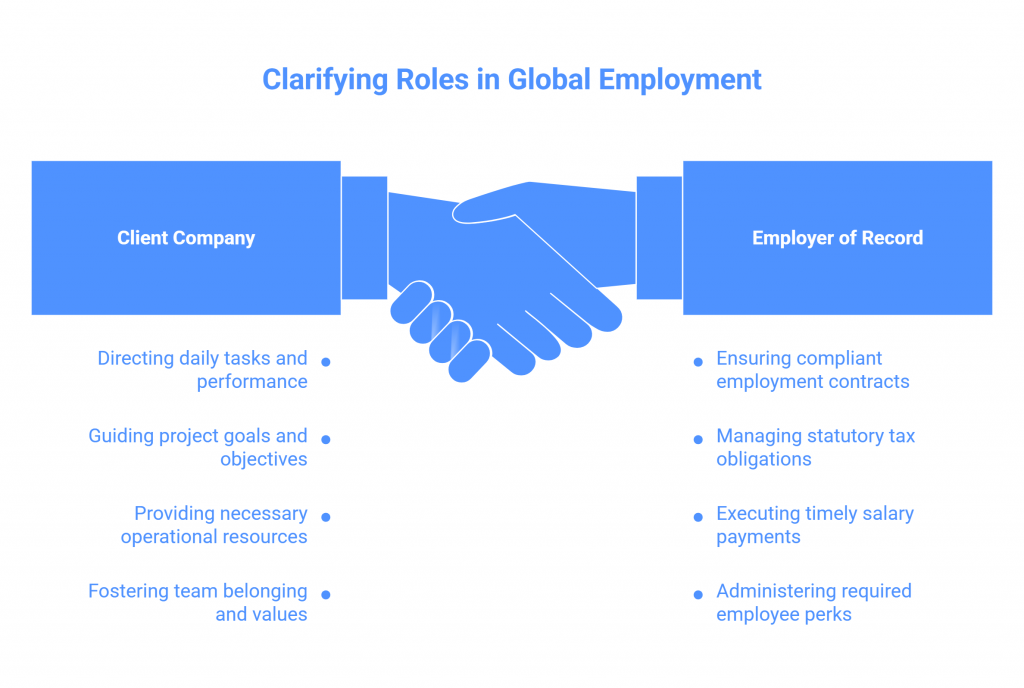
An Employer of Record (EOR) is a third-party organization that legally employs workers on behalf of a client company in a country where the client does not have a registered entity. The EOR assumes all statutory employer obligations: drafting compliant contracts, registering with tax and social security authorities, processing payroll, administering benefits, and managing terminations.
Critically, the EOR absorbs the legal liability associated with employment compliance in that jurisdiction. If a labor law violation occurs, the EOR – not the client – bears the regulatory and financial consequences. As a result, the client retains full operational control over the employee’s work, projects, and performance, while the EOR handles every legal and administrative dimension of employment.
This separation of operational management and legal employment is what makes the EOR model uniquely suited for international expansion without entity setup.
The regulatory environment for global employment has grown more complex – and more consequential – than at any point in the past decade. Several converging trends make it essential for HR teams to understand not just what an EOR does, but exactly how the process unfolds:
In this environment, understanding how employer of record services work isn’t academic – it’s operational risk management.
The EOR engagement follows a structured, repeatable workflow. While specifics vary by country and provider, the core process consists of five phases that move from scoping through ongoing lifecycle management. The following framework maps each step, clarifying exactly who does what and when.
5-Step EOR Process Framework – Client vs. EOR Responsibilities
| Step | Phase | What the Client Does | What the EOR Does |
|---|---|---|---|
| Step 1 | Country Selection & Scope Definition | Client identifies target country, role requirements, compensation range, and timeline. | EOR confirms coverage, local employment law requirements, mandatory benefits, and the estimated onboarding timeline. |
| Step 2 | Compliant Employment Contract Drafting | Client provides role details, reporting structure, IP terms, and compensation expectations. | EOR drafts a locally compliant employment contract covering statutory clauses, notice periods, probation rules, termination protections, and non-compete enforceability. |
| Step 3 | Employee Onboarding & Registration | Client introduces the employee to the team, tools, and workflows. Manages day-to-day direction. | EOR registers the employee with local tax authorities, social security systems, pension schemes, and statutory insurance. Handles work permits and visa processing if applicable. |
| Step 4 | Payroll Processing & Benefits Administration | Client approves payroll inputs (hours, bonuses, deductions) each cycle. | EOR calculates gross-to-net pay, withholds income tax, processes employer contributions, administers benefits (health, pension, leave), and files statutory reports. |
| Step 5 | Ongoing Compliance & Lifecycle Management | Client manages performance, projects, and team integration. | EOR monitors regulatory changes, adjusts contracts for new legislation, manages salary revisions, handles disputes, and executes compliant offboarding when needed. |
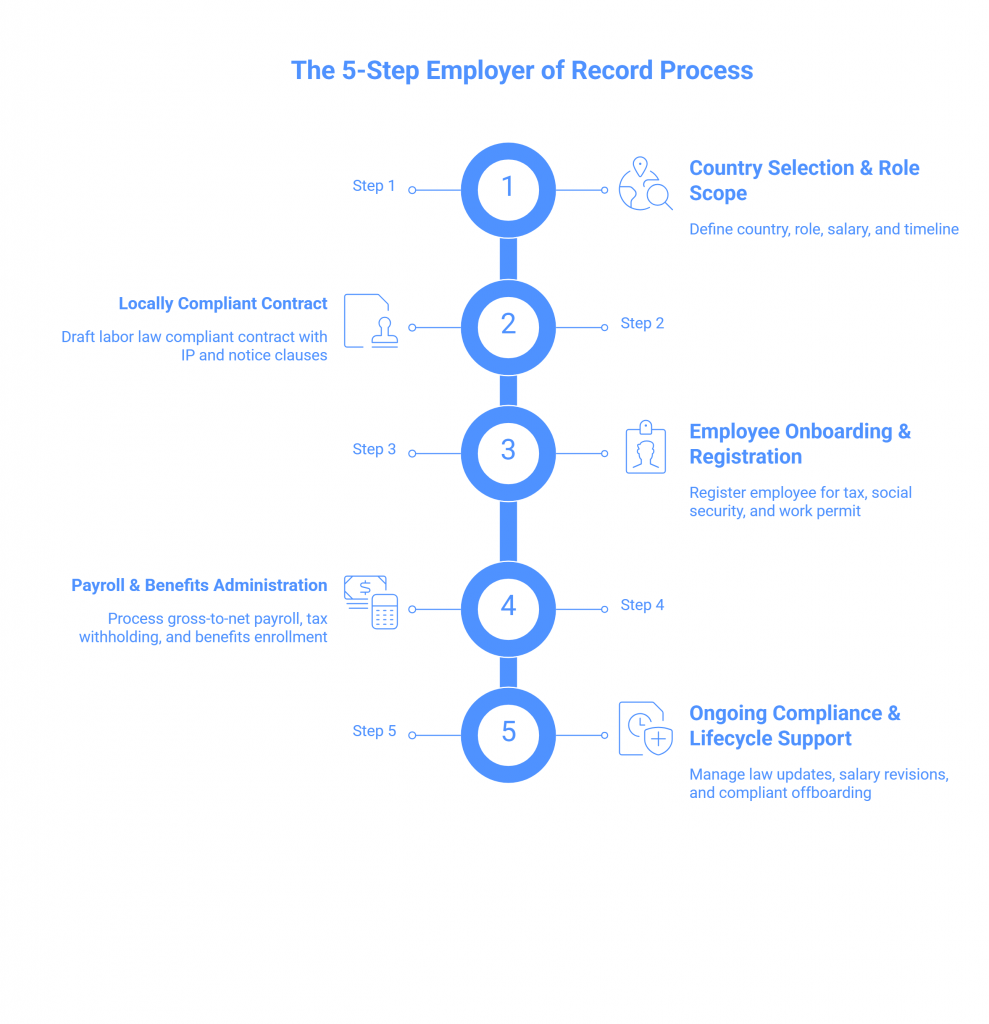
The process begins when a company identifies a target market and role. The client provides the EOR with the country, job description, seniority level, expected compensation range, and desired start date. The EOR then confirms coverage in that country and provides a detailed briefing on local employment requirements.
This includes mandatory benefits (health insurance, pension contributions, paid leave minimums), statutory notice periods, probation rules, and any industry-specific regulations. For instance, hiring a software engineer in Germany triggers different mandatory insurance requirements than hiring the same role in India or Brazil. The EOR maps these requirements before any contract is drafted.
Timeline: Typically 1–2 business days for scoping and confirmation.
Once the scope is confirmed, the EOR drafts a locally compliant employment contract. This is not a template adapted from another country – it is a jurisdiction-specific document that reflects current labor law, statutory clauses, and enforceability standards.
The contract covers compensation structure, benefits entitlements, working hours, overtime provisions, intellectual property assignments, confidentiality clauses, non-compete enforceability (which varies dramatically by country), termination protections, and notice period requirements. In addition, the EOR ensures the contract language meets local language mandates where applicable – several jurisdictions require contracts in the local language to be legally binding.
Timeline: 2–5 business days for contract drafting and client review.
With the signed contract in hand, the EOR initiates formal onboarding. This involves registering the employee with local tax authorities, social security systems, pension funds, and any mandatory insurance providers. If the hire requires a work permit or visa, the EOR manages the end-to-end application process, including sponsor transfers, dependent visa processing, and renewal tracking.
Simultaneously, the client handles operational onboarding: introducing the employee to the team, setting up tools and access, and integrating them into project workflows. The split is clean – the EOR owns the legal and administrative onboarding; the client owns the functional and cultural integration.
Timeline: 3–7 business days for registration (longer if a visa/work permit is involved).
Once the employee is registered and active, the EOR begins recurring payroll processing. Each pay cycle, the EOR calculates gross-to-net compensation, withholds applicable income taxes, processes employer-side contributions (social security, pension, health insurance), and disburses net salary to the employee in local currency.
Beyond payroll, the EOR administers statutory benefits: health insurance enrollment, pension contributions, paid leave tracking, parental leave compliance, and any country-specific entitlements. The client approves payroll inputs – hours, bonuses, expense reimbursements, deductions – and the EOR executes compliant processing and statutory filings.
Frequency: Monthly in most jurisdictions; bi-weekly or weekly where local norms dictate.
The EOR relationship doesn’t end at the first payroll run. Ongoing compliance management is arguably the most valuable – and most overlooked – phase of the EOR process. The EOR continuously monitors regulatory changes in every active jurisdiction: minimum wage adjustments, new filing requirements, updated leave policies, tax code revisions, and employment law amendments.
More importantly, the EOR manages the full employment lifecycle: annual salary revisions with statutory compliance, contract amendments for role changes, dispute resolution and mediation, and – when necessary – compliant termination and offboarding, including severance calculations, final settlements, and authority deregistration.
Duration: Continuous for the entire employment period, with quarterly compliance reviews recommended.
To provide complete clarity on the scope of EOR coverage, the following table maps each employment function to the EOR’s specific responsibility, what’s included, and the corresponding process stage.
EOR Function Coverage Matrix
| Function | EOR Responsibility | What’s Included | Stage |
|---|---|---|---|
| Employment Contracts | ✅ Fully drafted by EOR | Local labor law clauses, notice periods, IP assignments, and non-competes | Step 2 |
| Tax Registration | ✅ EOR registers employer + employee | Income tax, social security, and municipal taxes, where applicable | Step 3 |
| Work Permits & Visas | ✅ EOR manages end-to-end | Application, renewal, sponsor transfer, and dependent visas | Step 3 |
| Payroll Calculation | ✅ EOR processes each cycle | Gross-to-net, tax withholding, employer contributions, currency conversion | Step 4 |
| Statutory Benefits | ✅ EOR administers | Health insurance, pension, paid leave, parental leave, and severance accrual | Step 4 |
| Regulatory Monitoring | ✅ EOR tracks ongoing | Legislative changes, minimum wage updates, and new filing requirements | Step 5 |
| Termination & Offboarding | ✅ EOR executes compliantly | Notice periods, severance calculations, final settlements, deregistration | Step 5 |
| Employee Disputes | ✅ EOR manages locally | Mediation, legal counsel coordination, and tribunal representation if needed | Step 5 |
Scenario: A UK-based HealthTech startup (Series B, 110 employees, $22M ARR) won a clinical trial partnership requiring data analysts in India, regulatory specialists in Germany, a compliance officer in the Netherlands, and biostatisticians in Brazil. They needed all 8 hires onboarded within 30 days.
Challenge: The company had no legal entities in any of the four countries. Entity setup in Germany alone would have delayed hiring by 8–10 weeks. The clinical trial timeline was fixed – a 30-day delay would have cost the partnership.
EOR Solution: The company engaged an EOR to hire all 8 employees across four jurisdictions. Compliant contracts were drafted within 4 days. Registration with local tax and social security authorities was completed within 7 days. One hire in Germany required a Blue Card work permit, which the EOR managed end-to-end.
Results: All 8 hires were onboarded within 18 days. The clinical trial launched on schedule. The company saved an estimated $120K in entity setup costs and avoided an estimated 14 weeks of entity establishment delays across four markets. Zero compliance incidents reported over the first 9 months.
Compunnel has been managing global workforce operations for over 30 years – with operational infrastructure across 150+ countries and a process architecture refined through thousands of international hires.
The five-step process outlined above maps directly to Compunnel’s EOR execution model. Contracts are drafted by in-country legal teams, not adapted from templates. Payroll is processed through integrated systems with real-time statutory reporting capabilities. Immigration support covers end-to-end visa and work permit management, including dependent processing.
Compunnel’s EOR offers a cost-effective pricing model with no advance payroll funding requirement, no security deposits, and flexible monthly contracts. The scope extends beyond standard EOR to include immigration, benefits customization, and compliant offboarding – all managed under one operational umbrella.
If you’re evaluating how employer of record services work in the context of your next international hire, a 15-minute conversation can map the process to your specific country, role, and timeline.
EOR Readiness Checklist: Are You Prepared to Hire Globally?
Before engaging an EOR, use this checklist to ensure your organization is operationally ready for a smooth onboarding process.
EOR Readiness Checklist – Pre-Engagement Preparation Guide
| Readiness Item | Stage | Owner |
|---|---|---|
| ▢ Identified target country for first international hire | Pre-Step 1 | HR / Expansion Lead |
| ▢ Defined role, seniority level, and compensation band | Step 1 | Hiring Manager |
| ▢ Confirmed budget for EOR monthly fee + employee compensation | Step 1 | Finance / HR |
| ▢ Gathered employee personal details for contract drafting | Step 2 | HR Operations |
| ▢ Reviewed and approved locally compliant employment contract | Step 2 | Legal / HR |
| ▢ Confirmed work permit or visa requirements (if applicable) | Step 3 | HR / EOR Partner |
| ▢ Set up payroll inputs and approval workflows | Step 4 | Finance / HR Ops |
| ▢ Briefed internal team on EOR employee integration | Step 4 | People Manager |
| ▢ Established quarterly compliance review cadence with EOR | Step 5 | HR Director |
| ▢ Documented offboarding protocols and notice period triggers | Step 5 | Legal / HR |
AI-Powered Contract Generation: Leading EOR providers are deploying AI to generate jurisdiction-specific contracts in hours rather than days, with automated clause validation against current labor codes.
Predictive Compliance Monitoring: Machine learning models are being trained on regulatory change patterns to alert EOR operations teams before new legislation takes effect, enabling proactive contract and payroll adjustments.
Integrated Employee Experience Platforms: The EOR onboarding process is increasingly embedded within the client’s existing HRIS and collaboration tools, creating a seamless experience where the employee doesn’t perceive the EOR as a separate layer.
Real-Time Payroll Dashboards: Transparency in payroll processing is becoming table stakes – clients expect real-time visibility into gross-to-net calculations, tax filings, and employer contribution breakdowns across every jurisdiction.
Understanding how employer of record services work is the foundation for confident global hiring. The five-step process – from country scoping through ongoing lifecycle management – transforms international employment from a compliance minefield into a structured, repeatable operation.
The EOR model works because it cleanly separates what you do best (managing your team, directing their work, integrating them into your culture) from what requires local legal expertise (contracts, registration, payroll, compliance, and offboarding). That separation is what enables speed without sacrificing compliance, and scale without compounding risk.
For HR leaders evaluating their global hiring architecture, the question is not whether EOR works – it’s whether your current approach delivers the same speed, compliance coverage, and cost predictability.
Ready to see how the EOR process maps to your next international hire?
Book a 15-minute walkthrough with Compunnel’s global hiring team – no pitch, just a step-by-step process review tailored to your target country and role.
https://www.compunnel.com/talent/employer-of-record-services/

List of Content

Introduction Global hiring has shifted from a competitive advantage to a strategic necessity. However, the decision between an EOR vs…

In early 2025, a major US healthcare system experienced a ransomware attack that disrupted patient care for 37 days. The organization had Multi-Factor…