How Employer of Record Services Work: From Contract to Payroll in 5 Steps
Introduction The concept of an Employer of Record is straightforward: a third party becomes the legal employer of your international…
Global hiring has shifted from a competitive advantage to a strategic necessity. However, the decision between an EOR vs PEO vs staffing agency model remains one of the most consequential – and most misunderstood – choices HR leaders face. Each model carries distinct implications for compliance, cost structure, speed-to-hire, and long-term workforce flexibility, particularly when evaluating global employer-of-record services as part of an international expansion strategy.
In 2026, with 73% of HR leaders projecting that more than half their new hires will be international, selecting the wrong model doesn’t just slow growth – it introduces regulatory exposure, payroll complexity, and hidden costs that compound over time. As a result, understanding the structural differences between these three models is essential before committing budget or headcount.
This guide breaks down how each model works, where it fits, and which scenarios demand which approach – backed by data, comparison frameworks, and a real-world case study.
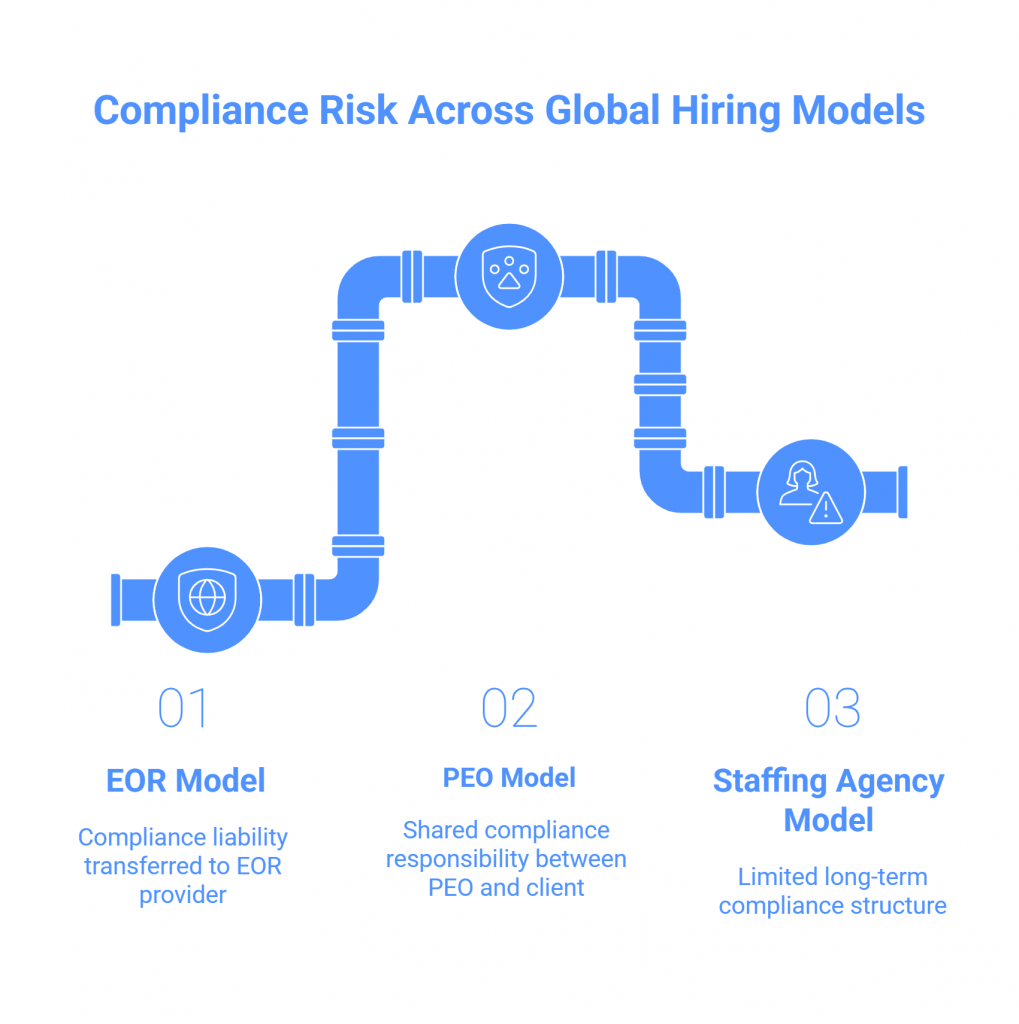
An Employer of Record is a third-party organization that becomes the legal employer of your workforce in a foreign country. The EOR handles all employment-related compliance: contracts, payroll, tax withholding, statutory benefits, and termination protocols. More importantly, the EOR assumes full legal liability for employment compliance in that jurisdiction.
For instance, if a US-based SaaS company wants to hire three engineers in Germany without establishing a GmbH, the EOR employs those engineers on the company’s behalf. Day-to-day management, project direction, and performance remain with the client. The EOR handles everything else – from social security contributions to severance calculations.
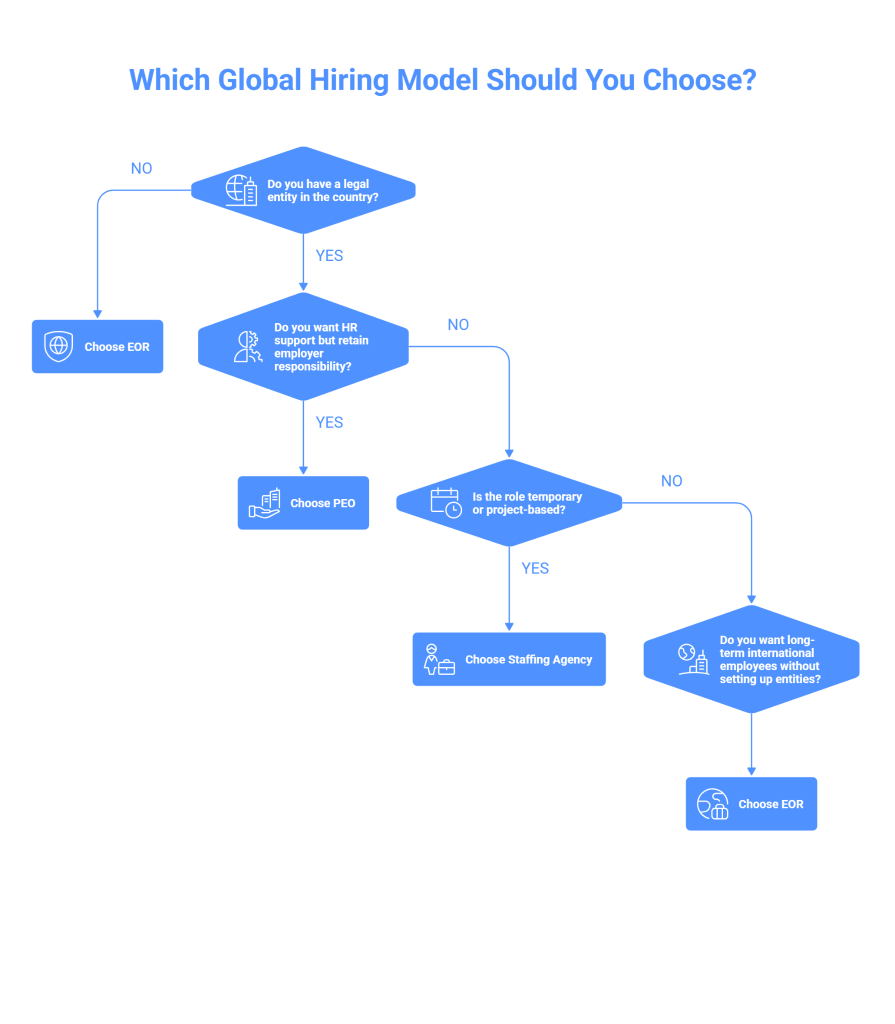
A PEO operates on a co-employment model. The PEO becomes a co-employer alongside your company, sharing employer responsibilities such as payroll processing, benefits administration, and HR compliance support. However, here’s the critical distinction: a PEO requires you to already have a legal entity in the country where you’re hiring.
In addition, the compliance liability in a PEO arrangement is shared, not transferred. If a labor law violation occurs, both the PEO and the client bear responsibility. This model works well for US-based companies with domestic headcount seeking HR operational support, but it’s fundamentally limited for cross-border expansion.
Staffing Agency
A staffing agency sources, recruits, and employs temporary or contract workers on your behalf. The agency is the legal employer for the duration of the assignment. Staffing is purpose-built for project-based, seasonal, or short-term workforce needs rather than full-time, permanent international hires.
Consequently, while staffing agencies offer speed and flexibility for tactical roles, they’re not designed to support long-term global workforce strategies, immigration processing, or compliance-heavy international employment.
To clarify the structural differences, the following comparison covers ten critical evaluation criteria across all three models.
EOR vs PEO vs Staffing Agency – Comprehensive Comparison Table
| Criteria | EOR | PEO | Staffing Agency |
|---|---|---|---|
| Legal Employer | EOR provider (full liability) | Co-employment (shared liability) | Staffing agency (temporary) |
| Entity Required? | No – hire without entity | Yes – local entity required | No – but limited to temp roles |
| Compliance Ownership | EOR handles 100% | Shared with client | Agency handles for temp staff |
| Best For | Global expansion, speed-to-market | US domestic co-employment | Short-term / project staffing |
| Speed to Hire | 5–14 days | 2–4 weeks (entity needed) | 1–2 weeks |
| Cost Model | $199–$600/employee/month | % of payroll (typically 10–15%) | Markup on hourly rate (25–75%) |
| IP Protection | Strong – direct employment | Moderate – co-employment | Weak – agency-employed |
| Scalability | High – 150+ countries | Limited to entity locations | High for temp workforce |
| Employee Benefits | Full statutory + custom | Shared plan with client | Basic / varies by agency |
| Contract Flexibility | Monthly / no lock-in | Annual agreements typical | Per-project or per-placement |
*Estimates may vary by country, provider, workforce size, and specific business requirements.
The regulatory landscape for international employment has intensified significantly. As a result, the consequences of choosing the wrong hiring model have grown proportionally.
In this environment, selecting a hiring model based solely on cost or convenience introduces material risk. The compliance architecture of your chosen model determines your exposure profile.
– Hire in 150+ countries without entity setup – operational in 5–14 days.
– 100% compliance liability transferred to the EOR provider.
– Full-service coverage: payroll, benefits, immigration, work permits, and offboarding.
– Flexible monthly contracts – scale up or wind down without long-term commitments.
– Strong HR operational support for US-based companies with existing entities.
– Access to group health insurance and retirement plans at better rates.
– Shared HR administration reduces internal operational burden.
– Fast access to pre-vetted temporary or contract talent.
– Ideal for project-based engagements with defined timelines.
– No long-term employment obligations or benefits commitments.
EOR: Per-employee monthly fees can add up on a scale. Some providers also require advance payroll funding or annual lock-ins. Choosing a financially stable, transparent provider is critical.
PEO: The entity requirement is the primary blocker for international expansion. In addition, shared compliance liability means the client retains significant legal exposure. PEOs are rarely viable outside the US market.
Staffing: Not suitable for permanent, full-time international hires. Limited IP protection, no immigration support, and temporary workers may lack the cultural integration needed for long-term roles.
Use this decision framework to match your specific business situation to the right global hiring model. Each scenario maps to the model that delivers the strongest fit.
EOR vs PEO vs Staffing – Scenario-Based Decision Matrix
| Your Scenario | EOR ✓? | PEO ✓? | Staffing ✓? |
|---|---|---|---|
| Expanding to a new country, no entity | ✅ Best fit | ❌ Needs entity | ❌ Limited scope |
| Need full-time hires in 30+ countries | ✅ Ideal | ❌ Not designed for this | ❌ Temp only |
| US-based, 50+ employees, need HR support | ✅ Works | ✅ Best fit | ⚠️ Overkill |
| Short-term project, 6-month contract | ✅ Flexible | ❌ Over-commitment | ✅ Best fit |
| Testing demand in LATAM before the entity | ✅ Perfect | ❌ Entity-first model | ⚠️ Partial |
| Need immigration/visa sponsorship | ✅ Full support | ❌ Rarely offered | ❌ Not available |
| Want to convert contractors to employees | ✅ Seamless | ❌ Complex | ❌ Not applicable |
Understanding the operational workflow of each model reveals why speed, compliance, and scalability vary so significantly.
EOR vs PEO vs Staffing – Step-by-Step Process Flow
| Step | EOR Process | PEO Process | Staffing Process |
|---|---|---|---|
| 1 | Select country → EOR drafts compliant contract | Establish a local entity first | Define temp role requirements |
| 2 | Onboard employee in 5–14 days | Negotiate co-employment terms | Agency sources candidates |
| 3 | EOR runs payroll, tax, and benefits | Shared payroll processing | The agency handles payroll for temps |
| 4 | EOR manages compliance & exits | Client retains compliance risk | The agency manages temp contracts |
| 5 | Scale up/down monthly | Locked into an entity-based model | Extend or end per project |
Scenario: A US-based cybersecurity SaaS company (Series C, $85M revenue, 320 employees) needed to hire 15 engineers across Germany, India, and Brazil within 60 days to meet a product launch deadline.
Challenge: Entity setup in Germany alone would have taken 8–12 weeks and required $40K–$60K in legal and registration costs. The PEO model was eliminated because the company had no existing entities in any of the three countries. A staffing agency couldn’t support full-time, IP-sensitive engineering roles.
Solution: The company engaged an EOR provider to hire all 15 engineers as full-time employees across three countries. Compliant contracts were drafted in 5 days. Payroll, statutory benefits, and local tax obligations were handled end-to-end by the EOR.
Results: All 15 hires onboarded within 14 days. The company saved an estimated $150K+ in entity setup costs across three markets. Zero compliance incidents over 12 months. The product launched on schedule, and the international team contributed 34% of the next release’s feature output.
Compunnel has operated in the global staffing and workforce solutions space for over 30 years – not as a VC-funded startup testing the market, but as an operationally scaled, financially stable organization that has processed payroll and managed compliance through three economic recessions.
When evaluating EOR vs PEO vs staffing models, the question isn’t just which structure fits today – it’s which partner can support the structure you need across 150+ countries with consistent execution.
Compunnel’s EOR offers a cost-effective pricing model with no advance payroll funding requirement, no security deposits, and flexible monthly contracts. The scope extends beyond basic EOR to include immigration processing, visa and permit management, benefits administration, and compliant offboarding.
For teams comparing models or reviewing their current global hiring architecture, a 15-minute conversation can clarify which approach aligns with your specific expansion roadmap.
Several macro trends are accelerating the convergence and evolution of global hiring models:
AI-Driven Compliance Automation: EOR providers are integrating real-time regulatory monitoring, automated contract generation, and predictive compliance alerts – reducing manual oversight and error rates.
Hybrid Workforce Models: Companies increasingly blend EOR employees, contractors, and local entity hires within the same market. The right EOR partner can manage this complexity under one operational umbrella.
Real-Time Statutory Reporting: Multiple jurisdictions are shifting from monthly to real-time payroll and tax filing, which strains fragmented systems and rewards consolidated global payroll infrastructure.
Director Liability Expansion: International classification errors increasingly carry personal liability for company directors – raising the stakes of non-compliant hiring arrangements.
The choice between EOR vs PEO vs staffing isn’t a matter of preference – it’s a matter of fit. Each model serves a distinct purpose, and deploying the wrong one creates friction in every direction: compliance, cost, speed, and employee experience.
For companies expanding internationally without entities, the EOR model consistently delivers the strongest combination of speed, compliance coverage, and cost predictability. PEOs remain effective for US-based co-employment, and staffing agencies excel at short-term, project-specific workforce needs.
The most effective global hiring strategies aren’t built on a single model. They’re built on the right model for each market, each role, and each phase of growth.
Ready to evaluate which model fits your expansion plan?
Book a 15-minute consultation with Compunnel’s global hiring team to map your workforce needs to the right hiring structure – no pitch, just clarity.
https://www.compunnel.com/talent/employer-of-record-services/

List of Content

Introduction The concept of an Employer of Record is straightforward: a third party becomes the legal employer of your international…

In early 2025, a major US healthcare system experienced a ransomware attack that disrupted patient care for 37 days. The organization had Multi-Factor…