EOR for Startups: The Best Way to Scale Teams Globally Without Risk
Introduction Startups don’t have the luxury of waiting. When a Series B closes, and the board expects 40% headcount growth across three countries…
As we enter January 2026, the traditional corporate “headcount plan” is undergoing a quiet but radical retirement. For decades, the start of the fiscal year involved a rigid forecast of full-time equivalents (FTEs) designed to last twelve months. But in today’s volatile market, these plans rarely survive the first quarter.
The reality for 2026 is sharp: Budgets have reset, transformation roadmaps are live, and the skills gaps identified last year have officially hardened into operational bottlenecks. In the C-suite, the narrative has shifted. According to recent workforce research, skills gaps are no longer just an HR headache—they are the primary barrier to business execution. Consequently, workforce strategy has moved from a back-office administrative function to a front-line business imperative. Enterprises are no longer simply “hiring”; they are building agile talent models that prioritize speed, reduce fixed risk, and access specialized expertise through sophisticated contingent workforce solutions.
2026 is the year workforce strategy stops being about planning and starts being about execution.
An agile talent model is not just a collection of contractors; it is a modular, multi-layered approach to work. It moves away from the binary “permanent vs. temporary” mindset toward a “capability-first” framework. Leading organizations now view their workforce as a dynamic ecosystem rather than a static chart.
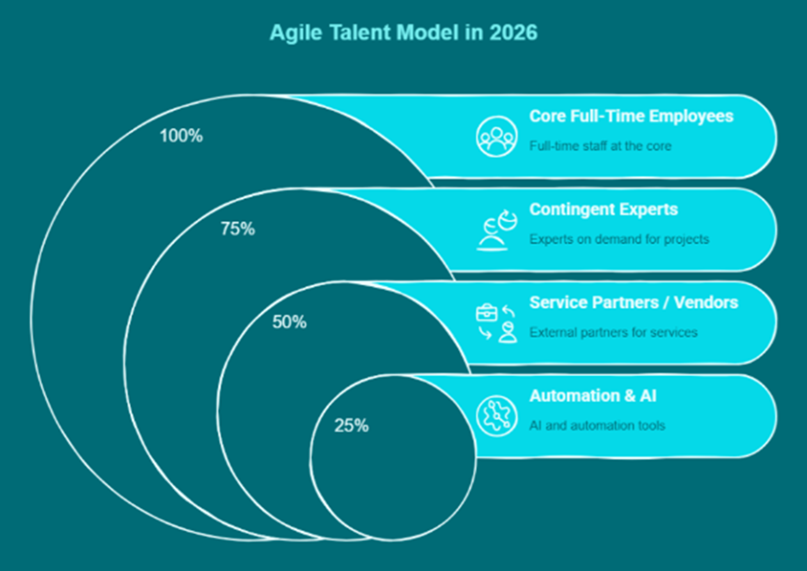
By adopting this layered structure, enterprises achieve “stagility”—the ability to maintain a stable, culture-carrying core while using contingent workforce solutions to pivot as market demands shift.
The transition to agile models isn’t a trend; it’s a survival response to three major market forces that have reached a tipping point this year.
1. Demand Volatility & Speed to Capability
In 2026, the shelf-life of technical skills is shorter than ever. Hiring cycles for permanent roles frequently lag behind the actual business need. By the time an FTE is sourced, onboarded, and trained, the project requirements may have already evolved.
Enterprises are now using flexible talent models to bypass these delays. By leveraging Direct Sourcing and pre-qualified talent benches, leaders can inject specific expertise—such as Generative AI orchestration or advanced cybersecurity auditing—into a project in days. This “speed to capability” is the new metric for competitive advantage.
2. “People Risk” as a Board-Level Priority
The executive mindset has shifted: people’s risk is now business risk. High market unpredictability has made large, fixed labor costs a significant liability.
Agile talent models allow organizations to convert fixed costs into variable expenses. Furthermore, as labor laws become more complex globally, enterprises are leaning on Employer of Record (EOR) and Payrolling Services to manage the compliance, tax, and classification risks associated with a global, non-employee workforce.
3. The Shift from Roles to Skills
We have moved past the era of the “job description.” In 2026, forward-thinking CHROs are implementing skills-based hiring. Industry category authorities note that mature enterprises now treat their contingent workforce as a “labor supply chain.”
Instead of looking for a “Marketing Manager,” an agile enterprise looks for a “specific cluster of skills” needed for a six-month product launch. This allows for talent scalability that is precise and efficient.
Moving from a traditional staffing model to a modern contingent workforce strategy requires a change in the operating model.
1. Skills Taxonomy Over Role Taxonomy Leading firms map the organization by skills rather than titles. This allows them to see exactly where they are “short” and decide whether to “build” (train an FTE), “buy” (hire a new FTE), or “borrow” (engage a contingent expert).
2. Predictive Capacity Planning Using AI/ML Services and predictive analytics, workforce planners can now forecast project-based demand 3–6 months in advance. This prevents “panic hiring” that leads to poor quality and high costs.
3. Centralized Governance Successful models are run by a cross-functional “Talent Taskforce” comprising HR, Procurement, and Finance. This ensures that every dollar spent on labor is visible, compliant, and optimized for ROI.
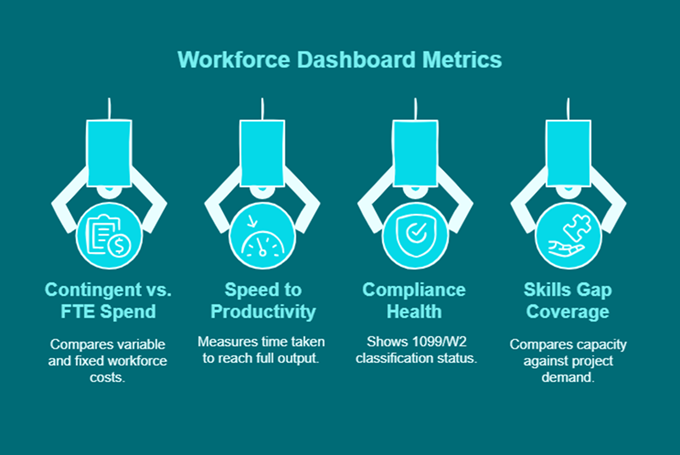
While the benefits of an agile talent model are clear, the path is littered with traps. As the saying goes in 2026: “Agility without governance becomes chaos.”
To transition toward a more agile, skills-based talent model, follow this 90-day checklist:
Days 1–30: The Visibility Audit
Days 31–60: The Skills Mapping
Days 61–90: The Governance Launch
The enterprises that will dominate the late 2020s are those that treat their workforce as a fluid supply of skills. By embracing contingent workforce solutions as a strategic lever for workforce agility, leaders can finally align their talent strategy with the speed of their business goals.
The question for 2026 is no longer “How many people do we need to hire?” but “What is the most agile way to access the skills we need to win?”
Get the Full 2026 Outlook. Workforce agility is just one piece of the puzzle. As AI begins to influence more hiring decisions and job titles continue to fade, how is your organization balancing the power of machines with the necessity of human judgment?
Download the Talent Report: Staffing Predictions 2026 – The Great Rebalance of Human + Machine to see the research driving the world’s most innovative workforce strategies.
List of Content

Introduction Startups don’t have the luxury of waiting. When a Series B closes, and the board expects 40% headcount growth across three countries…

Introduction Speed-to-market is a competitive advantage that compounds. Every week spent waiting for entity registration, legal approvals, or compliance sign-offs is a…