10 Key Benefits of Managed Payroll Services and When They Make Sense
Managed payroll services move much of the day-to-day payroll administration to a third-party provider. The provider can handle payroll calculations,…
Select location
You already know slow hiring is expensive — a single unfilled senior role drains $500+ per day in lost productivity, and every vacant week adds roughly $3,500 in overtime to cover the gap.
The question you’re here to answer isn’t whether to get professional hiring help. It’s which partner, at what cost, with what proof.
At Compunnel, we’ve worked with 500+ organizations on exactly this decision:
Before: 60-90 days to fill critical roles
After: 28-45 days with our solutions
Result: 40% better retention, 35% faster hiring
This guide covers what you get, what it costs, and how to evaluate any provider — including us. (New to full-time hiring services? Start with our complete guide first.)
When Compunnel partners with you, we do three things most providers don’t:
1. We learn how success actually looks inside your organization
2. We invest in passive candidate outreach
3. We measure and optimize everything
We’ve broken down the full 5-phase recruitment process in our complete guide. Here’s what that process delivers in practice:
Precision at the strategy stage. A healthcare network needed 12 RNs, but job postings brought 200+ unqualified applicants. We asked different questions — patient load, must-have certifications, why people leave, shift patterns — then built a targeted sourcing strategy: nursing schools nearby, passive candidates at competitor hospitals, credential verification partners. Result: 12 hires in 8 weeks, 90% still employed 18 months later.
Pipelines built before you need them. A manufacturing client told us “we can’t find quality supervisors.” We analyzed where their past supervisors came from — 60% were promoted from floor roles. So we built a talent pipeline of promising plant operators, pre-identified for promotion. Result: the problem was solved before positions even opened.
Screening that protects your managers’ time. You don’t see every candidate — we filter first through resume screening, phone screens, skills assessments, behavioral interviews, and reference checks. Your hiring managers interview 3-4 pre-qualified candidates instead of sorting through dozens of applications.
Active offer management. This is where deals fall apart. Top candidates compare offers, negotiate, and expect fast decisions. We manage market positioning, negotiation, speed, and competing offers — so they choose you.
Retention-focused onboarding. Placement isn’t the finish line — retention is. We provide pre-boarding communication, structured onboarding materials, 30/60/90-day check-ins, manager coaching, and an early warning system that fixes day-30 problems before they become terminal. Our clients report 25-40% better retention than industry average.
Enterprise hiring solutions are scalable recruitment services for organizations managing ongoing high-volume hiring, specialized talent needs, multi-location recruitment, or strategic workforce planning.
Core Components:
1. Workforce Planning — Forecast hiring demand, identify skill gaps, and develop recruitment roadmaps aligned with business goals.
2. Dedicated Recruitment Teams — Not ad hoc recruiters. Dedicated specialists who understand your culture, hiring standards, and talent requirements.
3. AI-Powered Candidate Sourcing — Matches candidates to requirements, identifies passive talent in competitive markets, ranks applicants by fit and readiness, reduces manual screening by 50%+.
4. Recruitment Analytics — Track time-to-fill, cost-per-hire, quality of hire, offer acceptance rate, source effectiveness, and employee retention.
5. Compliance & EOR Support — Employment classification accuracy, tax and benefits compliance, regulatory management, and risk mitigation across 80+ countries.
6. Employer Branding Support — EVP development, job advertisement optimization, career page recommendations, candidate communication strategies, recruitment marketing.
Scenario: You need one senior engineer ($120k salary)
What internal hiring actually costs:
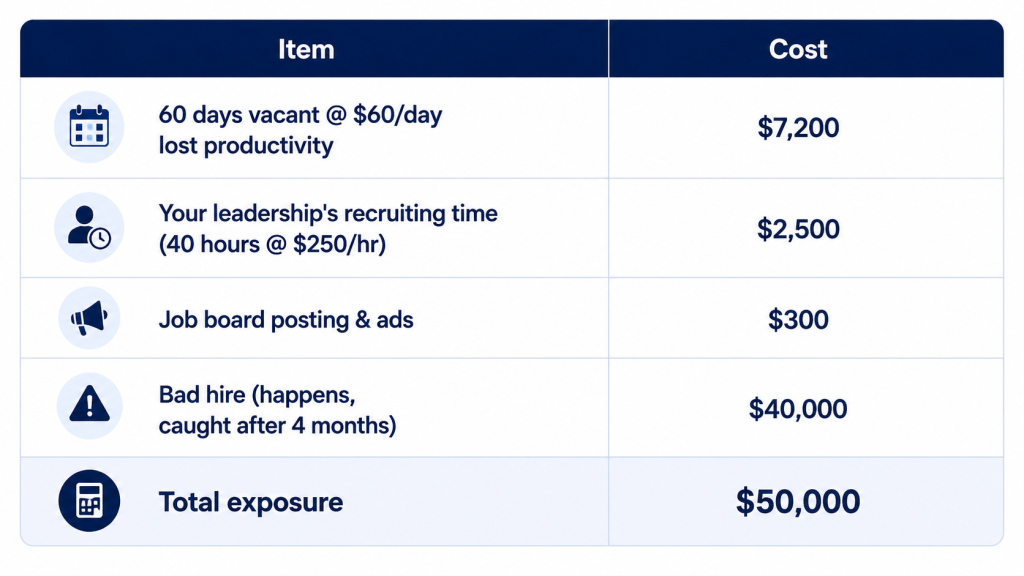
With a professional hiring partner: the vacancy window shrinks by weeks, your leadership’s time returns to running the business, and structured screening dramatically reduces bad-hire risk – SHRM research puts the average cost-per-hire near $4,700, and that’s before vacancy losses – typically making the recruitment fee a fraction of the DIY exposure. Scale this across 10 hires and the difference runs into six figures.
Pricing depends on the engagement model, role complexity, and hiring volume — filling a customer support role requires different sourcing effort than a senior AI engineer or C-level executive, and cost reflects that.
1. Contingency
You pay only on successful placement — no upfront cost, no risk if we don’t deliver. Best for: single roles, urgent hiring.
2. Subscription
A predictable flat monthly investment covering ongoing hiring needs. Best for: organizations with consistent, recurring hiring demand.
3. RPO (Recruitment Process Outsourcing)
A dedicated team runs your full recruitment function, including sourcing, screening, and analytics. Best for: high-volume hiring, long-term partnerships.
4. Enterprise
Custom-structured engagements for multi-location hiring, specialized roles, and scale. Often includes compliance/EOR support. Best for: large organizations with complex needs.
Pro Tip: Organizations hiring at scale typically secure lower per-hire costs through subscription or RPO models.
Want exact pricing for your hiring needs? Talk to our team for a custom quote — no commitment required.
The right way to evaluate cost isn’t the fee — it’s the fee against what vacancy is already costing you:
When improved retention, reduced overtime, and faster project delivery are included, the engagement typically pays for itself well within the first year. Internal HR owns what it does best — culture, retention, development — while we own sourcing and screening. That hybrid is how most successful organizations operate.
With U.S. Bureau of Labor Statistics data consistently showing millions of unfilled job openings nationwide, the competition for qualified talent isn’t easing — which makes an honest self-assessment worth five minutes.
Answer “Yes” to 3+ questions? Time to make a change.
The best hiring services combine industry expertise, dedicated recruiters, AI-powered sourcing, transparent pricing, measurable hiring metrics, and scalable enterprise support.
Important: Evaluate based on hiring speed, candidate quality, technology, compliance, and long-term alignment — NOT just cost alone.
Before signing an agreement with any provider (including us), ask:
Performance:
Sourcing:
Technology:
Quality:
Scaling:
Reporting:
Partnership:
Information Technology: Software engineers, cloud architects, cybersecurity professionals, AI specialists, data scientists. Clients fill senior engineer roles 40% faster through passive technical talent networks and validated skills assessments.
Healthcare: RNs, physicians, medical technologists, healthcare administrators, allied health. Credential verification expertise compresses licensing timelines that stall internal teams for weeks.
Manufacturing: Production supervisors, quality engineers, maintenance technicians, plant managers. Multi-facility hiring support with pre-built leadership pipelines.
Financial Services (BFSI): Risk and compliance specialists, financial analysts, relationship managers, fintech roles — with the regulatory expertise these hires demand.
Retail & E-commerce: Seasonal spikes, store expansion, distribution center recruitment, customer support at scale.
Engineering & Construction: Civil and mechanical engineers, project managers, site supervisors, safety specialists — reducing project delays caused by talent shortages.
Logistics & Supply Chain: Procurement, transportation, warehousing, and operations professionals to build resilient teams.
A mid-sized technology company planned to expand into three new markets within twelve months.
They needed to hire:
Total: 120 people in 12 months
Within eight months:
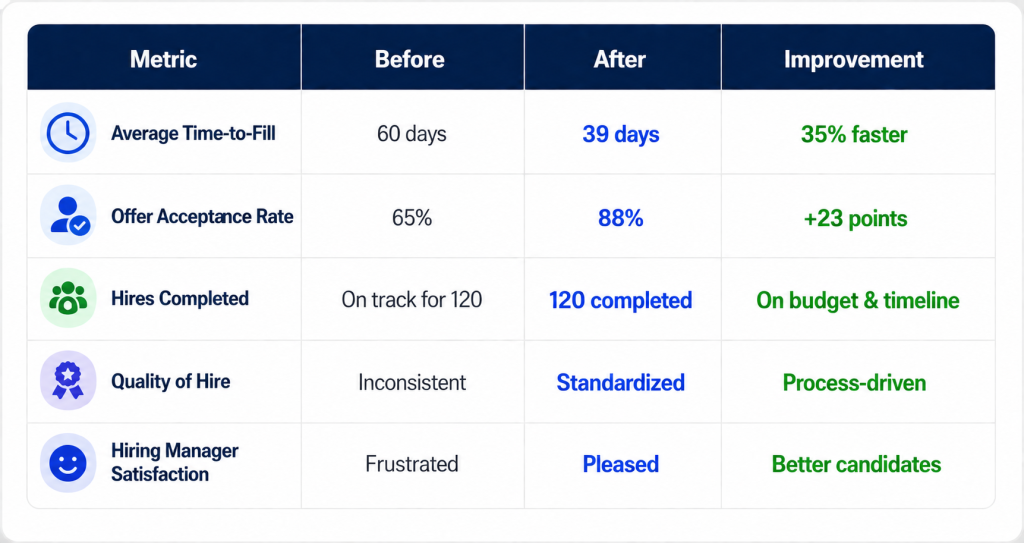
The Insight: Structured recruitment processes and dedicated hiring support dramatically improve efficiency and consistency — especially during rapid growth.
Pricing depends on the engagement model — contingency (pay on successful placement), subscription (flat monthly fee), RPO (dedicated recruitment function), or custom enterprise agreements. Cost is shaped by role seniority, industry demand, hiring volume, and urgency. Contact our team for pricing specific to your hiring needs — and evaluate any provider on overall value delivered, not just upfront cost.
Recruitment Outsourcing: Outsourcing specific activities (sourcing, screening); flexible, project-based. RPO: The provider manages ALL recruitment functions as an extension of your HR team — a long-term partnership with deeper integration.
Start with a single hard-to-fill role or department rather than outsourcing everything at once. Measure results against your internal baseline (time-to-fill, quality, retention), then scale based on proven outcomes. Most engagements deliver measurable ROI within 6 months.
Yes, High-volume recruitment (50+ hires) combines dedicated recruitment teams, talent pipelines, automation, and standardized processes — see the 120-hire case study above.
Yes, Flexible engagement models support growing businesses that are planning expansion, hiring for specialized roles, or building teams without a large internal recruitment department.
Evaluate based on industry expertise, hiring methodology, talent network depth, technology capabilities, transparency in pricing and reporting, compliance support, client success stories, and scalability for your needs.
Finding exceptional talent shouldn’t slow your business growth.
At Compunnel, we’ve helped 500+ organizations hire smarter, faster, and with greater confidence. Whether you need to fill specialized positions, manage high-volume recruitment, or develop a long-term hiring strategy, our enterprise hiring solutions deliver measurable results.
Your Next Steps
1. Identify Your Challenge — Slow hiring timeline? Quality issues? Scalability needs? Specific industry expertise?
2. Schedule a Consultation — Discuss your specific situation with our team. No commitments — just honest conversation about what’s possible.
3. See What’s Possible — Learn how other organizations in your industry have solved similar challenges.
Explore our Full-Time Hiring Services to see how we help you hire faster, retain longer, and scale with confidence — from sourcing and screening to offer and onboarding.
Talk to Our Expert → A 30-minute conversation. No commitment — just clarity on your hiring roadmap.

List of Content

Managed payroll services move much of the day-to-day payroll administration to a third-party provider. The provider can handle payroll calculations,…

Most enterprises are running a contingent workforce program that was designed for a slower era. Requisitions sit in queues for…