Contingent Workforce Solutions in 2026: How Enterprises Are Building Agile Talent Models
As we enter January 2026, the traditional corporate "headcount plan" is undergoing a quiet but radical retirement. For decades, the…
Picture this: a mid-sized fintech company in New Jersey posts a senior data engineer role. They get 47 applications. Two are qualified. One takes a counteroffer. The other wants to be fully remote from Lisbon.
This is not a hypothetical. It is Tuesday in 2026.
ManpowerGroup’s Talent Shortage Survey put a number on the quiet panic spreading through HR teams globally: 74% of employers are struggling to find the skilled workers they need, up from just 45% in 2014. In the Asia-Pacific, that figure climbs to 77%. And according to LinkedIn’s 2026 Talent Report, 86% of companies lack what researchers now call “talent velocity” — the organizational ability to see, acquire, and deploy skills in real time.
The talent pool did not shrink overnight. Aging workforces are retiring faster than younger generations can step up. Specialized skills in AI, cybersecurity, engineering, and digital health are evolving faster than any university curriculum can keep pace with. And geography — that old reliable anchor of the hiring process — has simply stopped doing its job.
The companies pulling ahead right now are not waiting for the pipeline to refill. They are hiring from wherever the talent actually lives. And to do that compliantly, at speed, and without building an entire legal infrastructure in every new country, they are turning to Employer of Record services.
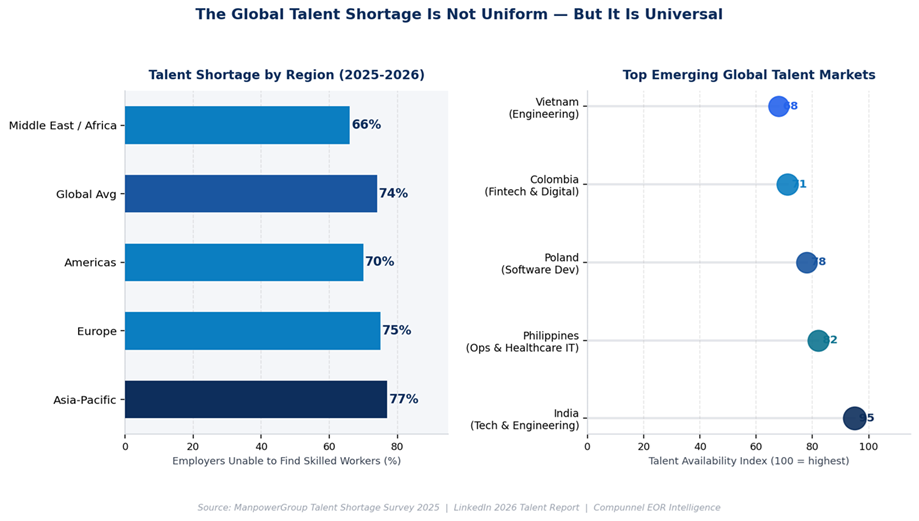
The global talent map has been redrawn. India now hosts over 1,700 Global Capability Centers employing nearly 1.9 million people, with Hyderabad and Pune joining Bangalore as world-class technology hubs. Brazil and Colombia are emerging as the go-to markets for nearshore fintech and digital services talent in the Americas. Vietnam and the Philippines continue to supply high-quality engineering and operations professionals at a scale that no domestic market in the West can match right now.
And then there is the H-1B factor. Recent U.S. Department of Homeland Security reforms have made the visa process significantly more expensive and less predictable, as an HR Executive reported in February 2026. For companies that once relied on bringing international talent to the United States, the calculus has shifted sharply. It is no longer about moving people to work. It is about taking the work to the people — and building compliant employment relationships wherever those people already live.
The strategic shift is being noticed at the highest levels. Thales, the French aerospace and defense company, is committed to adding 9,000 employees globally, with concentrated engineering investment in India. The French are not alone. Across sectors, multinational companies are building distributed talent pipelines rather than competing for the same shrinking local pools.
The question that naturally follows is: how do you employ someone in Vietnam, Colombia, or Poland without spending six months setting up a legal entity, hiring local counsel, and wiring together a payroll system you barely understand? The answer has a name.
There is a persistent misunderstanding about Employer of Record services. Many HR leaders encounter EOR as a compliance tool — a way to keep payroll legal in a foreign country. That framing undersells what EOR actually does.
An Employer of Record becomes the legal employer for your international hires. It handles employment contracts, payroll, statutory taxes, benefits administration, and labor law compliance in countries where you have no entity. You keep full control of the work — who does what, when, and how. The EOR owns the legal and operational employment burden. It is the difference between hiring in a country and being present in a country.
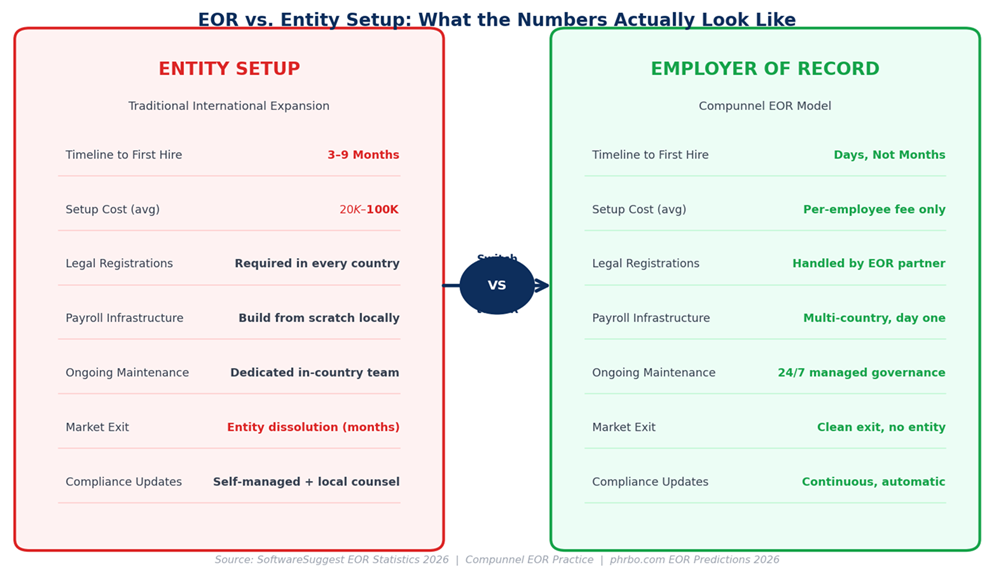
In 2026, the most forward-thinking organizations are using EOR for a second strategic purpose: market testing. Before committing to the cost and complexity of incorporating a legal entity abroad — which can run between $20,000 and $100,000 depending on the jurisdiction, and take three to nine months — they hire a small team through an EOR, validate the market opportunity, and make a data-driven decision about whether a permanent entity is worth it. EOR converts a binary, high-stakes decision into a staged, low-risk experiment.
According to SoftwareSuggest’s 2026 EOR market analysis, EOR services reduce global expansion timelines by up to 80% and allow companies to onboard compliant international employees in days rather than months. The global EOR market is valued at $5 billion in 2026 and is projected to reach $19.8 billion by 2036, growing at a 14.8% compound annual rate. That is not the growth curve of a compliance workaround. That is the growth curve of critical infrastructure.
Speed without structure creates its own problems. The rush to tap global talent markets has left a trail of misclassification violations, payroll errors, and regulatory penalties for companies that tried to hire internationally without the right foundation.
Governments are not standing by. EOR industry analysts writing in late 2025 flagged a sharp acceleration in enforcement activity: tax authorities across the United States, United Kingdom, Australia, and the EU are now actively targeting cross-border worker misclassification, closing loopholes that companies once relied on when engaging overseas talent as contractors. In 2026, the enforcement perimeter has extended explicitly to foreign and globally hired workers.
The practical consequence is that a company hiring a developer in Berlin through a payment platform — but not a proper employment structure — is accumulating tax and labor liability with every payroll cycle. Employer of Record services eliminate this exposure by establishing the correct legal employment relationship from day one, in full alignment with local labor law.
This matters particularly for enterprise HR and legal teams who are accountable for workforce risk. The question is no longer whether global hiring creates compliance exposure. It does. The question is whether that exposure is owned by the organization or by a governed EOR partner who has accepted legal employer responsibility.
Most EOR platforms solve a piece of the problem. Compunnel’s Employer of Record services are built to own the entire employment liability chain — from the moment a hire is initiated to the moment they exit. As the legal employer of record, Compunnel assumes the compliance obligation, the payroll execution responsibility, and the statutory risk across every market it operates in. For HR and legal teams tired of managing fragmented vendor relationships across jurisdictions, that accountability structure is a material difference.
The service architecture covers what actually breaks in global hiring operations:
For enterprise organizations building distributed teams across Asia-Pacific, Europe, or Latin America, Compunnel’s model provides what the Compunnel EOR campaign page describes as “strategic employment ownership” — a single accountable partner that turns global headcount complexity into a governed, predictable system.
ISO 9001:2015, ISO 27001, and SOC 2 certifications back the data security and process governance standards that enterprise procurement and legal teams require before signing off on a global employment partner.
The talent shortage is not a temporary market condition. It is a structural reality shaped by demographics, skill evolution, and the permanent normalization of distributed work. Companies that restrict their hiring to local talent markets are competing for a shrinking pool, while their faster-moving competitors are hiring the best available talent from wherever it lives.
Employer of Record services are the operational layer that makes borderless talent strategy executable — not someday, not after entity setup, but within days of making a hiring decision.
The companies that will own the next decade of talent advantage are not the ones who hire the most locally. They are the ones who hire the best globally, compliantly, and fast.
Compunnel’s Employer of Record services let you build compliant, fully governed global teams without entity setup, legal overhead, or compliance guesswork. See how seamless global hiring actually works.

List of Content

As we enter January 2026, the traditional corporate "headcount plan" is undergoing a quiet but radical retirement. For decades, the…

For the modern C-suite, the traditional debate over "temporary staffing" has officially concluded. In its place is a more sophisticated…