Your Local Talent Pool Just Ran Out. Here Is What Smart Companies Are Doing Instead.
The Hiring Crisis Nobody Saw Coming (Except Everyone Did) Picture this: a mid-sized fintech company in New Jersey posts a…
It starts with ambition. A decision is made to enter a new market — maybe Germany, maybe India, maybe Brazil. The legal team gets involved. A local counsel is retained. Banking setup begins. Labor law opinions are drafted. The HR team waits.
Three months pass. Then six. The market window starts to narrow. A competitor hires the candidate you were targeting. The quarter closes with nothing to show for the expansion initiative except a half-built entity and a legal invoice.
This is the incorporation trap. It is real, it is expensive, and it is still the default playbook at organizations that have not yet discovered there is a better one.
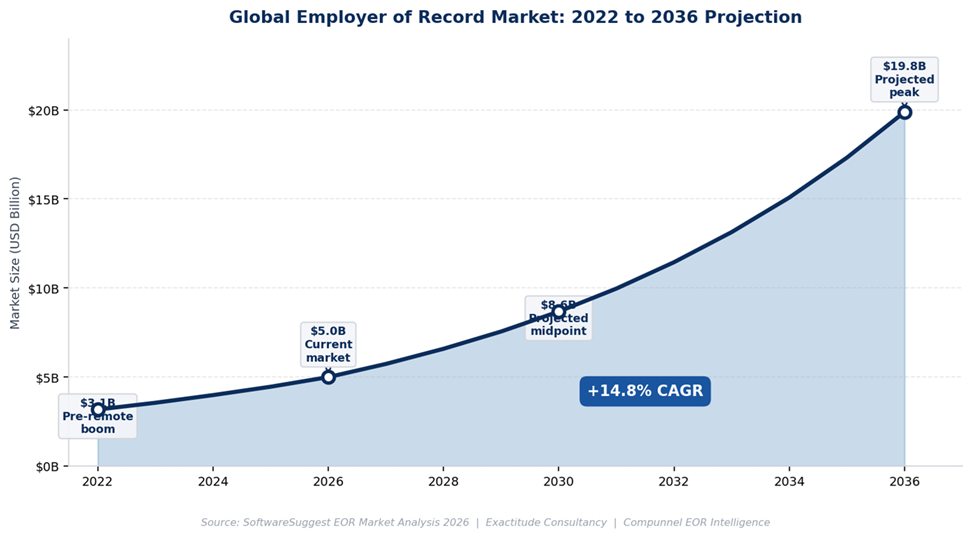
The data on the alternative is not subtle. According to Software Suggest’s 2026 EOR market analysis, Employer of Record services reduce global expansion timelines by up to 80%. The global EOR market, currently valued at $5 billion, is on track to reach $19.8 billion by 2036 at a 14.8% CAGR — one of the steepest growth curves in the HR technology sector. When a market grows that fast, it is usually because it is solving a problem that people have stopped tolerating.
Seamless is an overused word. Let us make it concrete.
A U.S.-based healthcare technology company needs three clinical data analysts in the Philippines. Traditional route: incorporate a Philippine entity, register with the Bureau of Internal Revenue, set up SSS, PhilHealth, and Pag-IBIG contributions, draft employment contracts compliant with the Labor Code, and establish a Philippine payroll system. Timeline: four to seven months. Cost: upward of $40,000 before a single paycheck is issued.
EOR route: the provider already has a compliant entity in the Philippines, already understands the Labor Code, and already runs payroll in Philippine pesos with all statutory contributions handled. The company submits the hire details. Employment contracts are issued within days. Payroll runs on the standard cycle. The analysts are onboarded, compliant, and productive within two weeks.
That is what seamless looks like — not as a marketing claim, but as a measurable difference in hiring timelines, legal exposure, and capital efficiency.
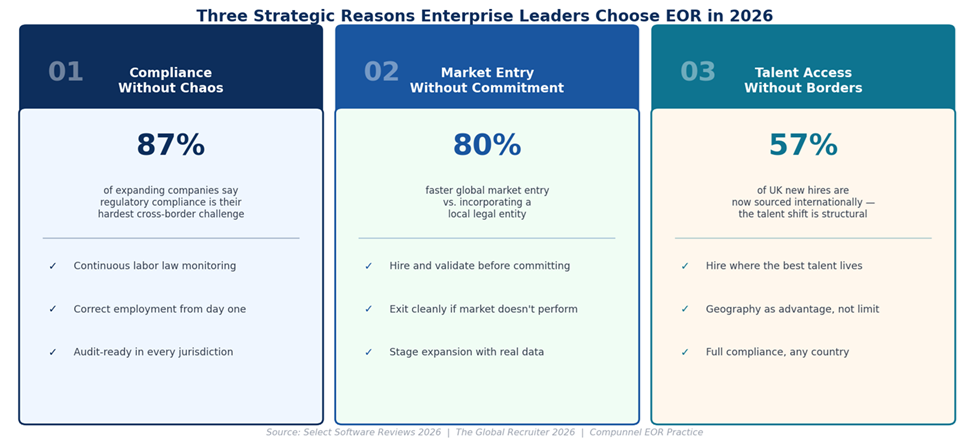
This gap is why 87% of companies planning international expansion in 2026 say that meeting local tax and employment regulations will be their hardest task. The challenge is not identifying where to expand. It is executing the expansion without drowning in the regulatory complexity that comes with it.
For years, organizations hired internationally by classifying workers as independent contractors and processing payments through global payment platforms. It was fast, it was cheap, and it was increasingly illegal. EOR industry analysts entering 2026 documented a significant expansion of enforcement: governments worldwide are actively reclassifying cross-border workers who were engaged as contractors but whose working arrangements reflect employment. The enforcement perimeter now extends explicitly to foreign and globally hired workers, and the penalties look backward — meaning years of misclassified payroll can become years of back taxes, social contributions, and fines.
The calculation has changed. Using a payment platform to pay an overseas worker was once a gray area. In 2026, it is a documented liability. Employer of Record services establish the employment relationship correctly at inception, eliminating the misclassification exposure before it begins to accumulate.
The regulatory environment for cross-border employment has not stabilized. It is accelerating. South Korea enacted new remote work hour and privacy amendments in 2026. Austria’s Teleworking Act, active since 2025, introduced detailed frameworks for equipment compensation, tax incentives, and remote work protections. Singapore formalized employee rights to request flexible work arrangements under its updated Tripartite Guidelines. The Conexis VMS 2026 contingent workforce analysis framed it directly: in 2026, compliance risk is no longer occasional — it is structural.
An Employer of Record monitors these changes continuously, not annually. When a new regulation takes effect in a country where your people are employed, the EOR updates the employment contracts, adjusts payroll configurations, and ensures filings remain current. Your HR team receives the outcome, not the workload.
The most underused feature of Employer of Record services has nothing to do with compliance. It is optionality.
Before committing to entity incorporation — with its fixed legal costs, ongoing maintenance overhead, and minimum three-month setup timeline — an organization can hire a small team through an EOR, validate the market, build local relationships, and generate real revenue data. If the market performs, the entity’s decision is now evidence-based. If it does not, the organization exits cleanly without the legal complexity of dissolving a registered company in a foreign jurisdiction.
This is how a $5 billion market category grows at 14.8% annually. It is not just compliance buyers. It is strategy buyers — CFOs and expansion leaders who have realized that EOR gives them a way to make global market entry decisions with dramatically less committed capital and dramatically more real-world intelligence.
The talent shortage is forcing a binary choice for many organizations: hire the best available locally, or hire the best globally. The Global Recruiter’s 2026 hiring research found that 57% of new hires in the UK are now coming from abroad — nearly two in three new recruits are international within a single year. This is not an exception. It is the leading edge of a structural shift in how talent pipelines are built.
Employer of Record services make the best global option operationally equal to the best local option. When you can hire a qualified engineer in Vietnam as quickly and compliantly as hiring one domestically — with full payroll, statutory benefits, and legal employment handled — geography stops being a constraint and starts being an advantage.
One of the hidden costs of rapid global hiring is operational fragmentation. Companies that build distributed teams quickly often end up with different payroll vendors in different countries, inconsistent employment contract standards, compliance gaps in lower-priority markets, and HR operations teams spending significant time reconciling data across disconnected systems.
A governed Employer of Record infrastructure eliminates this fragmentation. Every hire in every country runs through the same employment framework, the same compliance architecture, and the same payroll engine. The organization gains consistent visibility, consistent standards, and a single accountable partner — rather than a collection of local exceptions that get reviewed once a year and quietly accumulate risk the rest of the time.
Most EOR providers lead with coverage maps. Compunnel leads with accountability. Compunnel’s Employer of Record model is built around what it calls strategic employment ownership: a single partner that assumes full legal employer responsibility across regions, rather than serving as a payroll passthrough that leaves compliance exposure distributed and unowned.
The practical difference shows up in the moments that matter most. When a labor law changes in a country where your team is employed, Compunnel updates the employment framework — you do not have to discover the change yourself. When a statutory audit arises, Compunnel provides the documentation. When an employee exits, the offboarding process follows local legal requirements on notice periods, final settlements, and statutory documentation, without your legal team having to become experts in employment law for that jurisdiction overnight.
This level of governance is backed by ISO 9001:2015, ISO 27001, and SOC 2 certifications — the quality, security, and operational standards that enterprise procurement teams require before trusting a third party with employment liability in multiple countries.
For organizations that have been burned by EOR providers that excel at the pitch and underdeliver on execution, Compunnel’s governed model offers something the market increasingly values: accountability that holds when the situation gets complicated.
The companies building the next generation of global teams are not the ones waiting for their legal teams to greenlight a new entity. They are the ones that made the structural decision to separate talent strategy from legal infrastructure — and found a governed EOR partner to close the gap between where they want to hire and where they are currently equipped to hire.
The market for global talent is enormous. The compliance complexity is real. The tools to navigate both simultaneously have never been more capable. The only remaining variable is how fast your organization is willing to move.
Stop Letting Entity Setup Slow Down Your Global Hiring Strategy
Compunnel’s Employer of Record services handle payroll, compliance, statutory benefits, and employment governance across markets — so you can make the hire first and let the infrastructure follow. No entities. No guesswork. No lag.
See How Seamless Global Hiring Works →

List of Content

The Hiring Crisis Nobody Saw Coming (Except Everyone Did) Picture this: a mid-sized fintech company in New Jersey posts a…

As we enter January 2026, the traditional corporate "headcount plan" is undergoing a quiet but radical retirement. For decades, the…