Home>Insights>Blogs > The Hybrid Hustle: How SMBs Are Rewriting Work for 2025
The Hybrid Hustle: How SMBs Are Rewriting Work for 2025
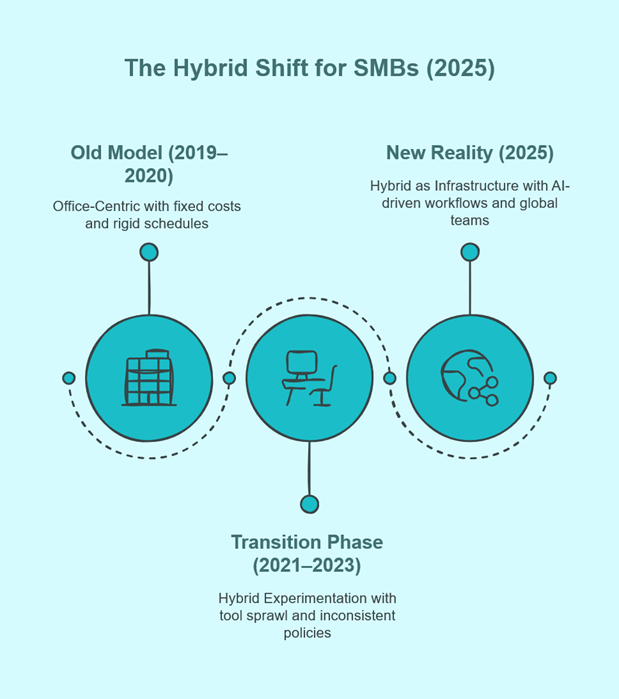
Hybrid work didn’t ease into the mainstream; it crashed through it. In less than five years, the traditional office model has quietly collapsed for a majority of knowledge-driven roles. What began as a temporary disruption is now the default operating system for modern organizations. In 2025, small and mid-sized businesses (SMBs) will not adopt hybrid work anymore; they will be judged by how well they execute it.
Unlike large enterprises cushioned by transformation budgets and layered governance, SMBs are redesigning work in real time—with lean teams, compressed margins, and relentless performance pressure. Every misstep now carries immediate financial and cultural consequences. This shift is not cosmetic. It is fundamentally rewriting how SMBs attract talent, manage productivity, control costs, and scale across borders—often through models like Employer of Record (EOR) to grow without legal or compliance drag.
Hybrid is no longer a policy choice. For SMBs in 2025, it is a strategic infrastructure decision—one that separates organizations built to scale from those quietly slipping into irrelevance.
Hybrid Work for SMBs: From Experiment to Expectation
Hybrid work has become the dominant model for knowledge-based roles. Recent workforce studies show:
Nearly one in four new job postings is now hybrid, with fully on-site roles steadily declining.
Employee engagement is highest among hybrid workers (35%), exceeding both fully remote and fully in-office employees.
Over 80% of SMBs worldwide operate under a hybrid model, and the majority plan to sustain this approach beyond 2025.
Hybrid is no longer a projection of the future—it is the current state of work. Candidates now evaluate employers through the lens of flexibility, autonomy, and growth potential just as rigorously as compensation.
For SMBs competing with large enterprises for skilled professionals, hybrid work has become a strategic currency, not a cultural perk.
Why Hybrid Impacts SMBs Differently
What works for Fortune 500 organizations often proves unsustainable for SMBs.
Large enterprises can absorb inefficiencies through scale. SMBs cannot. They operate under three persistent constraints:
Limited budgets
Lean, multi-functional teams
Aggressive growth expectations
Research indicates that SMBs allocate nearly two-thirds of their IT budgets to maintaining existing systems, leaving limited capacity for large-scale experimentation. Yet more than 60% of SMBs are accelerating investments in AI and automation, signaling a decisive move toward intelligent efficiency rather than infrastructural expansion.
For SMBs, hybrid work is not about enhancing workplace aesthetics or branding employee experience initiatives. It is about building a lean, adaptive workforce model that supports continuous growth without introducing structural fragility.
The Three Strategic Tensions of Hybrid Work
Hybrid work is not a binary choice between remote and office; it is a continuous balancing act. The organizations that succeed are those that actively manage these tensions rather than ignore them.
Flexibility vs. Productivity: Employees expect autonomy, while leadership is accountable for results. The solution is not tighter supervision but outcome-driven performance—clear KPIs, reduced reliance on meetings, and measurable deliverables. SMBs that shift from time-based to output-based management report faster execution and lower burnout.
Cost Control vs. Talent Experience: Hybrid lowers real estate costs but introduces new investments in collaboration tools, cybersecurity, and employee enablement. High-performing SMBs rely on a minimum viable hybrid stack—centralized communication, project management, core security, and AI-based productivity tools—to stabilize costs without compromising experience.
Autonomy vs. Psychological Safety: Flexibility without structure increases isolation and cultural risk. Leading SMBs address this through manager training, explicit hybrid norms, enforced time-off, and strong written communication. Culture in hybrid organizations is built on clarity, not proximity.
The Hybrid Talent Market: Competitive and Borderless
In 2025, talent mobility has reached historic levels. Employees now prioritize flexibility as strongly as compensation, and career movement is continuous rather than episodic. A growing share of the workforce is also polyworking, further fragmenting traditional employment loyalty.
This creates a dual reality for SMBs.
Risk: Top performers will exit quickly if flexibility, growth pathways, and purpose are unclear or inconsistently delivered.
Opportunity: Hybrid enables SMBs to access broader talent pools, secure specialized skills at optimized cost, and compete with large enterprises without absorbing their overhead.
When supported by structured Full-time Hiring and Contingent Workforce models, hybrid becomes a scalable growth strategy—not merely a retention lever.
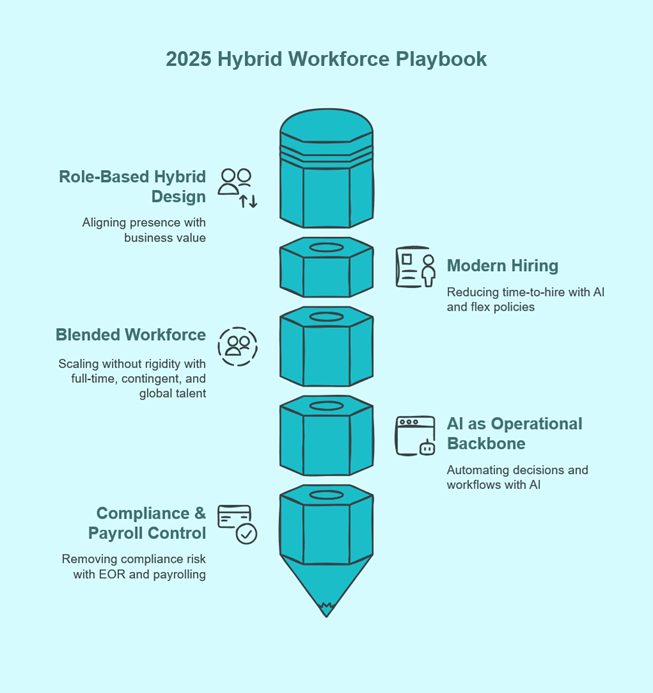
The 2025 Hybrid Playbook for SMBs
Hybrid success in 2025 is no longer driven by policy—it is driven by precision. High-performing SMBs are converging around a set of execution-first principles that balance flexibility, scalability, and risk.
1. Design Hybrid by Role, Not by Attendance
High-performing SMBs replace rigid attendance rules with role-based presence models:
Client-facing roles: selective in-person engagement for relationship-driven work
Technical, marketing, and operations: remote-first with structured collaboration days
Leadership: flexible with intentional visibility
This approach minimizes friction and aligns physical presence with business value.
2. Modernize Hiring for Hybrid Operations
Hybrid organizations require hiring strategies built for flexible execution:
Clear flexibility expectations in job descriptions
Technology-enabled screening and assessments
Access to permanent, contract, and project-based talent
Direct Sourcing combined with AI-driven talent intelligence reduces time-to-hire while improving the accuracy of fit.
3. Implement a Blended Workforce Model
By 2025, high-growth SMBs no longer rely on a full-time workforce. Instead, they blend:
Full-time employees for continuity and leadership
Contingent professionals for agility and niche expertise
Global talent via Employer of Record (EOR) for compliant international expansion
This model enables rapid scaling without long-term financial or legal rigidity.
4. Integrate AI as the Operational Backbone
AI now underpins core hybrid workforce functions, including:
Resume screening and candidate matching
Workforce analytics and demand forecasting
Meeting documentation and knowledge management
Workflow automation
Organizations using AI/ML Services achieve faster decisions, lower administrative burden, and higher workforce productivity.
5. Mitigate Compliance and Payroll Complexity
Distributed workforces create immediate exposure to tax, labor law, payroll, and contractor classification risks. To manage this, SMBs increasingly rely on:
Payrolling Services for multi-state and cross-border employees
Employer of Record (EOR) models for compliant market entry without local entity setup
This structure removes compliance risk from the growth equation.
How Compunnel Enables Hybrid Success for SMBs
Sustained hybrid performance requires more than internal policy revision—it demands an integrated workforce ecosystem.
Strengthened through AI/ML Services for smarter talent decisions
Hybrid success is not achieved by replicating enterprise models. It is achieved by engineering a workforce structure aligned to business reality, growth trajectory, and risk posture.
Conclusion: The Strategic Imperative of Hybrid in 2025
The Hybrid Hustle of 2025 is disciplined, data-driven, and unforgiving of inefficiency. It accelerates execution, exposes operational gaps, and rewards organizations that design for clarity and scale. For SMBs, hybrid is no longer a workplace policy—it is a core business architecture shaping competitiveness, cost control, and long-term talent sustainability.
The organizations that succeed will move beyond surface-level flexibility and commit to system-level workforce transformation.
Whether you are building a hybrid-first permanent team, scaling through contingent talent, expanding globally through Employer of Record (EOR), or optimizing hiring with AI-powered workforce intelligence, Compunnel delivers compliant, future-ready workforce solutions built for 2025 and beyond.
Connect with Compunnel Talent to design a hybrid workforce that scales with confidence—not complexity.
VP of Finance & Operations with 25+ years of experience spanning Finance, Operations, and Global Workforce Management. She specializes in Employer of Record (EOR) solutions, multi-state payroll, and compliance frameworks across diverse geographies. Lalitha offers a strategic lens on managing global workforces and navigating regulatory complexity. On this blog, she writes about EOR models, global payroll compliance, and international hiring strategies at
Compunnel Inc,
In early 2025, a major US healthcare system experienced a ransomware attack that disrupted patient care for 37 days. The organization had Multi-Factor…
Every cloud migration eventually reaches the same conversation. Engineering wants to move fast. Compliance requires that every data flow be mapped before…