Future-Proof Hiring: EOR + AI for Compliant, Scalable Global Teams in the 2026 Talent Wars
Two forces are simultaneously reshaping global workforce management. AI adoption: 64% of IT leaders predict a complete HR-IT merger within five…
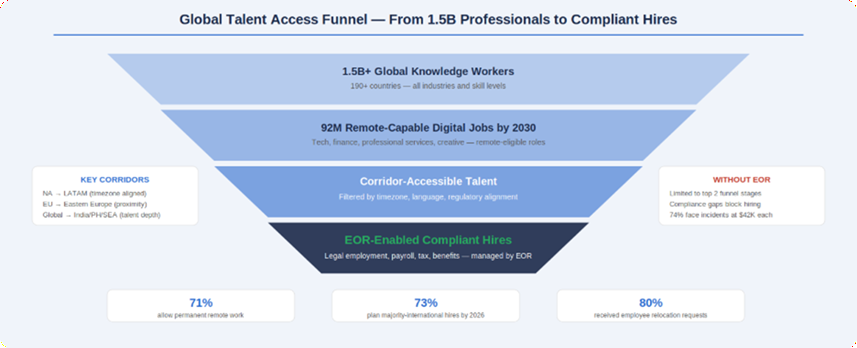
Seventy-one percent of companies allow permanent remote work. Fifty-two percent of the global workforce participates in remote or hybrid models. And 73% of HR leaders anticipate that more than half their 2026 hires will be based outside their primary country.
The gap between companies with infrastructure for compliant global remote hiring and those treating it as an exception is widening into a structural competitive disadvantage. The global knowledge workforce exceeds 1.5 billion professionals. Remote-capable digital jobs will reach 92 million by 2030. What’s missing for most companies isn’t intent. It’s a compliant infrastructure.
When a Lisbon-based employee accepts an Austin-based role, Portuguese labor law, tax, social security, working time directives, and GDPR all apply. The company has created an employment relationship in Portugal, whether it intended to or not. Without an entity or EOR, it’s non-compliant from day one. 74% of international hirers have faced at least one compliance incident. Average cost: $42,000-before legal fees and reputational damage.
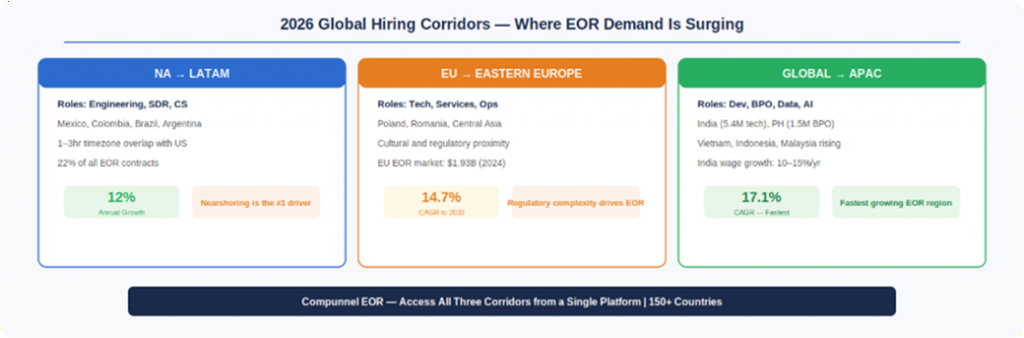
NA → LATAM: Engineering, SDR, and CS roles flowing to Mexico, Colombia, Brazil, Argentina. 1–3 hour timezone overlap, cultural familiarity, and 22% of EOR contracts.
EU → Eastern Europe: Poland, Romania, and increasingly Central Asian markets. Europe’s EOR market ($1.93B in 2024) is growing at 14.7% CAGR-driven by regulatory complexity that makes EOR the path of least resistance.
Global → APAC: India (5.4M tech professionals), Philippines (1.5M BPO), plus Vietnam, Indonesia, Malaysia as cost-competitive alternatives. 17.1% CAGR-fastest growing EOR region.
These are corridors Compunnel has operated in for decades, not markets we’re entering now. The difference between an EOR provider that’s been in India for 30 years versus one that opened a local partnership last year shows up in exactly one place: the edge cases. Visa complications. Regulatory audits. Payroll disputes. That’s where operational depth matters.
Eighty percent of leaders received relocation or travel-work requests in 2025. Each creates a potential tax nexus, benefit obligation, and labor law trigger. Without infrastructure, companies face a binary: deny the request and risk losing the employee, or approve it and accept unquantified compliance risk.
An EOR eliminates this dilemma. When an employee moves from Berlin to Barcelona, the EOR transfers the employment relationship to the Spanish entity, managing tax transition, benefit adjustments, and regulatory compliance. The employee sees continuity. The company sees zero disruption.
Locally compliant compensation frameworks informed by 150+ country benchmarking data. Consistent employee experience regardless of jurisdiction, benefits, onboarding, and payroll accuracy shouldn’t vary by country. Unified data infrastructure: 41% of EOR platforms offer HRMS/ATS API connectivity for real-time global workforce visibility.
In 2026, distributed global teams are the operating model, not the exception. EOR is the infrastructure that makes this model work compliantly, scalably, and without requiring your HR team to become experts in 20 different labor law regimes simultaneously.
If you’re building a distributed team across multiple countries-or just thinking about it-it might be worth a quick conversation about which corridors work best for your roles and where the compliance pitfalls actually are.
Happy to share what we’ve seen work across 150+ countries. services.compunnel.com/employer-of-record

List of Content

Two forces are simultaneously reshaping global workforce management. AI adoption: 64% of IT leaders predict a complete HR-IT merger within five…

Eighty-six percent of HR leaders cite international compliance as their top challenge. In 2026, that number carries real weight. The EU…