Home>Insights>Blogs > Future-Proof Hiring: EOR + AI for Compliant, Scalable Global Teams in the 2026 Talent Wars
Future-Proof Hiring: EOR + AI for Compliant, Scalable Global Teams in the 2026 Talent Wars
Two forces are simultaneously reshaping global workforce management.
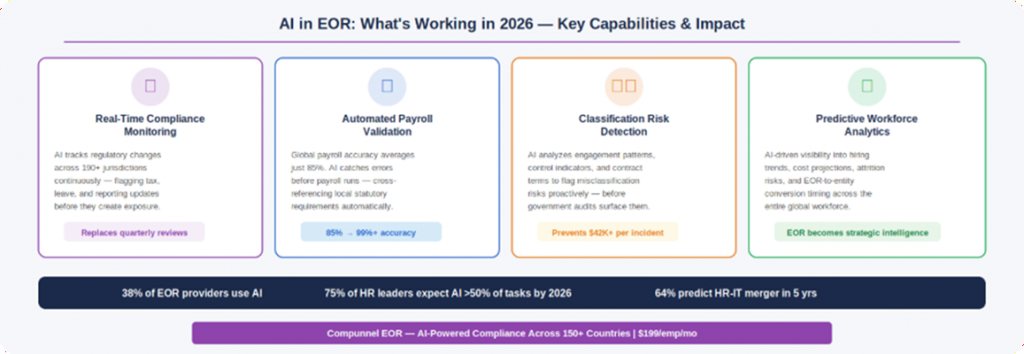
AI adoption: 64% of IT leaders predict a complete HR-IT merger within five years. 75% of HR leaders expect AI to handle more than half of routine tasks by the end of 2026. AI isn’t augmenting HR. It’s restructuring it.
AI regulation: The EU AI Act (August 2026) classifies HR AI as “high-risk.” Illinois, Colorado, Texas, and California have enacted AI-in-employment laws. South Korea’s AI Basic Act took effect in January 2026. Malaysia’s AI Governance Bill is expected in mid-2026. Meanwhile, 38% of EOR providers already use AI for payroll and compliance automation, but the regulatory framework governing those tools is being written in real time.
The companies that win the 2026 talent wars won’t be those that adopt AI fastest. There will be those who deploy AI within a compliance architecture that scales across jurisdictions. That architecture is EOR.
AI in EOR: What’s Already Working
Real-Time Compliance Monitoring: AI tracks regulatory changes across 190+ jurisdictions continuously, flagging tax, leave, and reporting updates before they create exposure. This replaces quarterly reviews with continuous monitoring.
Automated Payroll Validation: Global payroll errors remain a consistent operational risk, particularly across multi-jurisdiction teams where statutory rules, currencies, and reporting requirements vary. AI catches discrepancies before runs, cross-referencing local statutory requirements and flagging withholding anomalies before they become incidents.
Classification Risk Detection: AI analyzes engagement patterns and contract terms to flag misclassification risks proactively, before $42K+ government audits surface them.
Predictive Workforce Analytics: Visibility into hiring trends, cost projections, and attrition risks. EOR shifts from transactional compliance to a strategic intelligence layer.
The Regulatory Paradox
Here’s the tension most EOR conversations miss: the same AI tools that improve compliance are themselves becoming regulated. The EU AI Act requires human oversight, audit logs, and bias-free operation for employment AI. Colorado demands risk management programs. California requires four years of automated decision records.
This makes EOR provider selection a strategic decision, not a procurement exercise. The right partner hasn’t just deployed AI for efficiency-they’ve built governance frameworks, bias testing, and documentation that satisfy the very standards the AI is supposed to enforce. At Compunnel, this is where our 30-year operational track record becomes relevant-not as a marketing claim, but as the audit trail that regulators actually look for when evaluating compliance infrastructure.
The AI-Ready Workforce Stack
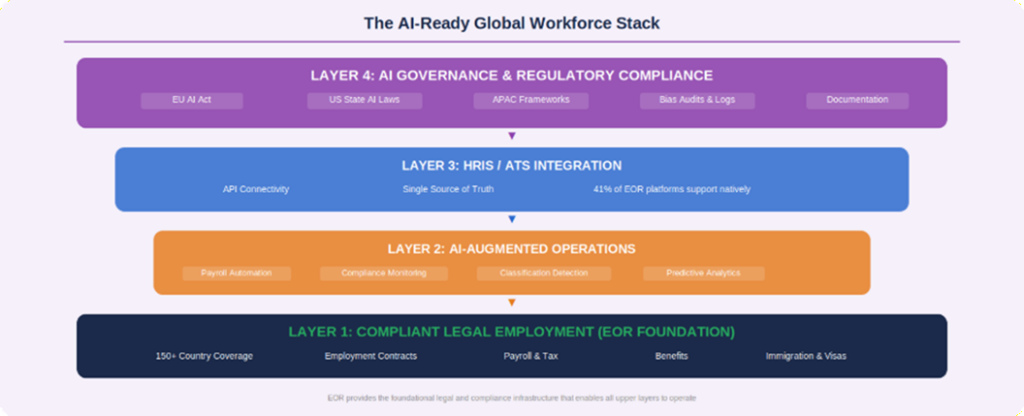
Layer 1 – Compliant Legal Employment: EOR provides entity infrastructure across jurisdictions, absorbing employment liability and ensuring every hire meets local standards.
Layer 2 – AI-Augmented Operations: Payroll automation, compliance monitoring, classification detection, governed by the EOR’s compliance frameworks.
Layer 3 – HRIS/ATS Integration: API connectivity for a unified workforce view. 41% of EOR platforms support this natively.
Layer 4 – AI Governance: Policies, audits, and documentation for EU AI Act, US state laws, and APAC frameworks. Non-negotiable in 2026.
The talent wars of 2026won’tbe won by the biggest HR departments.They’llbe won by companies with thesmartest infrastructure-those that move fast, stay compliant, and scale without breaking. EOR, integrated with AI and governed by robust compliance frameworks, is that infrastructure.
If you’re thinking about how AI and EOR fit together for your 2026–2027 workforce planning, or just want to stress-test your current setup against the new regulatory landscape, we’d welcome the conversation.
Seventy-one percent of companies allow permanent remote work. Fifty-two percent of the global workforce participates in remote or hybrid models. And 73% of…