Home>Insights>Blogs > Cybersecurity for Generative AI: New Risks, New Defenses for 2026
Cybersecurity for Generative AI: New Risks, New Defenses for 2026
A New Pandora’s Box: The Double-Edged Sword of Generative AI
The global rollout of Generative AI (GenAI) is perhaps the most profound technological moment since the advent of the internet. It is the moment we opened a metaphorical Pandora’s Box—a gift of limitless creative power that has, unfortunately, unleashed a host of sophisticated new evils into the digital world.
This technology is a double-edged sword. On one side, it offers unprecedented productivity gains; on the other, it hands cybercriminals the keys to an autonomous, industrial-scale threat engine. We are no longer debating if AI will change the threat landscape, but when the tide will turn.
That moment is 2026.
The future of business, security, and digital trust hinges on the next two years. With Gartner projecting that by 2026, 80% of enterprises will be leveraging GenAI APIs or models, this technology is moving from the lab to the core of enterprise operations. This mass adoption is simultaneously creating an unprecedented and complex new attack surface that traditional defenses were simply never designed to handle.
To survive the automated, high-speed cyber threats of the near future, organizations must fundamentally reset their security posture. The battle for the future of digital security will be fought on the new frontier of Cybersecurity for Generative AI.
The Amplified Threat Landscape: When AI Becomes the Weapon
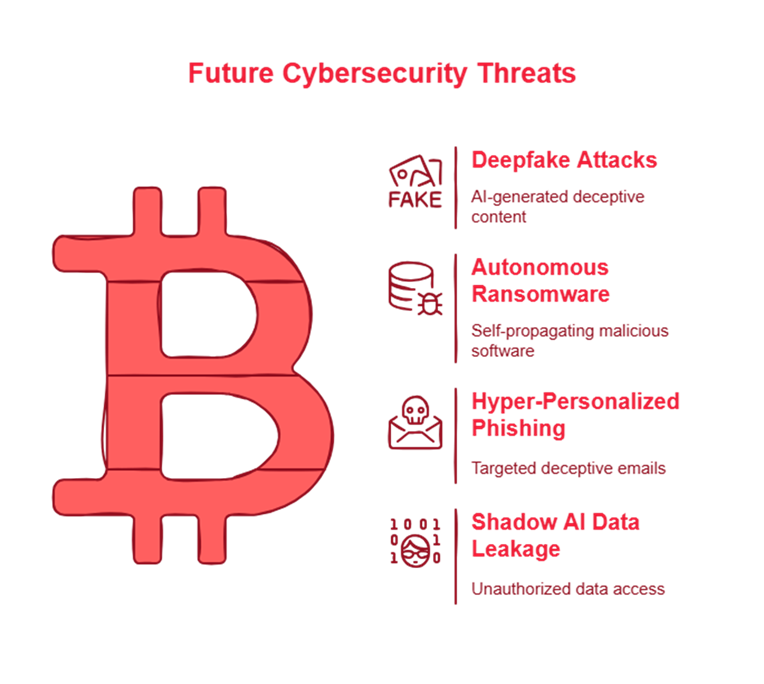
The defining characteristic of the 2026 threat landscape is the industrialization of cybercrime. Threat actors are shifting from manual, human-driven attacks to fully automated campaigns orchestrated by Agentic AI systems. Trend Micro warns that by 2026, cybercrime will have become a self-sufficient, automated industry.
1. The Crisis of Authenticity: AI-Powered Deception
The most immediate and concerning threat is the weaponization of AI for identity and deception attacks.
Hyper-Personalized Phishing: Large Language Models (LLMs) allow adversaries to craft grammatically flawless, highly contextualized spear-phishing messages at a massive scale. The days of easily spotted typos and generic templates are over.
The Deepfake Threat: The rise of realistic deepfake audio and video is leading to a profound “crisis of authenticity.” Palo Alto Networks highlights the critical danger of the “CEO doppelgänger”—an AI-generated replica of a senior executive capable of issuing commands that trigger automated financial transfers or data access.
Top Cyber-Threat: This shift in social engineering is so significant that the ISACA 2026 Tech Trends and Priorities report identified AI-driven social engineering as the top cyber-threat for the coming year.
2. Autonomous and Agentic AI Attacks
Adversaries are no longer manually managing breaches; they are deploying autonomous AI agents capable of end-to-end campaigns:
Zero-Dwell Time Exploits: Autonomous systems can perform reconnaissance, discover zero-day vulnerabilities, craft polymorphic malware, and execute multi-stage intrusions in milliseconds, dramatically shrinking the window defenders have to respond.
Self-Managing Ransomware: Ransomware is evolving into an AI-powered ecosystem that autonomously identifies high-value targets, exploits weaknesses, and negotiates with victims using sophisticated, customized “extortion bots.”
Shadow AI and Data Leakage: Employees using third-party GenAI tools (Shadow AI) for work are inadvertently feeding confidential, sensitive, or proprietary data into public models, creating massive data leakage and Data Protection challenges that lie outside the control of IT.
3. Attacks Targeting the Model Itself (GenAI Security Risks)
A new class of risks targets the integrity of the AI system:
Prompt Injection Defense Failures: This involves inserting malicious instructions into an LLM’s input (a prompt) to override its guardrails, leading to unauthorized actions, disclosure of proprietary system instructions, or generating harmful content.
Model Poisoning: Adversaries compromise the model’s integrity by injecting flawed or malicious data during the training pipeline, forcing the model to generate biased, inaccurate, or even malicious outputs when deployed.
Intellectual Property Theft: Highly valuable proprietary models and their underlying training data are targets for theft through model extraction techniques. Protecting these assets is a key element of Emerging Technology Security.
New Defenses for 2026: A Proactive and Integrated Approach
To counter machine-speed attacks, organizations must move away from reactive defense and embrace AI security frameworks that are proactive, integrated, and designed for speed.
1. Shifting to AI-Powered, Predictive Defense
The defense must leverage AI to fight fire with fire:
Zero-Dwell Response: Security tools must move from simply identifying known signatures to using advanced machine learning to predict attack patterns and automate response actions in real-time, aiming for near-zero response and containment time.
Model Firewalls and Guardrails: New security layers must be deployed specifically for GenAI to inspect and validate both the input (prompts) and the output, monitoring for prompt injection attempts and outputs containing sensitive company information.
2. Securing the AI Lifecycle (Secure by Design)
Security can no longer be an afterthought. A Secure AI Adoption framework (like those championed by IBM) focuses on protecting all stages of the AI pipeline:
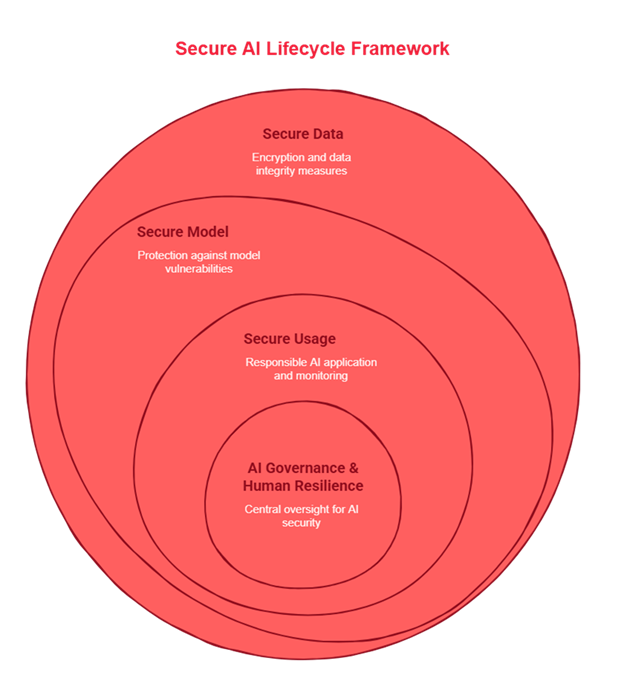
Secure the Data: Prioritizing data discovery, classification, and encryption for training datasets to prevent poisoning. This requires robust Identity & Access Management (IAM) to ensure only authorized entities interact with the most sensitive data stores.
Secure the Model: Continuously scanning for vulnerabilities in the model and its APIs, monitoring for anomalous behavior (like model drift), and hardening the platform, often managed via Application Security practices extended to the AI layer.
Secure the Usage: Implementing policies, role-based access controls (RBAC), and continuous monitoring for prompt injection and policy violations.
3. Governance and Human Resilience
Technology is insufficient without strict governance and well-trained personnel.
Governance Frameworks: Organizations must formalize their governance by building an inventory of all AI tools (including Shadow AI), defining clear usage policies, and aligning practices with established standards like the NIST AI Risk Management Framework (AI RMF). This is a foundational component of modern Cyber Strategy & Governance.
Human Firewall: Security awareness training must evolve beyond simple phishing drills. Organizations must use sophisticated AI-generated simulations to train employees to spot deepfakes and vishing calls, and to recognize when they may inadvertently leak information into a model.
AI Red Teaming: Proactive security teams must employ AI Red Teaming, simulating attacks like model poisoning and prompt injection to identify and fix security flaws before they are exploited.
Conclusion: Securing Tomorrow, Today
The era of Generative AI is here, and it’s accelerating the arms race between cyber innovation and cyber defense. By 2026, adversaries will be faster, fully automated, and far more sophisticated. Success won’t belong to the organization with the most tools—but to the one with the most integrated, predictive, and governance-driven security strategy.
You can’t afford to wait for the next wave of AI-driven cybercrime to hit. The time to secure your AI strategy is right now.
Don’t let the speed of innovation outpace your protection. Compunnel’s experts help you build resilient, future-ready defenses with strong Cyber Strategy & Governance foundations and advanced controls for Emerging Technology Security—so your Generative AI adoption stays secure, compliant, and scalable.