Future-Proof Hiring: EOR + AI for Compliant, Scalable Global Teams in the 2026 Talent Wars
Two forces are simultaneously reshaping global workforce management. AI adoption: 64% of IT leaders predict a complete HR-IT merger within five…
Eighty-six percent of HR leaders cite international compliance as their top challenge. In 2026, that number carries real weight. The EU AI Act’s high-risk obligations begin in August 2026. India’s four Labour Codes reach full parity by April. The EU Pay Transparency Directive must be transposed by June. And in the US, Illinois, Colorado, Texas, and California have all enacted AI-in-employment laws this year.
This isn’t incremental evolution. The compliance environment is being rewritten simultaneously across every major hiring geography. The question isn’t whether your team is capable of managing it—it’s whether the operational bandwidth and specialization required make internal management the right model, or whether the risk-transfer approach of an Employer of Record is the more strategic response.
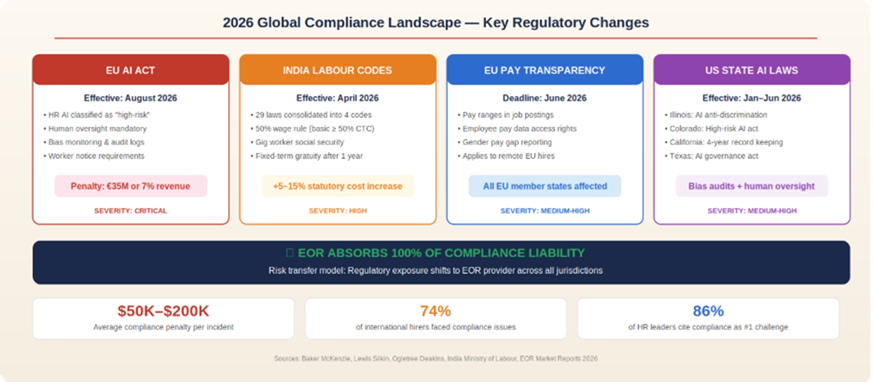
The Act classifies AI in recruitment, evaluation, and workforce management as “high-risk.” Organizations deploying these tools on EU workers must ensure human oversight, worker notice, logging, and bias monitoring. Penalties reach €35 million or 7% of global turnover. As AI becomes embedded in hiring workflows across the EU, the compliance obligations that come with it are now codified and enforceable.
For companies scaling into EU markets, the compliance obligation is substantial. An EOR absorbs this exposure by maintaining the employment relationship and owning the regulatory burden. Your legal team doesn’t need to become EU AI Act specialists-your EOR partner already is.
India’s four Labour Codes target full implementation by April 2026. The 50% wage rule-basic pay must be at least half of CTC-increases statutory costs by 5–15%. Fixed-term employees get pro-rata gratuity after one year. Gig workers receive social security eligibility for the first time.
For multinationals with India teams, India remains the top EOR destination with 5.4 million tech professionals, so every payroll structure and contract needs restructuring. At Compunnel, we’ve already restructured across our India client base to align with the new codes. It’s the kind of foundational compliance work that’s invisible when done well-and catastrophic when missed.
By June 2026, member states must require pay ranges in job postings and gender pay gap reporting. Any company hiring EU-based workers, including remotely, needs compliant compensation structures. An EOR ensures pay equity requirements are met without building this capability from scratch.
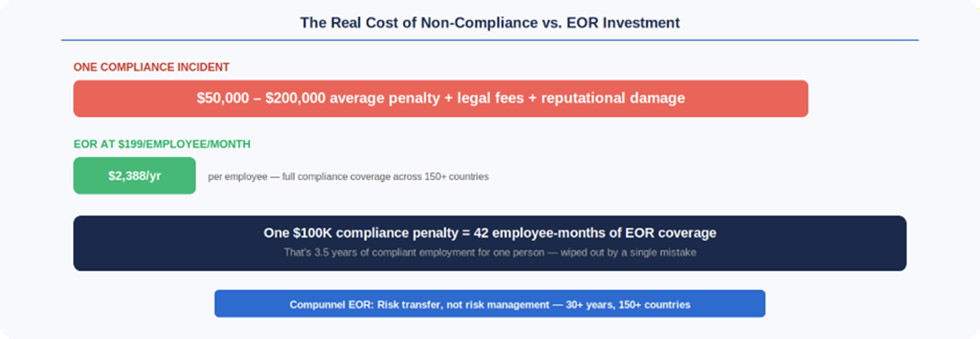
Average compliance penalty: $50,000–$200,000 per incident. One missed filing, one misclassified contractor, one payroll error in a jurisdiction your team didn’t know had changed its rules – and the cost of a full year of EOR coverage evaporates before lunch. And this isn’t theoretical: 74% of international hirers have already experienced at least one incident.
The real business case for EOR in 2026 isn’t convenience. It’s risk transfer. When compliance liability sits with an organization whose entire model is built to manage it across 150+ jurisdictions – rather than on a stretched internal team trying to monitor four simultaneous regulatory overhauls – the risk calculus changes fundamentally. You are not buying a service. You are moving a line item off your balance sheet and onto someone whose job is to make sure it never becomes one.
If compliance across multiple jurisdictions is keeping your team up at night-or if you’re just trying to understand what the EU AI Act and India’s codes mean for your specific setup-we’re happy to walk through it.
No pitch, just clarity. Book 15 minutes at services.compunnel.com/employer-of-record

List of Content

Two forces are simultaneously reshaping global workforce management. AI adoption: 64% of IT leaders predict a complete HR-IT merger within five…

Seventy-one percent of companies allow permanent remote work. Fifty-two percent of the global workforce participates in remote or hybrid models. And 73% of…