Home>Insights>Blogs > Cloud Security in 2026: How to Stay Health Insurance Portability and Accountability Act (HIPAA), General Data Protection Regulation (GDPR) & California Consumer Privacy Act (CCPA) Compliant Without Slowing Down Innovation
Cloud Security in 2026: How to Stay Health Insurance Portability and Accountability Act (HIPAA), General Data Protection Regulation (GDPR) & California Consumer Privacy Act (CCPA) Compliant Without Slowing Down Innovation
Every cloud migration eventually reaches the same conversation. Engineering wants to move fast. Compliance requires that every data flow be mapped before the switch is flipped. The resulting friction slows deployments and frustrates everyone involved. In 2026, that friction isn’t just inefficient – it’s genuinely dangerous.
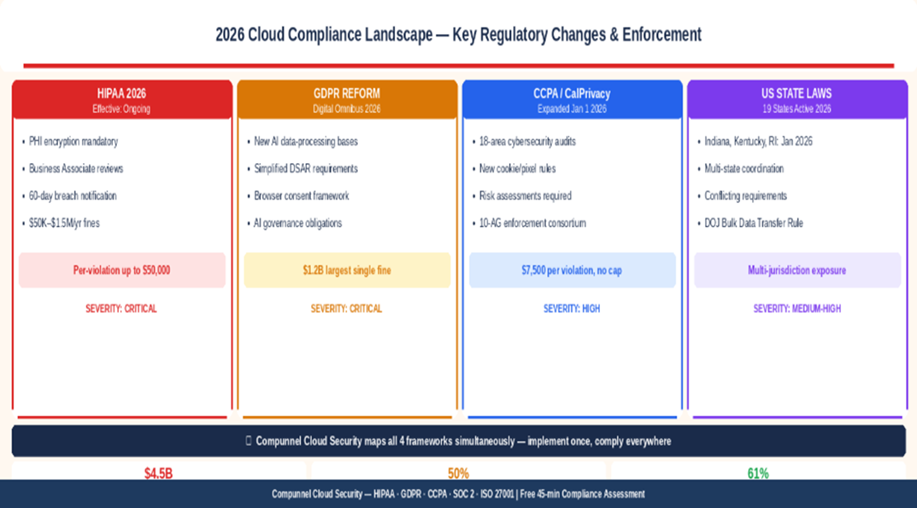
50% of organizations reported an increase in compliance violations last year. CCPA infractions can cost up to $7,500 per violation with no upper limit. GDPR fines have exceeded $4.5 billion since 2018, with the largest single fine reaching $1.2 billion. (TechMagic / CloudEagle, 2026)
The 2026 Compliance Landscape Has Fundamentally Changed
Organizations that built their cloud compliance programs around the regulatory environment of 2023 are operating with outdated assumptions. Multiple significant changes have taken effect in the past 18 months.
US State Privacy Laws – from 2 to 19. As of January 2026, comprehensive privacy legislation is actively enforced across 19 US states. A coordinated 10-state enforcement consortium – including California, Oregon, Colorado, and Connecticut – is now pursuing multi-jurisdictional violations simultaneously.
Expanded CCPA Regulations. New rules effective January 1, 2026, introduce risk assessments for high-risk data processing, new cookie and pixel regulations, and cybersecurity audit requirements across 18 specific areas of an organization’s security program.
GDPR’s Digital Omnibus Reform. The EU’s Digital Omnibus package proposes new legal bases for AI-related data processing, simplified Data Subject Access Request (DSAR) requirements, and browser-level consent frameworks – requiring proactive monitoring and preparation now.
How Compunnel Builds Compliance Into Cloud Architecture
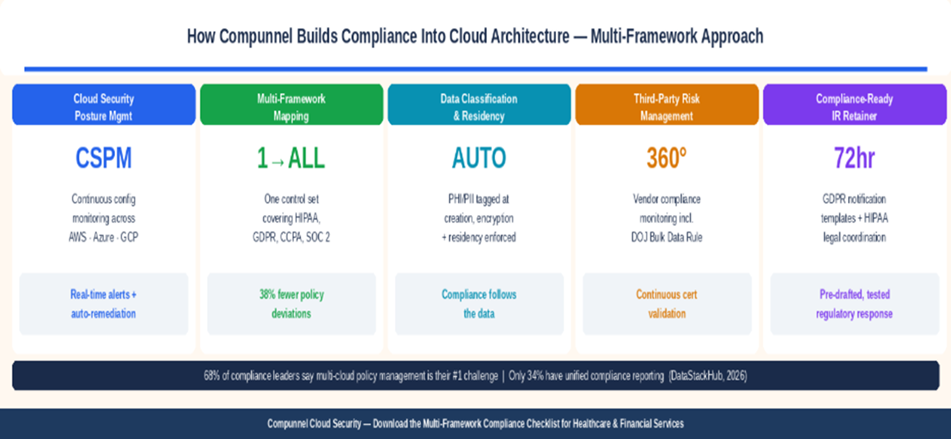
Compunnel’s approach treats compliance as a design input – not a constraint applied after the fact.
– Cloud Security Posture Management (CSPM): Continuous configuration monitoring across Amazon Web Services (AWS), Azure, and Google Cloud Platform (GCP) – deviations flagged in real time, automated remediation for common drift.
– Multi-Framework Mapping: one control set mapped to HIPAA, GDPR, CCPA, System and Organization Controls 2 (SOC 2), and International Organization for Standardization 27001 (ISO 27001) simultaneously – Reduces overhead while improving consistency across all frameworks.
– Data Classification & Residency: automated Protected Health Information (PHI)/Personally Identifiable Information (PII) identification at the point of creation with encryption, access restrictions, and residency enforcement that follows the data.
– Third-Party Risk Management: Continuous vendor compliance visibility, including Department of Justice (DOJ) Bulk Data Transfer Rule analysis for international relationships.
– Compliance-Ready Incident Response: 72-hour GDPR breach notification, HIPAA notification requirements, and regulatory templates – all pre-drafted and tested.
The Competitive Advantage
61% of companies report that security compliance was necessary to secure contracts. 40% used compliance maturity to reach enterprise buyers. 32% cited it as a factor in satisfying investors. (Secureframe, 2026)
In early 2025, a major US healthcare system experienced a ransomware attack that disrupted patient care for 37 days. The organization had Multi-Factor…