Contingent Workforce Planning: Forecasting Flexible Headcount for the Year Ahead
Contingent workforce planning helps organizations estimate how much external talent they may need, when they will need it, and where…
Select location
There are now over 150 EOR providers globally, and on the surface many of them look similar. They all promise to hire workers on your behalf in dozens of countries, handle payroll, and keep you compliant. The pricing looks comparable. The sales decks cover the same countries.
But there is one distinction that does not always come up clearly in the first conversation: whether the provider operates through its own legal entities in the countries where you want to hire, or whether it relies on a network of third-party local partners to deliver the service.
That difference has always existed in the EOR market. In 2026, it matters a lot more.
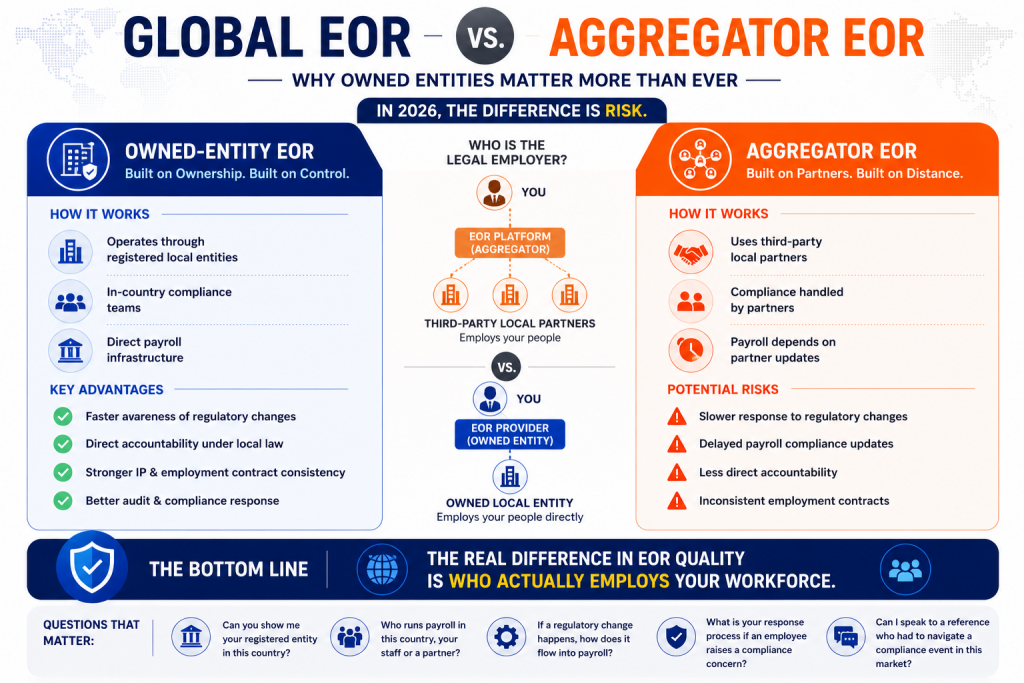
An aggregator-model EOR accepts your contract and your employees, then subcontracts the actual in-country employment to a local partner. Your point of contact is the platform. The compliance work is done by a third party you have never vetted and may not even know the name of.
This model is not inherently fraudulent. Many aggregator-model providers work with reputable local partners. The problem is lag time and accountability. When a country changes its minimum wage, updates its pension contribution rates, or passes new labor protections, an owned-entity provider with in-country staff usually knows before the effective date. An aggregator model is dependent on the local partner relaying that update, and that relay is not always timely.
One specific example from early 2026: Armenia introduced new health insurance requirements in January. Providers with owned entities and in-country compliance teams updated payroll automatically before the effective date. Some aggregator-model providers were still catching up weeks later, because the change came through a partner notification rather than an internal monitoring process.
When an EOR provider has a registered legal entity in a country, they are the employer of record in the literal legal sense. The employment contract is issued from their local company. Payroll is processed from their local banking infrastructure. The compliance liability sits with an organization that is directly subject to local law.
That changes the risk profile significantly. If a government audit flags an employment practice as non-compliant, the owned-entity EOR is in the room with you. They have local counsel, local relationships, and direct accountability. An aggregator model adds a layer of distance that can complicate resolution.
For IP-sensitive companies, it also matters who signs the employment contracts for your engineers and product people. Contracts issued from an EOR’s owned local entity typically have cleaner IP assignment language because they are operating under a single legal framework. Partner-issued contracts sometimes introduce inconsistencies.
If you are comparing EOR providers for hiring in India, Brazil, Germany, or any market that matters to your company, here are the questions that get past the sales deck:
The distinction between owned-entity and aggregator EOR is the most operationally critical factor when hiring across multiple markets. The Everest Group analysis on EOR consolidation notes that recent M&A activity reflects providers moving to bring compliance infrastructure in-house rather than relying on partners, precisely because enterprise clients have started asking these questions.
The EOR market has matured enough that buyers no longer need to take marketing claims at face value. The right provider will welcome scrutiny of their in-country infrastructure, because it is genuinely what sets them apart.
Ready to hire globally without the compliance headache? Talk to our experts at Compunnel EOR Services and find out how we can get your next international hire done right.

List of Content

Contingent workforce planning helps organizations estimate how much external talent they may need, when they will need it, and where…

Managed payroll services move much of the day-to-day payroll administration to a third-party provider. The provider can handle payroll calculations,…