10 Key Benefits of Managed Payroll Services and When They Make Sense
Managed payroll services move much of the day-to-day payroll administration to a third-party provider. The provider can handle payroll calculations,…
Select location
Imagine ignoring 99% of your human identities. No access reviews. No offboarding. No ownership. No audit trail. Your security team would consider that catastrophic.
That is exactly what most enterprises are doing with machine identities right now.
Research from Entro Labs puts the NHI-to-human identity ratio at 144:1 in cloud-native and DevOps environments. Rubrik Zero Labs puts the average enterprise figure at 45:1. ManageEngine’s 2026 Identity Security Outlook found organizations reporting ratios of 100:1 to 500:1. And according to CSO Online’s 2026 NHI analysis, 68% of IT security incidents now involve machine identities.
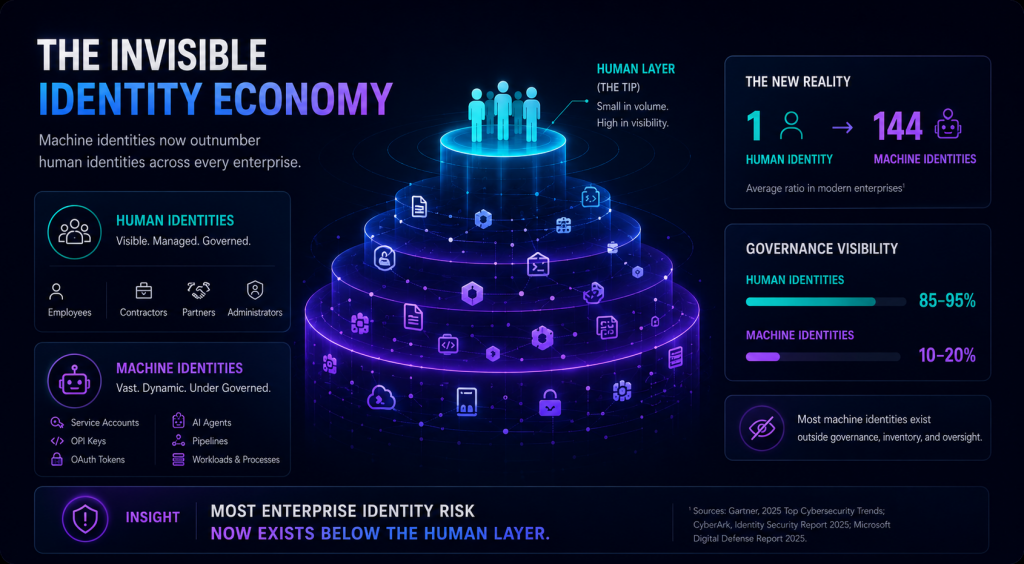
This is not a developer hygiene problem. It is an enterprise governance crisis.
Privileged Access Management was the right control for 2018. In 2026, it addresses only the NHIs your security team already knows about.
PAM vaults secrets. It does not govern the sprawl of machine identities that were created outside IT workflows. A credential that was never registered with the vault is invisible to every PAM-based control you have built.
The deeper problem is that NHI sprawl is fundamentally a governance failure, not a technical one. You cannot rotate a secret you do not know exists. You cannot enforce least privilege on an identity that has no owner. You cannot offboard a service account when nobody is accountable for tracking it.
As The Hacker News reported in May 2026, organizations that cannot demonstrate lifecycle governance, ownership accountability, and least-privilege enforcement for NHIs are accumulating compliance exposure alongside security exposure.
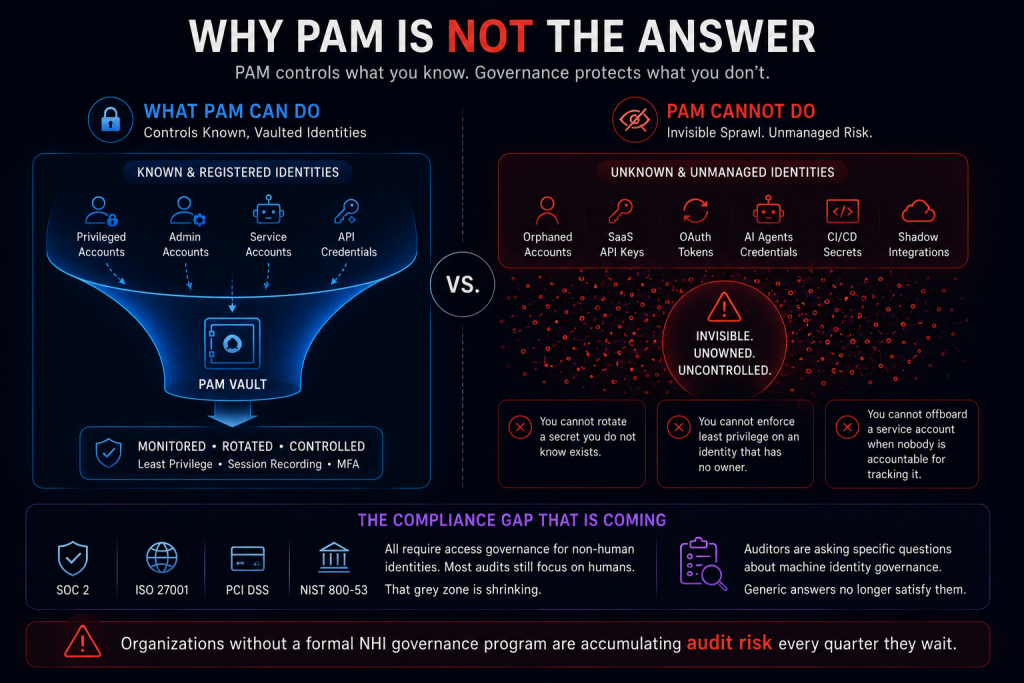
SOC 2, ISO 27001, PCI DSS, and NIST 800-53 all carry access governance requirements that apply to non-human identities as much as human ones. In practice, most audit processes focus on human users and treat NHIs as a grey zone.
That grey zone is shrinking. Auditors are beginning to ask specific questions about machine identity governance. Generic answers no longer satisfy them. Organizations that have not built a formal NHI governance program are accumulating audit risk with every quarter they wait.
An effective NHI governance program rests on three pillars:
This connects directly to the broader Identity and Access Management Services framework that governs both human and machine identity risk. It also supports the Security Operations Services capability needed to detect anomalous NHI behavior in real time.
For a detailed look at the NHI risk landscape, LastPass’s April 2026 NHI research provides strong data on AI agent credential sprawl and its security implications.
Find out how many unmanaged machine identities are operating in your environment. Request an NHI Governance Assessment from our team.

List of Content

Managed payroll services move much of the day-to-day payroll administration to a third-party provider. The provider can handle payroll calculations,…

Most enterprises are running a contingent workforce program that was designed for a slower era. Requisitions sit in queues for…