Contingent Workforce Planning: Forecasting Flexible Headcount for the Year Ahead
Contingent workforce planning helps organizations estimate how much external talent they may need, when they will need it, and where…
Select location
On June 7, 2026, pay transparency rules took effect across all 27 EU member states. If your company has employees in the EU, whether through a direct entity or through employer of record services, those employees now have rights that did not exist last month.
This is not a reporting requirement that kicks in years from now. Some of the core obligations are active right now, and they apply to every employer regardless of size.
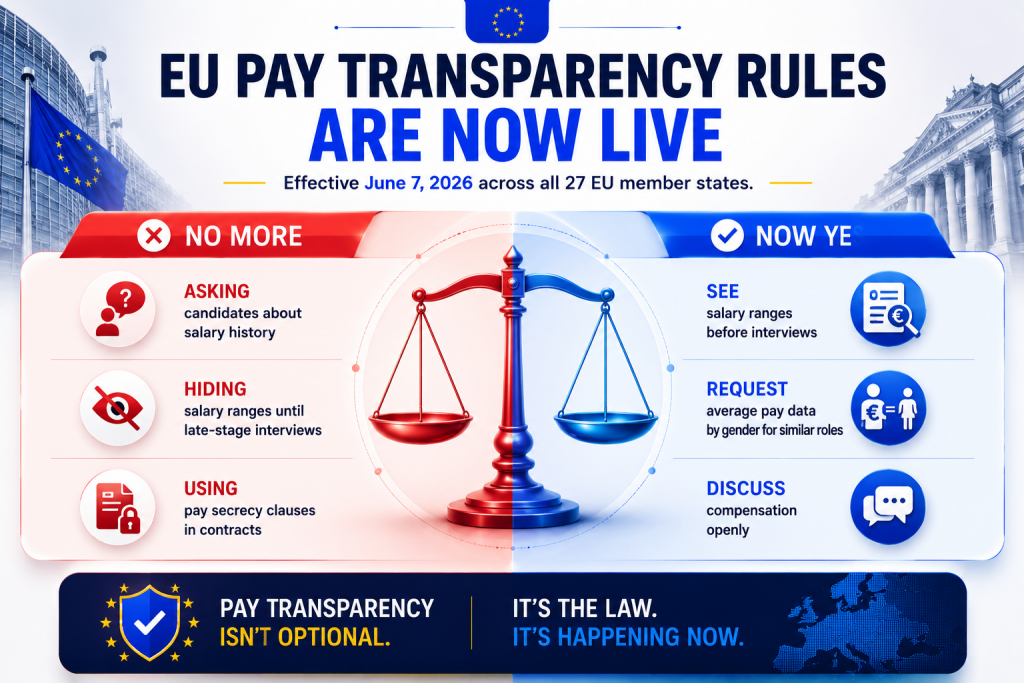
The EU Pay Transparency Directive (Directive 2023/970) has three layers of obligation that operate on different timelines. The ones that are live today cover recruitment and employee information rights.
From this point forward, every job posting for an EU-based role must include the salary or salary range before the first interview. You cannot ask candidates what they currently earn. Candidates who accept a role can then request information about the average pay of people doing the same work, broken down by gender, and you have two months to respond.
Pay secrecy clauses in employment contracts are now prohibited. If you have standard contracts that include a line about not discussing compensation, those clauses are invalid for EU employees from June 2026 onward.
The reporting layer follows later. Companies with 250 or more employees need to submit their first gender pay gap report by June 2027, using 2026 pay data. Employers with 150 to 249 employees follow on the same timeline, every three years. Companies with 100 to 149 employees begin triennial reporting in 2031. Where a pay gap within a role category exceeds 5% and cannot be justified by objective criteria, a formal joint assessment with employee representatives is required.
If you are hiring in Germany, France, the Netherlands, Poland, or any other EU country through an EOR service provider, the directive applies based on where the employee is located, not where your company is headquartered. A US company hiring a developer in Berlin through an EOR is fully within scope.
That creates a responsibility split worth understanding. The EOR is the legal employer in the EU country. They issue contracts, run payroll, and manage statutory obligations. Pay transparency compliance sits squarely within that. The EOR needs to issue job offers with salary ranges disclosed, handle pay information requests from employees within the two-month window, and collect the data needed for gender pay gap reporting when your headcount in a member state crosses the relevant threshold.
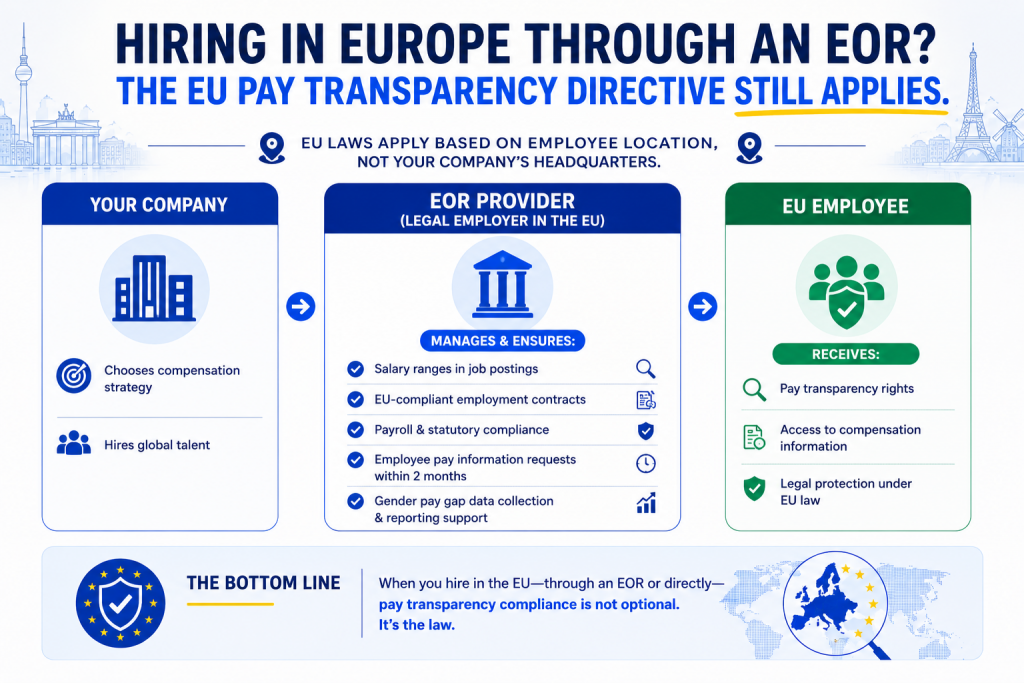
What this means in practice: when evaluating EOR providers for EU hiring, pay transparency compliance should now be on your checklist. Ask specifically how they handle salary disclosure in recruitment, how they respond to employee pay information requests, and whether they have a data collection process ready for gender pay gap reporting.
One effect that is easy to underestimate: because the directive applies based on employee location rather than company headquarters, multinationals may find it simpler to standardize pay transparency practices across their entire global workforce rather than maintaining different policies for EU and non-EU employees. The analysis by Gibson Dunn notes that non-EU employers with EU-based staff are fully in scope, which makes a unified global compensation architecture worth considering.
Companies that have historically kept compensation ranges internal are adjusting their hiring processes right now. The companies that have been moving toward pay transparency over the past couple of years are finding the transition more straightforward than those starting from scratch.
If you are building EU hiring programs in 2026 and want a partner that has already built these compliance requirements into their employment workflows, this is exactly the kind of operational detail that separates a well-prepared EOR from one that is still catching up.
Ready to hire globally without the compliance headache? Talk to our experts at Compunnel EOR Services and find out how we can get your next international hire done right.

List of Content

Contingent workforce planning helps organizations estimate how much external talent they may need, when they will need it, and where…

Managed payroll services move much of the day-to-day payroll administration to a third-party provider. The provider can handle payroll calculations,…