10 Key Benefits of Managed Payroll Services and When They Make Sense
Managed payroll services move much of the day-to-day payroll administration to a third-party provider. The provider can handle payroll calculations,…
Select location
2026 is the year the offensive use of artificial intelligence stopped being theoretical and started reshaping real risk. Attackers and nation-state actors are using AI to scale phishing, produce convincing deepfakes, and automate intrusions. Defenders are racing to embed the same capabilities into detection, response, and resilience. This tug of war is changing how Organizations budget for security, how boards measure trust, and where enterprises invest in cybersecurity solutions.
The State of Cybersecurity 2026 report highlights a new battleground—speed and scale. Investments are shifting to instant threat prevention, identity control, and accountability-driven compliance. Compunnel’s view is simple: the AI arms race rewards Organizations that pair technology with proven cyber strategy services and operational discipline.
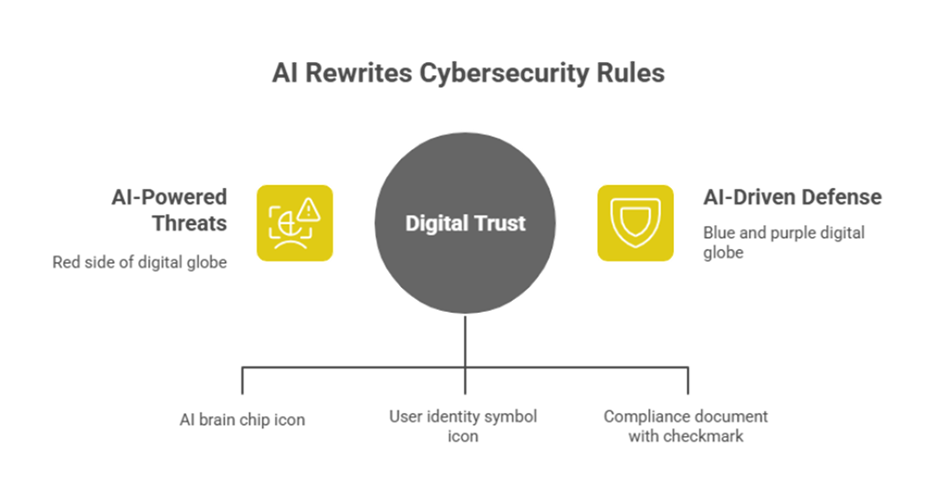
From chaos to control — the intersection of AI, identity, and compliance defines cybersecurity’s new balance.
AI has changed the attacker’s playbook. What used to require specialist skills can now be automated. Bad actors use AI to craft targeted phishing at scale, generate synthetic identities that defeat basic verification, and create polymorphic malware that mutates to avoid signature detection. These capabilities shorten the window from vulnerability discovery to exploitation.
Experts warn the next step is agentic malware: AI agents that plan and execute multi-stage attacks with little human direction. That possibility raises stakes for critical infrastructure and supply chains, making rapid detection and containment essential rather than optional.
The practical effect on organizations is clear. Legacy tools alone will not stop modern campaigns. Enterprises need integrated cybersecurity services that combine threat intelligence, continuous monitoring, and identity-first controls to reduce dwell time and limit impact. Compunnel helps clients shift from isolated tools to coordinated security operations solutions that close the gap from detection to response.
Defense now demands three things: speed, context, and governance. AI can provide all three when applied correctly. Leading firms are investing in AI-enabled security operations solutions, cloud security services for unified visibility, and identity and access management solutions that enforce continuous verification. Gartner and industry leaders are already recommending centralized AI security platforms to govern and protect AI usage itself.
A compact checklist for organizations ready to act:
Compunnel delivers these capabilities through cybersecurity strategy services and managed security offerings that align technical controls to business outcomes. That approach turns investment into measurable resilience, not just tool sprawl.
Budgets follow the intelligence. According to industry data, global cybersecurity investment is expected to surpass $240 billion in 2026, with the sharpest increases in AI-enabled analytics, identity protection, and cloud security services. Organizations have realized that tools alone do not ensure safety — coordinated architecture does.
The new investment priorities fall into three clear categories:
CISOs and CFOs are beginning to evaluate cyber spend the same way they assess business investment — by outcome, not by tool count. At Compunnel, our cybersecurity solutions and services are designed to convert each dollar spent into measurable resilience, cleaner audits, and stronger operational uptime.
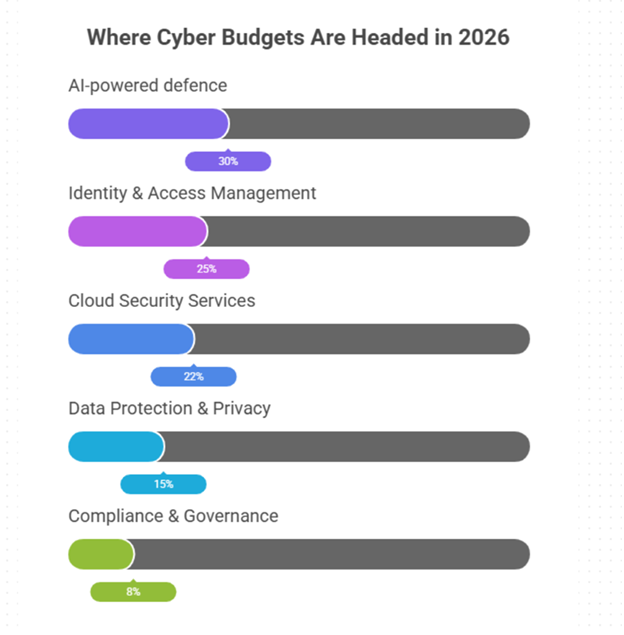
Global cybersecurity spend will exceed $240 billion in 2026, with AI, identity, and cloud protection taking the lead.
In 2026, digital trust has become a currency of its own. Customers, investors, and regulators now measure confidence in a company by how it protects and governs data. AI has increased both opportunities and risks, creating a paradox in which transparency matters as much as technology.
Regulations such as the EU AI Act and DORA require Organizations to prove accountability. That is why many enterprises are investing in cybersecurity compliance services and data privacy services that verify how AI systems make decisions and store information.
Trust is built on three layers:
At Compunnel, we help enterprises operationalise these layers through integrated cyber strategy services that connect AI ethics, data governance, and security automation. The outcome is measurable trust — not as a marketing phrase but as a verifiable business advantage.
The next phase of cybersecurity is predictive intelligence. The winners in this AI arms race will be the Organizations that learn faster than attackers. Compunnel’s approach combines automation, human expertise, and continuous monitoring to transform reaction into anticipation.
Our cybersecurity solutions & services cover every layer of defence:
Through this integrated framework, Compunnel helps clients create adaptive ecosystems where each control reinforces the others. The result is clarity — a direct line between security investment and business performance.
The AI arms race is permanent. Attackers will continue to evolve; defenders must evolve faster. The State of Cybersecurity 2026 report shows that enterprises building resilience through intelligence, automation, and governance are already outperforming peers in recovery speed and reputation stability.
At Compunnel, we believe cybersecurity is no longer a defensive function. It is a growth strategy that strengthens trust, operational excellence, and innovation.
Ready to lead the next phase of digital trust?
Download the full State of Cybersecurity 2026 report and see how AI, identity, and compliance are reshaping enterprise resilience. www.compunnel.com/cybersecurity

List of Content

Managed payroll services move much of the day-to-day payroll administration to a third-party provider. The provider can handle payroll calculations,…

Most enterprises are running a contingent workforce program that was designed for a slower era. Requisitions sit in queues for…