Contingent Workforce Planning: Forecasting Flexible Headcount for the Year Ahead
Contingent workforce planning helps organizations estimate how much external talent they may need, when they will need it, and where…
Select location
Managed payroll services move much of the day-to-day payroll administration to a third-party provider. The provider can handle payroll calculations, payments, tax administration, filings, and reporting based on the employer’s data and instructions. The employer continues to make decisions about pay, hiring, compensation policies, and workforce management.
This article explains 10 key benefits of managed payroll services, along with the limits of outsourcing payroll, the factors that affect cost, and the situations where managed payroll may make the most sense. It also looks at how one Compunnel client moved more than 130 workers across eight states onto a new payroll program within 45 days.
Managed payroll services outsource the operational work of running payroll to a third-party provider. Depending on the service scope, the provider may calculate gross-to-net pay, process payments, manage payroll tax administration, prepare filings, support year-end reporting, and maintain payroll records.
The employer still controls pay rates, raises, workforce policies, hiring decisions, and other employment decisions. The provider works with the information and instructions supplied by the employer.
Managed payroll is different from payroll software. With payroll software, an internal team still performs most payroll activities using a technology platform. With managed payroll, the provider performs more of the operational work.
It is also different from payrolling, an Employer of Record arrangement, or a Professional Employer Organization model. These services may involve different employment structures, responsibilities, and workforce needs.
| Model | Who performs payroll administration? | Employment relationship | Primary purpose |
|---|---|---|---|
| Managed payroll | Third-party provider | Client remains the employer | Outsource payroll operations |
| Payroll software | Internal team | Client remains the employer | Support payroll processing with technology |
| Payrolling | Provider | Depends on service structure | Place sourced workers on a provider payroll |
| Employer of Record | EOR provider | EOR employs the worker for legal purposes | Employ workers where a client needs an employment solution |
| PEO | PEO and client share defined responsibilities | Co-employment model | Combine payroll, HR, benefits, and related services |
Understanding these differences matters because payroll outsourcing should match the business problem the organization is trying to solve.
| # | Benefit | In one line |
|---|---|---|
| 1 | Reduced payroll processing workload | Internal teams spend less time on recurring payroll administration |
| 2 | Fewer manual payroll errors | Standard processes and automated checks can reduce avoidable mistakes |
| 3 | Payroll tax administration support | Providers can manage filings, deposits, and payroll tax calendars |
| 4 | Multi-state payroll support | Providers can help manage different state and local payroll requirements |
| 5 | Access to payroll technology and expertise | Use provider systems and specialists without managing everything internally |
| 6 | Stronger security controls | Established providers may offer dedicated payroll security and access controls |
| 7 | Better business continuity | Payroll does not depend on one internal employee or a small team |
| 8 | Scalable payroll operations | Capacity can grow without matching every increase with internal headcount |
| 9 | HR and benefits integration | Payroll data can connect with other workforce systems where integrations exist |
| 10 | Employee self-service | Workers can access common payroll information without relying on HR each time |
Every payroll cycle includes recurring administrative work. Hours must be reviewed, overtime calculated, deductions applied, benefit contributions updated, and payments prepared. The amount of work grows as headcount, pay groups, locations, and payroll frequency increase.
A managed payroll provider takes on much of this recurring processing activity. Internal teams still review inputs, approve payroll, and manage exceptions, but they spend less time building every payroll run from the beginning.
This can give HR, finance, and payroll teams more time for work that requires internal judgment, including employee support, workforce planning, compensation reviews, and process improvement.
The benefit is not simply “saving time.” It is shifting repetitive payroll administration to a delivery model designed to handle the work consistently across pay cycles.
Payroll mistakes can come from incorrect data, missed changes, manual calculations, or inconsistent processes. A pay-rate change that is not entered correctly, an incorrect deduction, or a missed overtime rule can create corrections that take time to resolve and may affect employee trust.
Managed payroll providers typically use standardized workflows, automated calculations, review steps, and exception checks to reduce avoidable processing errors.
That does not mean outsourcing removes every payroll mistake. Providers still depend on accurate information from the employer. Incorrect hours, incomplete employee records, or late changes can still create problems.
The main advantage is process consistency. A structured payroll environment can reduce dependence on spreadsheets, manual calculations, and individual workarounds.
Payroll tax administration involves more than calculating deductions. Employers may need to manage federal, state, and local deposits, returns, reconciliations, year-end forms, and filing deadlines.
A managed payroll provider can help calculate payroll taxes, prepare returns, submit filings, maintain filing calendars, and keep records of completed activities.
That support can reduce the administrative burden on internal teams, particularly when payroll spans multiple jurisdictions.
However, outsourcing payroll does not automatically remove the employer’s tax responsibilities. Employers should understand the legal and contractual structure of the provider relationship and continue to review payroll tax activity.
The value of a managed service is therefore not a complete transfer of accountability. It is access to systems, processes, and payroll specialists who manage the operational work and help the employer stay organized.
Multi-state payroll can become complex quickly. Federal requirements are only one part of payroll. State and local requirements can vary based on where employees live, where they work, and how the business operates.
Organizations may need to manage different tax registrations, withholding rules, unemployment requirements, local taxes, and other payroll obligations.
The United States has thousands of local payroll tax jurisdictions, and new requirements continue to emerge. The original draft cites Symmetry research reporting more than 7,000 local payroll tax jurisdictions and close to 200 new jurisdictions added each year.
A managed payroll provider can help determine which payroll rules apply and update payroll systems as requirements change.
This support still depends on accurate employee and work-location data. Employers need clear processes for reporting where employees live and work, especially when remote or hybrid arrangements change.
Modern payroll operations often require more than a basic calculation tool. Organizations may need payroll engines, employee portals, reporting tools, tax capabilities, workflow controls, integrations, and secure access.
Building and supporting that environment internally can require software, implementation work, payroll expertise, system administration, and ongoing maintenance.
Managed payroll can give organizations access to provider technology and payroll specialists as part of the service.
The exact arrangement varies. Some providers include technology within the service fee. Others may charge for implementation, integrations, additional modules, or special reporting.
The main benefit is that the employer does not have to manage every part of the payroll technology environment independently. This can be especially useful for organizations that need stronger payroll capabilities but do not want to build a larger internal payroll technology function.
Payroll systems contain sensitive information, including Social Security numbers, bank details, compensation data, tax information, and employee records. That makes security an important part of payroll operations.
Established managed payroll providers may offer encrypted platforms, role-based access, controlled user permissions, audit trails, monitoring, and formal security practices designed for payroll data. These controls can be difficult for smaller internal teams to build and maintain on their own.
Outsourcing does not eliminate security risk. It introduces a third party that must also be reviewed carefully.
Employers should ask providers about encryption, access controls, hosting, security certifications, incident-response processes, data backups, user authentication, and previous security events.
The benefit is not that managed payroll is automatically safer. The benefit is access to dedicated controls and infrastructure when the provider can demonstrate that those controls are in place.
Payroll cannot stop because a key employee is unavailable. Yet many internal payroll processes depend heavily on one or two people who understand the systems, deadlines, exceptions, and workarounds.
If one of those employees is absent or leaves the organization, the business may face an immediate knowledge and coverage gap.
A well-designed managed payroll service reduces that dependency through documented processes, shared systems, defined service teams, and backup coverage. Instead of relying on one internal specialist, payroll work is supported through a broader delivery structure.
The exact level of backup depends on the provider, so employers should ask how coverage works when the normal account contact is unavailable. Business continuity is therefore both a benefit and a provider-selection requirement.
Payroll workload usually grows with the business. Adding employees creates more payroll records, more questions, more payments, and more data to manage. Adding new states can also introduce registrations, tax rules, and local payroll requirements.
An internal team may eventually need additional staff simply to keep payroll administration running at the same level.
A managed payroll provider can help absorb some of that additional volume through existing systems and delivery teams.
This does not mean payroll growth becomes effortless. New locations, employee populations, and pay structures still require planning and setup.
However, the organization may be able to scale payroll operations without increasing internal payroll headcount at the same rate as workforce growth. For fast-growing or multi-state organizations, that can be an important operational advantage.
Payroll is connected to many other workforce processes. Health insurance deductions, retirement contributions, time and attendance, workers’ compensation information, garnishments, and other employee data may need to flow into or out of payroll.
When systems are disconnected, employees may have to enter the same information in multiple places. Internal teams then spend time comparing systems and resolving mismatches.
Managed payroll platforms may integrate with timekeeping, benefits, HRIS, retirement, and other workforce systems. Where the integrations are available and configured correctly, they can reduce duplicate data entry and manual reconciliation.
Integration should not be assumed. Employers should confirm which systems the provider supports, how data moves between platforms, who manages integration errors, and whether additional implementation costs apply.
Many payroll questions are simple and repetitive. Employees may need a pay stub, tax form, direct-deposit information, or other payroll records. When every request goes through HR or payroll staff, small questions can create a steady administrative burden.
Many managed payroll platforms include employee self-service tools that let workers access common payroll information directly. Depending on the platform, employees may be able to view pay statements, retrieve tax forms, update banking details, or access other payroll records.
Self-service is not unique to managed payroll. Modern in-house payroll software may provide similar features. Its value within a managed service is that the employee portal, payroll processing, and provider support can operate through the same service environment.
Managed payroll is not automatically better than running payroll internally. The better model depends on the organization’s workforce, payroll complexity, internal expertise, technology, and operating priorities.
| Area | In-house payroll | Managed payroll |
|---|---|---|
| Payroll calculations | Internal team | Provider performs agreed processing |
| Payroll tax filing execution | Internal team | Provider may prepare and submit filings |
| Employment tax responsibility | Employer | Employer generally retains important responsibilities |
| Technology administration | Employer manages payroll systems | Usually more provider-led |
| Staffing coverage | Depends on internal team depth | Defined through provider service model |
| Multi-state expertise | Must be built internally | Provider may supply specialist support |
| Data submission | Internal responsibility | Employer still provides and validates key data |
| Control over pay policy | Employer | Employer |
| Scaling | May require more internal capacity | Provider can absorb some additional processing volume |
Organizations with simple payroll, strong internal expertise, and modern systems may have little reason to outsource. The case for managed payroll may become stronger as payroll complexity increases across employees, locations, pay groups, jurisdictions, and business units.
Managed payroll cannot correct poor source data automatically. If hours are wrong, employee records are incomplete, pay-rate changes arrive late, or benefits data is inaccurate, the provider may process the wrong information correctly.
Employers still need clear internal processes for data ownership, approvals, employee changes, and exception management.
Managed payroll also creates reliance on an external provider. Service quality, response times, technology reliability, security, and payroll expertise can vary.
Organizations operating across multiple countries or regions may face another challenge if different providers use systems that do not integrate well. Data can become fragmented, creating additional reconciliation work.
The benefits of managed payroll therefore depend on two things working together: a capable provider and disciplined internal processes.
Managed payroll is most likely to add value when several payroll challenges exist at the same time.
| Signal | Why it matters |
|---|---|
| Payroll depends on one or two employees | Absence or turnover can create continuity risk |
| The business operates in several states | More jurisdictions increase payroll administration |
| Headcount is growing quickly | Payroll volume rises with workforce growth |
| There are multiple pay rates or employee groups | More variation increases processing complexity |
| Payroll errors require frequent corrections | Existing controls may not be strong enough |
| Internal payroll expertise is limited | Specialist support may be difficult to maintain internally |
| Payroll technology needs improvement | Managed services may provide access to stronger systems |
| Internal teams spend too much time on routine payroll work | Outsourcing may create more capacity for higher-value work |
No single factor means a company should outsource payroll. But when several of these conditions exist together, reviewing a managed payroll model may make sense. A smaller organization with straightforward payroll and strong internal processes may continue to manage payroll effectively in-house.
There is no standard price for managed payroll services. Providers usually consider the workforce, payroll schedule, service scope, systems, and level of complexity before building a quote.
| Cost factor | Why it affects pricing |
|---|---|
| Employee count | More workers create more payroll records and transactions |
| Pay frequency | Weekly payroll creates more annual processing cycles than biweekly payroll |
| Number of states and localities | More jurisdictions can require additional tax administration |
| Service scope | Processing, filings, employee support, reporting, and other services affect cost |
| Payroll complexity | Multiple rates, shifts, bonuses, garnishments, and employee groups require more work |
| Integrations | Connecting payroll with other systems may require setup and support |
| Implementation | Data migration, configuration, testing, and transition add initial work |
| Reporting needs | Custom reports and analytics may require additional service |
When comparing cost, employers should look beyond the provider fee. The internal alternative can include payroll salaries, benefits, software licensing, training, systems administration, tax expertise, backup staffing, and time spent resolving errors.
The right comparison is the total operating cost of each model, not the managed payroll fee by itself.
A US-based energy and utilities company with more than 4,400 employees needed to move more than 130 workers across retail, corporate, and plant operations onto a modern payroll process.
The workers were spread across eight states, which added payroll and compliance complexity. The client also had limited internal payroll technology experience.
Compunnel deployed a dedicated transition team using its StafflinePro platform. The work included pre-transition planning, worker registration, background checks, orientation, and structured follow-ups.
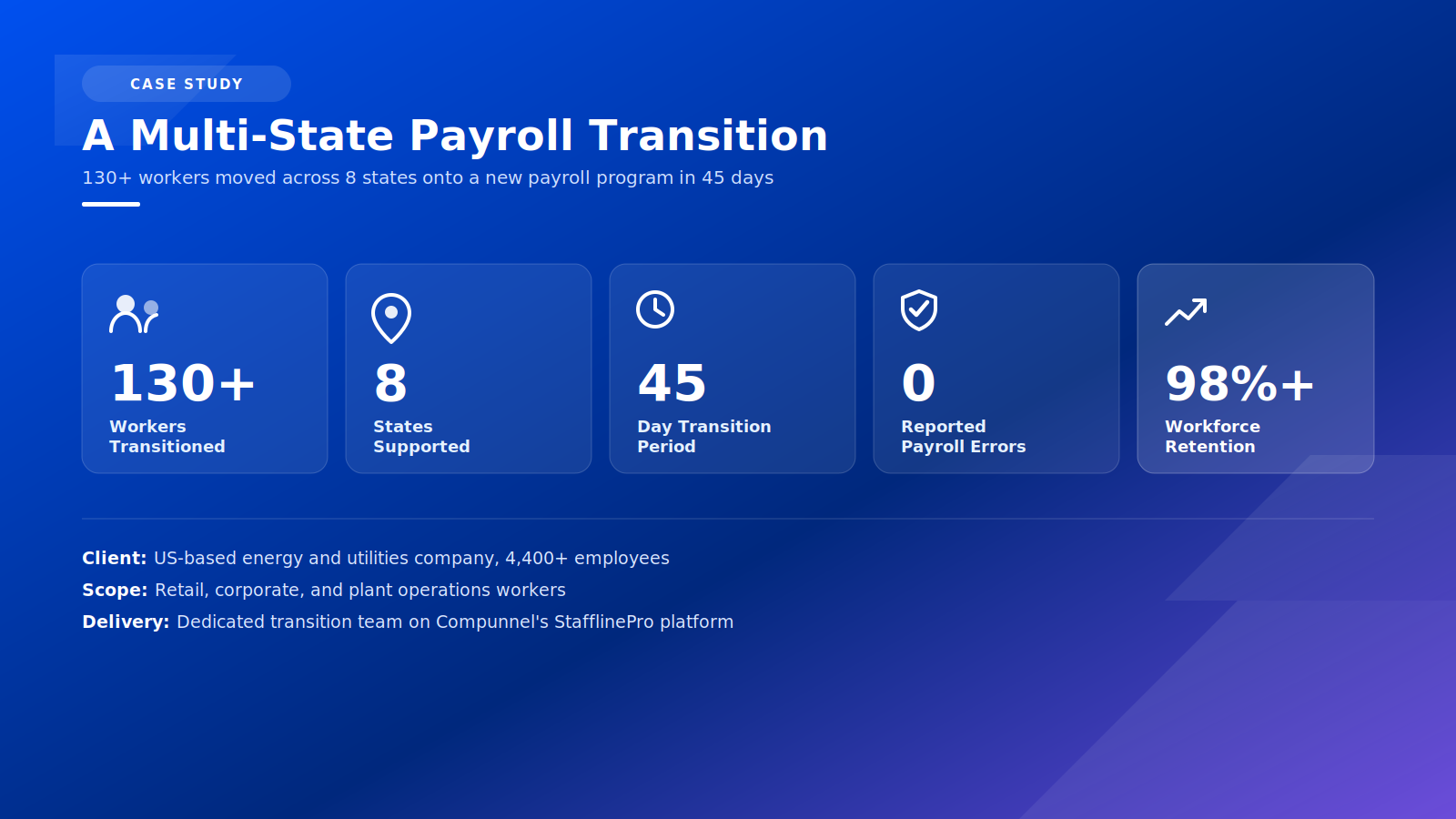
The case shows why managed payroll should be evaluated as an operating model, not simply as payroll software. The combination of technology, transition planning, payroll execution, and account support helped the client move a distributed workforce through the change.
A provider should be evaluated on more than features and price. Ask questions that show how the service will operate after implementation.
With more than 33 years of experience supporting workforce programs, Compunnel works with organizations managing complex talent, workforce, and payroll requirements.
Compunnel’s managed payroll services can support payroll processing, multi-state payroll administration, workforce transitions, employee access, and ongoing account support.
The right model depends on the workforce. Managed payroll may fit organizations that already employ their workers but need additional payroll infrastructure and operational support. Other situations may require different workforce solutions, including payrolling, Employer of Record services, full-time hiring, or contingent workforce services.
The goal is to match the operating model to the actual workforce requirement instead of treating every payroll challenge as the same problem.
Organizations evaluating managed payroll should start with their current process. Look at payroll workload, jurisdictions, errors, internal capacity, systems, service gaps, and future growth. That creates a clearer basis for deciding whether outsourcing payroll can improve the way the organization operates.
Start with your current payroll environment. Compunnel can help you review workload, jurisdictions, and internal capacity, then match the right operating model to your workforce.
Managed payroll is a service in which a third-party provider performs agreed payroll administration for an employer. Services may include payroll calculations, payments, payroll tax administration, filings, reporting, and employee payroll access. The employer continues to control compensation policies and workforce decisions.
Cost depends on factors such as employee count, pay frequency, jurisdictions, payroll complexity, service scope, implementation, and integrations. Employers should compare provider pricing with the full internal cost of payroll staff, technology, administration, and support.
It can be, especially when payroll depends on one person, internal expertise is limited, or the workforce spans several jurisdictions. A small organization with simple payroll and strong internal processes may decide that payroll software and internal administration remain sufficient.
With managed payroll, the client generally remains the employer and outsources payroll administration. A PEO operates through a co-employment model in which the PEO and client share defined employer responsibilities. PEO services may also include benefits, HR support, payroll, and other workforce services.
Security depends on the provider. Established managed payroll providers may offer encryption, access controls, monitoring, secure hosting, and formal security processes. Employers should review the provider’s security standards, certifications, incident-response practices, and access controls before selecting a service.
Yes, many providers support payroll across multiple US states, but coverage varies. Employers should confirm the specific states and local jurisdictions a provider supports and understand how employee work-location changes are managed.
Global payroll is a separate capability that not every managed payroll provider offers. Organizations should confirm country coverage, local expertise, technology, and employment requirements before assuming a provider can support international payroll. Hiring employees in countries where the company does not have its own employing entity may require an Employer of Record solution instead.
Managed payroll services can reduce payroll administration, improve process consistency, provide access to payroll technology and expertise, and help organizations manage growing payroll complexity.
Those benefits are not automatic. The employer still needs accurate data, clear internal ownership, strong approval processes, and oversight of important tax and employment responsibilities. The provider must also have the right systems, payroll expertise, security controls, coverage, and service model.
For organizations with growing headcount, multi-state payroll, limited internal capacity, or complex payroll requirements, managed payroll can provide a more scalable way to operate.
The decision should start with the current payroll environment. Understand where work is increasing, where risks exist, what the internal team can support, and what capabilities are missing. From there, employers can decide whether managed payroll is the right operating model for their workforce.

List of Content
Contingent workforce planning helps organizations estimate how much external talent they may need, when they will need it, and where…

Most enterprises are running a contingent workforce program that was designed for a slower era. Requisitions sit in queues for…